The second date: what to expect when you've passed the initial online dating filter
December 22, 2025
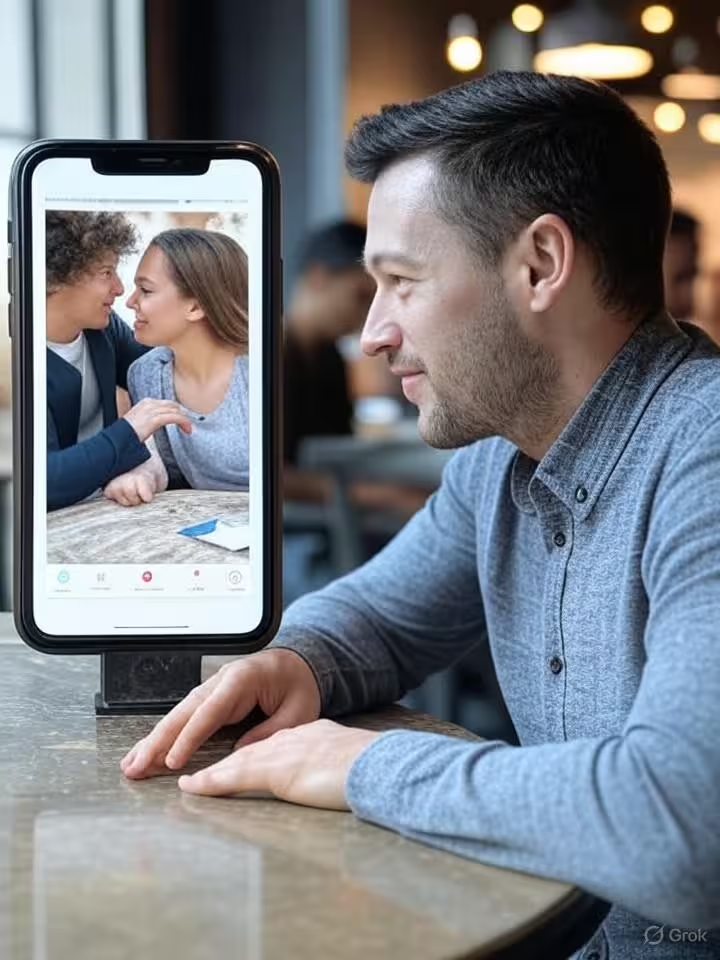
Picture this: you've survived the first date. You've gone through those first meeting jitters, that awkward moment of recognizing each other in person after weeks of messaging, and against all odds, it went well. Well enough that you both wanted to do it again. But now comes the second date, and believe me when I tell you that this stage is completely different.
After years of testing practically all the apps on the market -from Tinder's infinite swipes to Hinge's detailed proposals- and from having been on more second dates than I can count (some memorable, some best forgotten), I know that this moment is absolutely key. It's not just «another date». It's where you really start to see if there is something real or if everything will remain a fleeting match that will be diluted in an eventual slow fade.
The truth is that the second date operates under completely different rules. Social masks begin to fall away. Polite conversations give way to more substantive topics. And most importantly: both of you are actively evaluating whether this is worth investing emotional time in..
Why the second date is so decisive (more so than the first)
Look, the first thing to understand is that reaching a second date is already a small victory. In the world of dating apps, where swipes are endless and competition is fierce, not everyone makes the initial cut. Think about it: according to data from various studies on dating app behavior, only between the 20% and 40% of the first appointments lead to a second, depending on the platform and demographic group.
The first date usually functions as a basic compatibility testingVerify that there are no obvious red flags, that the person resembles your photos (no extreme kittenfishing), that there is a minimum of conversational chemistry. It's like an initial casting. But the second date? That's the real audition.
I'll confess something to you: in my experience, many second dates stem from a «let's try again» because the first one was a bit awkward due to nerves. And you know what? That's perfectly fine. Dating is not perfect, and sometimes you need that second try to see the real potential without the paralyzing anxiety of the first encounter.
However, not everything is rosy. Between us, I've seen cases where the second date reveals patterns that the first one cleverly concealed. Maybe that sarcastic humor you thought was funny in the app starts to feel like constant criticism. Or maybe you find out that what you interpreted as playful flirting is actually a tendency to make slightly condescending comments.
What is certain is that this stage filters a lot. If you have read about warning signs in online dating, If you're not sure what to expect, you'll know that some red flags only manifest themselves over time. On the first date, someone can perfectly control their image. On the second, the true patterns begin to emerge.
Note that on more selective platforms - I'm thinking of apps like Once or The League, where the matching is more curated - this may vary slightly, but the principle is the same: you're investing time in exploring beyond the superficial. It's no longer just «Am I attracted to him physically?» or «Does he have a sense of humor?». Now the questions are: Do you share fundamental values, is there compatibility in life rhythms, are you looking for the same thing?
From perfect match to reality: what exactly changes
Well, here comes the interesting part. On the first date, everything works a bit like a movie trailer: you show the best, you avoid spoilers, you maintain some mystery. But the second? That's where the script really develops.
Honestly, I have noticed that conversations move from the generic to the genuinely personal. You no longer just talk about «what you do for work» or «what series you're watching». The topics evolve into more revealing things: why your last relationship ended, what you're really looking for, what your plans are for the future, even - if there's trust - topics like attachment styles or past dating experiences.
On apps like Hinge, which market themselves as «designed to be deleted» and promote deeper connections from the start with their detailed prompts, this flows more naturally. But even on Tinder, where everything seems more superficial and quick, the second date forces you to dig deeper if there really is mutual interest.
Deeper conversations
The superficial talks of the first date give way to more revealing topics. Now you talk about values, past experiences, real expectations and what you are looking for in a relationship. This is where you find out if there is real compatibility beyond physical attraction.
Observation without filters
Without the adrenaline of the first encounter, you can both observe more clearly. Little details that went unnoticed become apparent: how he treats the waiter, whether he really listens or just waits his turn to speak, whether his actions match what he says.
Chemistry is defined
Physical tension evolves. Maybe there was a shy kiss at the end of the first date, or maybe just a warm embrace. On the second, that chemistry becomes clearer: either it naturally intensifies, or you discover that perhaps there is only intellectual connection without that essential romantic spark.
Imagine: you're in a quiet bar (because you've already learned that noisy places kill any deep conversation), and suddenly the topic of vulnerability comes up. You talk about fears, about experiences that marked you, about why modern dating sometimes feels like an exhausting second job. It is exciting, yes, but also risky, because you may discover fundamental incompatibilities.
For example: one seeks exclusivity relatively early on, while the other prefers to take it easy and keep meeting people. Or you discover that you have completely opposite communication rhythms - one needs daily messages, the other values his or her independent space. These differences are neither good nor bad, but ignoring them at this stage only postpones inevitable conflicts..
Physical chemistry also evolves significantly. Maybe on the first date there was a shy kiss goodbye, or just a warm embrace loaded with intention. On the second, that tension is resolved one way or another: either it naturally intensifies (more physical contact, more explicit flirting), or you discover that perhaps there is only intellectual connection without that fundamental romantic spark.
Also, don't underestimate the cumulative burnout if you've been on the dating circuit for months. Getting to the second date can be a relief-»finally someone worthwhile»-but it also brings its own pressure: the expectation that «it has to work this time.» And you know what? Such pressure can sabotage genuine connections. I have seen it countless times, both in my experience and in those of friends.
Signs that everything is on the right track (real green flags)
That said, here comes the interesting part: many times, the second meeting reveals green flags that went unnoticed at the first encounter. It is those subtle details that indicate that the person is not only interested, but also emotionally mature and genuine.
For example:
Recall specific details from previous conversations. Not just from the first date, but even from your chats on the app. «You mentioned you love Thai food, I found a new place» or «you said you were stressed about that project at work, how did it go in the end?». These details show real attention, not just killing time until the next match.
Proposes thoughtful plans. Instead of the typical «let's meet for a drink?», suggest activities based on shared interests you discovered on the first date. If you mentioned you like art, suggest visiting a gallery. If you talked about hiking, suggest a trail. This level of intentionality speaks volumes.
Maintains consistent communication between appointments. It doesn't disappear for days only to reappear with a generic «hey». There is a natural exchange of messages, no suffocating bombardments but no unexplained silences either. It's that middle ground that indicates genuine interest without emotional dependency.
Asks follow-up and in-depth questions. He doesn't just respond to what you say; he asks questions that demonstrate real curiosity about getting to know you. «Why did you choose that career?» «What do you value most in a friendship?» Seek to understand your perspective, not just fulfill the dating script.
His actions match his words. If you say you value punctuality, you are on time. If you mention that you care about honest communication, you don't play on ambiguous messages. Consistency between speech and behavior is pure gold in the modern dating world, where many people say one thing and do completely another.
In my case, a second memorable date was with someone I met at Coffee Meets Bagel. The first one had been okay but a bit forced on my part - I had too many expectations. On the second, I decided to just be myself without filters. I mentioned that I was frustrated with how superficial dating had become, and instead of responding with a cliché, she shared similar experiences in a vulnerable way. That mutual authenticity created a connection I didn't expect..
At the same time, it is crucial to mention the other side of the coin.
Red flags you can't ignore on the second date
Honestly, the second date can also reveal red flags that are easy to rationalize when you're excited to have found someone with potential. But ignore them at your own peril, because these patterns rarely improve over time; tend to intensify.
Intense love bombing: if suddenly it's all excessive flattery, grandiose statements about how special you are or premature hints of the future («we could travel together to...», «I've never felt this fast before»), set your alarm bells ringing. Love bombing is a manipulative tactic that creates accelerated false intimacy. Genuine connections are built progressively.
Inconsistencies in its narrative: if on the first date he said one thing about his situation (job, housing, past relationships) and on the second date he mentions something that contradicts that version, pay attention. It may be simple forgetfulness, yes, but it may also indicate that you are withholding important information or, worse, actively lying.
Completely dominates the conversation: if after two hours you have barely been able to talk about yourself because he/she monopolizes every topic by redirecting it to himself/herself, it is a clear network flag. Healthy conversations have a two-way flow. Someone who doesn't know how to listen on a date won't magically learn in a relationship.
Criticism disguised as «brutal honesty»: comments about your appearance, choices or personality presented as «I'm just being direct». For example: «that hairstyle doesn't suit you as well as your photos» or «you're not usually so quiet, are you? Genuine honesty doesn't need to hurt; these are strategies to undermine your confidence.
Avoid questions about intentions: if you try to clarify what he's looking for in dating and he responds with vague evasions («see what happens,» «flow,» «I don't like to put labels on it»), he may be keeping options open or avoiding commitment. There's nothing wrong with taking time, but perpetual ambiguity is different.
He constantly compares with his ex: Whether positively or negatively, repeatedly mentioning an ex-partner indicates that you have not closed that chapter. «My ex never did this» or «my ex was exactly like this» are signs that you are emotionally still hooked on the past.
What I have learned after too many disappointing second dates is that these signs are rarely exceptions that confirm the rule. Your intuition exists for a reason. If something feels uncomfortable or incongruous, don't ignore it hoping it will magically get better with more time.
The different scenarios that may arise
Now, let's talk about the possible paths this second date can take, because trust me, not all lead to the same destination. And that's okay; it's part of the process.
Scenario 1: Everything flows naturally. The conversation is easy, there is genuine laughter, the physical contact feels natural (not forced), and when you say goodbye you both know there will be a third date. This is the ideal scenario, though curiously not the most common. When it happens, you know. There's no hesitation or over-analysis; it just works.
Scenario 2: There is a connection but no romantic chemistry. The person is great, the conversation interesting, you could be excellent friends... but that romantic spark is missing. This is possibly the most emotionally complicated one, because there is nothing «wrong» to justify the romantic disinterest. It's just not there.
Scenario 3: Fundamental differences you didn't see before. You may discover that you have completely opposite ideas about important issues: monogamy vs. open relationships, whether or not you want children, future geographical plans, religious values. The second date often brings these issues to light.
Scenario 4: One is more interested than the other. The dreaded asymmetry. You feel that everything is going great while you perceive that the other person is polite but distant. Or vice versa: you notice their enthusiasm but don't feel it reciprocated. This disparity creates discomfort that usually leads to eventual ghosting or slow fade.
Scenario 5: The «let's save the salvageable». The first date was mediocre, but you decided to give it another try. Sometimes it works - the initial nerves disappear and the real connection emerges. Other times it just confirms that there is no compatibility. In my experience, this scenario has 50/50 odds.
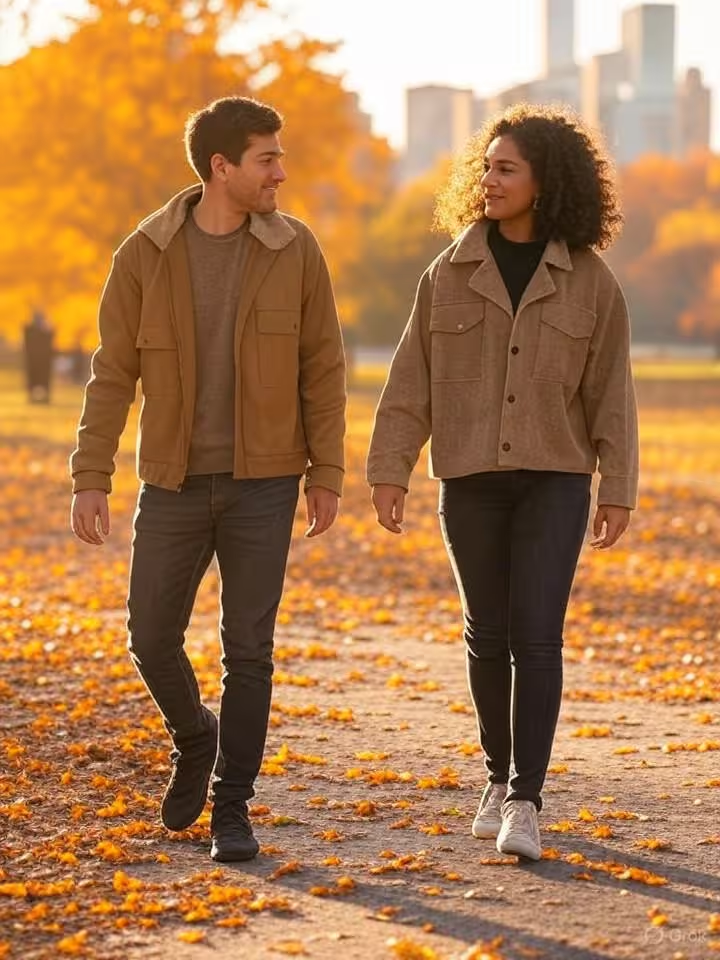
I confess that I've had it all. A second date in a park ended with a mutual and genuine «let's better be friends» (we still keep in touch occasionally, no hard feelings). Another at a small restaurant revealed that we were looking for completely different things - me something serious, him experimenting with no strings attached - so we saved time by being honest.
And you know what? Not all of these endings are failures. Every experience teaches you something: about what you are looking for, about what you can't tolerate, about how to communicate better. Dating is as much about self-knowledge as it is about meeting others.
How to handle the second date without unnecessary pressure
Well, to close this labyrinth without turning it into a rigid instruction manual (because dating is never that predictable), here are some tips that I have refined over the years and that genuinely work:
Relax with expectations. Seriously. The pressure that «this second date must be perfect and confirm that we are soul mates» kills any chance of organic connection. Better approach: «I'm going to get to know this person better and see how I feel.» Simple, no grandstanding.
Choose activities that facilitate conversation. The second date doesn't have to be a formal dinner (that can feel too intense). A stroll through a market, visit an exhibit, have coffee in a quiet place - settings where you can talk without formality but with enough external stimulation to avoid awkward silences.
Be authentic from now on. Don't save the «real you» for later. If something makes you uncomfortable, express it. If you have an opinion about something, share it (respectfully). Pretending to be someone else only delays the inevitable moment when the other person discovers who you really are.
Observe without judging prematurely. Yes, pay attention to signs and patterns, but don't turn the date into a mental interrogation where you analyze every gesture. Sometimes people are nervous, have had a bad day, or just need time to open up. Give them leeway.
Communicate your intentions if it arises naturally. If the conversation leads to a discussion of what you are both looking for in dating, don't evade. Ambiguity may seem safe but it only creates confusion. «I'm looking for something serious long-term» or «I want to take my time before I commit» are valid statements that clarify expectations.
Don't ignore your intuition. If something feels wrong - even if you can't articulate exactly what - pay attention to it. Your subconscious processes information that your conscious mind may be rationalizing. I've ignored my intuition too many times only to confirm months later that I was right.
Give space to silence. Not every moment needs to be filled with conversation. Comfortable silences are a sign of connection; if you can both be silent without anxiety, it's a good sign. If every second of silence feels tense, perhaps the compatibility isn't there.
Finally -and this is important- remember that you are also being evaluated. It's not just about determining if you like the other person; ask yourself if YOU are showing genuine interest, if you are present in the conversation, if you are being respectful of their time and vulnerability. Dating works in two directions.
What to do after the second date: managing expectations
Here's the trick that no one tells you: what happens after the second quotation defines as much as the quotation itself. It is in those later days that the dynamic is either consolidated or silently diluted.
If it went well and you want a third, don't play hard to get. That toxic «wait three days to write» rule is last century garbage. If you enjoyed the date, send a genuine message: «I had a great time with you today, let's do it again soon». Simple, direct, no mind games.
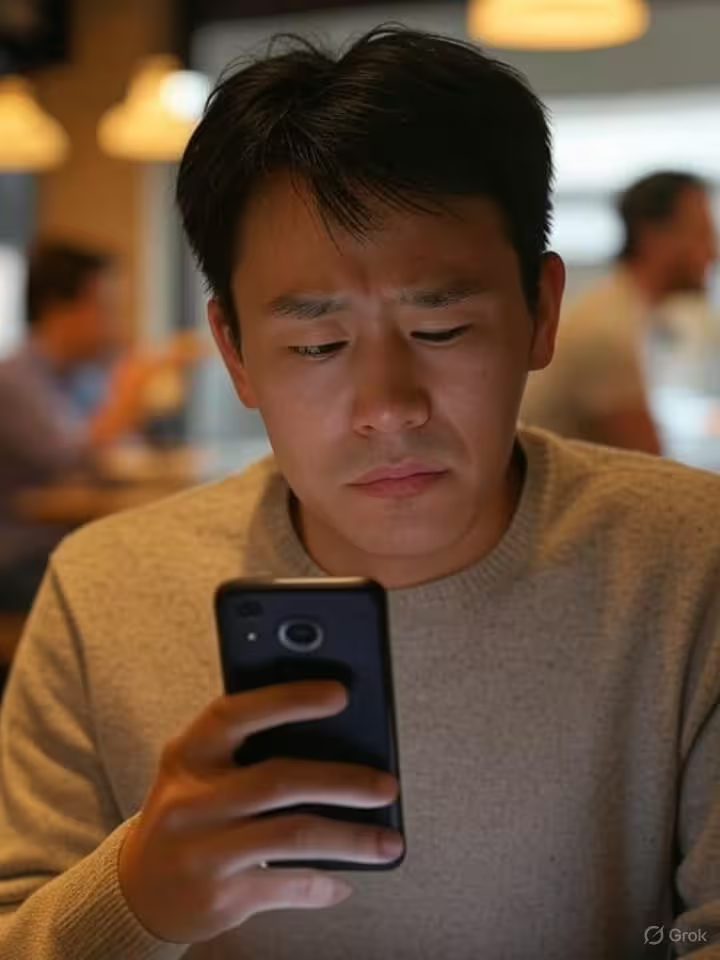
If it was ambiguous - neither great nor terrible - give yourself permission to reflect honestly. Don't move forward out of inertia or because «it should work on paper.» I've seen too many people forcing mediocre connections out of fear of being alone or because investing time is apps feels like wasted work. Your emotional time is worth more than that.
What if it definitely didn't work out? Communicate it maturely. A «I enjoyed meeting you but I don't feel we have the compatibility I'm looking for. I wish you the best» is infinitely better than ghosting. Yes, it may feel awkward, but it's the kind of awkwardness that builds personal integrity.
The truth is that not all second dates lead to something great. I've had hundreds of conversations on apps, dozens of first dates, and many second dates that didn't make it to third. And it is well. Each one taught me something: about my preferences, my limits, my patterns. About what I compromise and what is non-negotiable.
In the end, the second date is simply another piece of the puzzle that is building authentic connection in the digital age. It's not the final destination, just another step along the way. Some steps lead to meaningful relationships, others to valuable lessons. Both have merit.
When is the best time to propose a second date?
Ideally, mention your interest before the end of the first date if it went well, with something natural like «I'd like to do this again». After that, wait a day or two to confirm specific details by message. Don't play hard to get; if there was a connection, communicate it clearly without sounding desperate but showing genuine interest.
What type of plan is best for a second date?
Choose activities that facilitate conversation but with less pressure than a formal dinner. Good examples: stroll through a market, visit a small gallery, have coffee in a quiet neighborhood, or specific activities based on shared interests you discovered on the first date. The important thing is to be able to talk comfortably without the rigid formalities of a restaurant.
How do you know if there is real interest after the second date?
Clear signs include: consistent communication between dates without disappearing, he asks in-depth questions about you, he remembers details of previous conversations, he proposes specific plans for a third date, and his actions match his words. If after the second date he takes days to respond or his messages are generic and without substance, interest is probably lukewarm.
Is it normal to feel less nervous on the second date?
Completely normal and even desirable. The first date comes loaded with the anxiety of the first physical encounter and validation of the match. On the second date, that initial tension subsides, allowing for more authentic interactions. If you're still as nervous, ask yourself if it's positive excitement or anxiety because something isn't quite right.
Should I talk about exclusivity on the second date?
It is usually premature, unless you both clearly express being on that page. The second date is best to explore compatibility, values and what each is looking for in general, without pushing decisions. If the conversation about intentions («what are you looking for in dating?») comes naturally, fine, but forcing «the talk» so early can create unnecessary pressure.
What do I do if I don't feel romantic chemistry but I like her?
Be respectfully honest. You can say something like «I really like you and enjoyed getting to know you, but I don't feel that romantic connection. If you're interested, I'd love to keep in touch as friends, but I understand if you'd rather not.» Some people will appreciate the honesty and want friendship; others will need distance. Both responses are valid.
How much time should elapse between the first and second appointments?
Ideally between 3-7 days. Enough to maintain momentum without appearing desperate, but not so long that interest cools or new matches compete for attention. If you are traveling or have a busy schedule, communicating clearly avoids misunderstandings. Timing matters less than consistency in communication between appointments.