You've been swiping on Tinder for weeks when it appears: that profile that seems too good to be true. Magazine photos, a dream life amidst exotic travels, and a conversation that sparks with unusual intensity. You get your hopes up, you invest time and energy in that connection... until you start noticing strange things. The excuses for not making a video call, the stories that don't add up, those little details that your intuition red-flagged but you'd rather ignore because, let's be honest, you wanted to believe it was real.

After years of trying apps like Bumble, Hinge and even the more niche ones, I've learned to spot fake profiles almost by instinct. And I'm not alone in this: according to the Federal Trade Commission, online romance scams caused losses in excess of $547 million in 2021 alone. It's not about becoming paranoid, but about developing that radar that allows you to distinguish between a genuine profile and one created to deceive.
The good news is that fake profiles, no matter how elaborate, always leave clues. Catfish have recognizable patterns once you know what to look for. I'm going to show you exactly how to spot them before you invest your time (and your heart) in someone who doesn't even exist.
Photos that give away a fake profile
Let's start with the most obvious: pictures. When you review a profile on any dating app, the pictures are your first line of defense. And trust me, there are signs that scream «FAKE» if you know how to interpret them.
Fake profiles often use photos of models or influencers stolen from the internet. How to recognize them? Easy: all the photos look like professional shoots. Perfect lighting, studied poses, impeccable backgrounds in paradisiacal destinations... but zero casual photos. No blurry selfie taken on the couch at home, no picture with friends on a birthday, nothing that shows real everyday life.

I remember a match on Badoo that I found suspicious: eight perfect photos on Maldivian beaches, luxury restaurants and five-star hotels. Not a single normal photo. I did a reverse Google image search (yeah, this technique works incredibly well) and discovered that they were photos of a Brazilian model. The profile disappeared days later.
Here are the most common visual signs of a fake profile:
- Inconsistent quality: Mixing professional high-resolution photos with pixelated captures stolen from social networks
- Contradictory metadata: If a person claims to be 28 years old but their photos show styles from different decades, something is wrong.
- Watermarks removed: Odd smudges in corners where stock photo logos were probably present
- Suspicious quantity: Only 1-2 photos (insufficient to verify) or more than 15 (possible massive theft of a real profile)
The truth is that doing a reverse search literally takes you 30 seconds. Download the suspicious photo, upload it to Google Images or TinEye, and you're done. If it shows up on multiple websites, profiles from other countries or image banks, you know something is fishy.
And you know what still surprises me? How many people ignore obvious visual cues because they want to believe that this amazing person is really interested in them. Don't fall into that trap. Your gut exists for a reason.
Generic bios and empty promises
Let's move on to the profile text, because this is where catfish give themselves away even more. The bio of a fake profile has a very characteristic pattern: it either sounds too perfect or too vague. There is no middle ground.
In apps like Hinge, where prompts invite personal and creative responses, a generic bio sticks out like a sore thumb. Phrases like «I'm looking for my soul mate to travel the world» or «Successful entrepreneur looking for adventure» without any specific details are typical of fake profiles. Honestly, I've seen better descriptions in microwave instructions.
Look at these patterns:
- High status professions without substance: «International surgeon», «real estate investor», «commercial pilot»... but zero anecdotes or verifiable details.
- Stacked clichés: Lover of sunsets + travel + wine + laughter + adventures = red alert
- Perfect but unnatural grammar: It looks like it was translated by Google or written by a corporate bot.
- Basic cultural errors: He claims to live in Barcelona but uses expressions that are clearly not Spanish.
I once helped a friend review a Meetic match who claimed to be a «tech entrepreneur» based in Madrid. His bio was impeccable, sophisticated, promising... and completely hollow. Zero mention of specific startups, no details about his work, not even what kind of technology. When he asked her for more information, she started rambling on with generalities. Spoiler: he ended up asking her for money to «close an urgent deal» two weeks later.
Real profiles have substance. They mention specific hobbies («I go rock climbing in Montserrat on Sundays»), specific cultural references («fan of The Last of Us and terrified of season 2»), or admit imperfections with humor («I cook terribly but make decent coffee»). That imperfect authenticity is what to look for.
That said, don't confuse shyness or lack of creative writing with phoniness. Some genuine people simply suck at writing bios. The difference is that when you chat with them, that real personality emerges. The fake ones keep it vague indefinitely.
Suspicious photos
Professional quality images without casual photos, inconsistencies in age or style between photos, or clumsily removed watermarks. Use Google Images reverse search to check if photos are stolen from other profiles or image banks.
Empty bios
Generic descriptions full of clichés without specific personal details, high status professions without verifiable anecdotes, or perfect but unnatural grammar. Real people show imperfect personality, self-conscious humor and concrete cultural references in their profiles.
Urgent behavior
Pressure to share personal information too quickly, avoid questions about their daily life, reject video calls with constant excuses, or start with excessive love bombing type flattery. Scammers are always in a hurry to exit the app and move the conversation to WhatsApp.
Signs in conversation that scream scam
Well, now comes the part where fake profiles are really revealed: when you start chatting. This is where your instincts should kick in because conversational behavior gives away even the most elaborate catfish.
The first thing you'll notice with a fake profile is urgency. They want to move the conversation out of the app immediately. On Tinder, Bumble or any platform, they will ask for your WhatsApp or Instagram number after three messages. why? Because they know the apps have detection systems and can be banned. Also, once they have you on another platform, it's harder to report them.
I remember a match at Coffee Meets Bagel that after the first «hello» I was already asking for my WhatsApp «because I don't check this app often». Of course, no one checks the app where you just replied instantly. The level of contradiction was hilarious.
Other conversational red flags you can't ignore:
Generic and repetitive answers. If your messages sound like copy and paste, they probably are. Scammers handle multiple simultaneous conversations using templates. You notice when you ask a specific question and they answer something unrelated, or repeat the exact same phrase they used three messages ago.
They avoid questions about their daily lives. Ask them about their day, their specific job, or what they did over the weekend. Fake profiles will deflect with vagueness or change the subject to you constantly. «It was great, you tell me about your day» over and over again. Real people share anecdotes, even if they are boring.
Inconsistencies in its history. Take mental notes. If they said they live in Valencia but mention times in another time zone, or talk about places in Madrid as if they were local... something is wrong. Same with professions: a «doctor» who doesn't know basic terminology or an «architect» who can't describe any specific project.
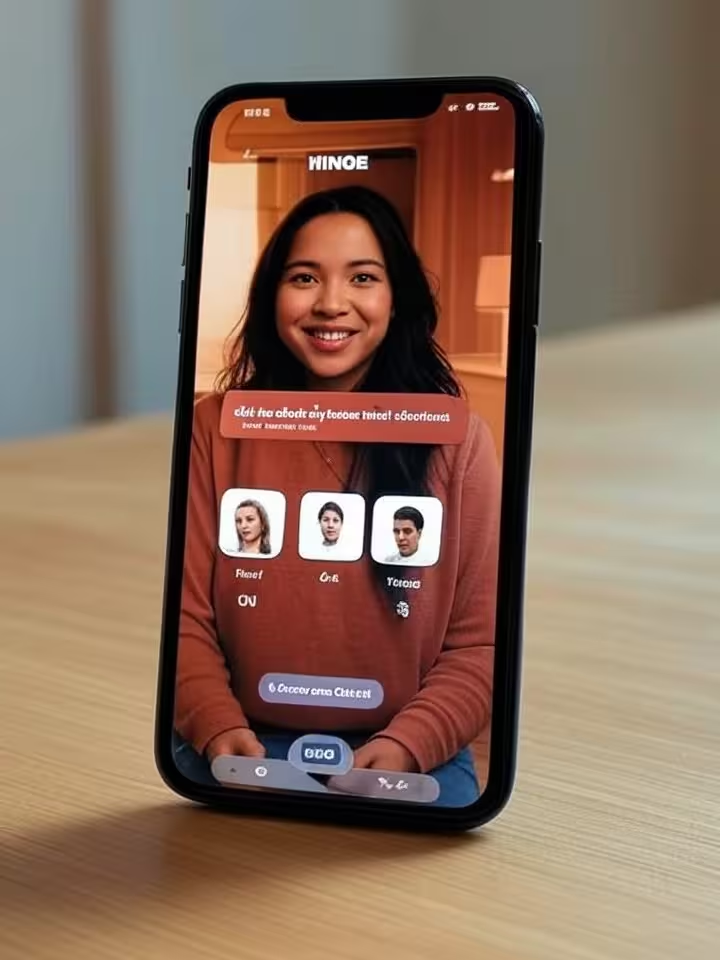
And here's the ultimate trick: propose a video call. This filters 99% from catfish instantly. Fake profiles will have a thousand excuses: broken camera, bad connection, they are camera shy... Nonsense. In 2024, we all make video calls. If after establish good conversation for days continue to refuse, you know what happens.
I confess that I implemented a personal rule: if after a week of chatting they don't accept a short 5-minute video call, I get unmatched. Zero exceptions. And do you know how many real profiles I have lost because of that? None. Because genuine people understand perfectly well the need to verify identity before meeting in person.
Why do you always avoid video calling?
Let's be clear about this because it is perhaps the most reliable signal out there. Video calling is kryptonite for fake profiles. They can't pretend to be who they are not in real time.
Catfish use stolen photos of other people. They can't appear on video being that person. It's as simple as that. So they come up with ever more elaborate excuses: they are in a place without good connection (for weeks), their camera stopped working just now, they have extreme social anxiety but curiously have no problem texting all day long....
Here's what few people mention: some more sophisticated scammers now use deepfakes or pre-recorded videos. It sounds like a movie, but it's happening. That's why it's not enough to just ask for a video call, you have to make it interactive. Ask them to do something specific during the call: wave their hand, touch their nose, show something from their immediate environment.
Look, I know this may sound paranoid. «Do I really have to ask someone to touch their nose on video call?» Yes. Because romance scams are a multi-billion dollar and increasingly elaborate industry. People lose life savings to these scams. Better to feel a little ridiculous asking for verification than to waste money or time on someone who was never real.
Love bombing and other manipulation tactics
Now, let's talk about something more subtle but equally dangerous: the emotional tactics that fake profiles use to hook you quickly.
The love bombing is when someone bombards you with attention, compliments and intense statements too soon. «I've never met anyone like you», «I feel like I've known you my whole life», «I think you're my soul mate»... after two days of chatting. It sounds romantic in movies, but in real life it's a huge red flag.
Genuine people build connection gradually. There is excitement, yes, but also natural wariness and curiosity to really get to know you. Scammers go straight for the emotional fast-forward because they need to gain your trust quickly and then ask you for money or information.
I once helped a friend who was convinced he had found «the one» in Match. She kept telling him how special he was, how different from other men, how much she needed him in her life...after five days. I asked her to try to ask him specific questions about his interests, his family, his day to day life. The answers were always vague and quickly returned to flattering him. Two weeks later, «family emergency» and he needed urgent money. You guessed it: fake profile.
Other common manipulation tactics:
Create artificial urgency. «I'm considering deleting the app», «I'm traveling soon and I don't know if I'll keep using this»... pressure to move faster than you're comfortable with. Real relationships don't operate on manufactured ultimatums.
Victim stories. They are always going through something difficult: a recent traumatic divorce, serious family problems, complicated financial situations... This sets the stage to eventually ask you for help (read: money).
Isolate the conversation. They want to be your sole focus. They constantly text you, expect immediate responses, and subtly discourage you from continuing to use the app or talk to other matches. This is control, not genuine interest.
The truth is that online dating requires maintaining healthy boundaries and a natural pace. If someone makes you feel pressured or speeds things up in an uncomfortable way, trust your instinct and brakes.
Practical tools to verify profiles
Well, you know the signs. Now let's talk about concrete tools you can use to verify if a profile is legitimate or not. Because sometimes your intuition needs technological support.
Reverse image search. I already mentioned it but it bears repeating because it is YOUR BEST FRIEND. Google Images and TinEye are free and effective. Take the photos from the suspicious profile, upload them, and see what comes up. If those photos are on multiple profiles with different names, on stock photo sites, or belong to an influencer or model, you've got your answer.
Verification in social networks. Search their name on Facebook, Instagram, LinkedIn. Real profiles usually have a consistent digital presence. If someone claims to be named Juan Garcia, be 35 years old and live in Seville, but there is no online trail... weird. Very weird. Especially for people under 50 who grew up with the internet.
But beware of jumping to conclusions. Some people value their privacy and have very closed networks or use nicknames. But there should be SOMETHING verifiable.
Social Catfish and similar services. There are platforms specialized in detecting catfish. Social Catfish allows you to search by name, email, phone number or image. Some services are paid but have limited free versions that may be sufficient.
In-app verification. Apps like Bumble, Tinder and Badoo have official verification systems. That blue check next to the name means that the person sent selfies in real time that the platform verified against their profile pictures. It's not foolproof (someone could use photos of a twin or something extreme), but it greatly reduces the risk.
Always prioritize verified matches when you have the option. And if someone doesn't have verification, you can politely ask them to do it. Real people have no problem with this.
Your own live verification. The most effective and free technique: ask for a specific photo or video at the moment. «Send me a selfie doing X gesture», «show me your current surroundings», «send me a video saying X phrase». This cannot be easily faked and filters out almost all fakes.
Yes, it can feel awkward to ask. Practice communicating it in a light-hearted way, «Hey, before we meet up I like to verify that we're both real haha, can you send me a quick selfie with thumbs up?» Genuine people totally get it and even appreciate you being cautious. Catfish will disappear.
What to do if you are already involved with a fake profile
Look, if you're reading this and you noticed that someone you're chatting with is showing several of these signs... take a deep breath. You're not alone. It happens more than you realize and it doesn't make you naive or dumb. Scammers are pros at this.
First: stop communicating immediately. Don't try to «unmask» or confront them. Scammers have ready-made responses to everything and you will only waste time and emotional energy. Simply cut off contact.
Second: blocks on all platforms. The app, WhatsApp, Instagram, email, everything. And yes, delete their number too. Don't put yourself in a position to receive any more manipulative messages.
Third: reports the profile. All apps have functions to report suspicious users. Use that option. Even if you already blocked, reporting helps the platform to investigate and potentially remove the profile before it deceives other people.
Fourth, and this is important: review your digital security. Did you share sensitive information, compromising photos, bank details or passwords? If so, change passwords, alert your bank, and consider reporting to the authorities if there was an extortion attempt.
I confess that it happened to me once in my first years using apps. I invested weeks in conversations with someone who turned out to be completely fake. I felt stupid, angry, distrustful of the whole digital world afterwards. But you know what? It was a valuable lesson that made me more aware and careful without making me cynical.
If you lost money: report it to the local authorities and to the platforms involved (your bank, the app, etc). The likelihood of recovering it is low, honestly, but creating official records helps to combat these networks on a broader level.
And please, don't let a fake profile destroy your confidence in online dating. The vast majority of users are real people looking for genuine connection. You just need to improve your detection radar, which is exactly what you're doing now.
How to protect your information from the beginning
The best defense against fake profiles is prevention. Here are the rules that I follow religiously and that you should adopt as well:
Don't share personally identifiable information too soon. Your full last name, exact address, specific place of work, detailed daily routines... all of that can wait until you have verified who the person really is and established real trust. At the first conversations, keep the details vague.
Use Google Voice number or similar before giving your real number. When it's time to exit the app, consider using a temporary number first. If it turns out to be catfish or just doesn't work, they don't have your real personal number.
Never, NEVER send money. It doesn't matter the emergency, the sob story, or how long you've been talking. If someone asks you for money before you've met in person multiple times, it's a scam. No exceptions. Scammers are masters at inventing convincing emergencies: sick family, visa problems, accidents, business opportunities... They're all lies designed to exploit your empathy.
The first appointment is always in a public place. When the time comes to meet in person, coffee shop or crowded bar. No pick-up at home, no going straight to her apartment, no isolated places. And let a friend know where you'll be, who you'll be with, and set up a safety check-in.
Keep apps up to date and review privacy settings. Platforms are constantly improving their security systems. Make sure you have the latest versions and check what information in your profile is public vs. private.
That said, strike a balance between caution and paranoia. You can't live assuming that every person is a scammer because then you'll never genuinely connect with anyone. Use these measures as initial filters, but allow trust to build naturally with those who pass those filters.
Verify with video call
Propose a short video call before investing more time. Ask them to make specific gestures during the call to confirm it is live. Fake profiles will reject this with constant excuses because they can't show themselves to be who they say they are.
Protect your information
Do not share identifiable personal details until you verify identity: full last name, address, place of work, daily routines. Never send money regardless of the story. First date always in a public place and let someone you trust know where you will be.
Block and report
If you detect a fake profile, cut off communication immediately, block it on all platforms and report it in the app. This helps protect other users. If you shared sensitive information, change passwords and alert your bank if necessary.
More secure apps with better verification
Not all dating apps are equal in terms of security. Some take verification more seriously than others, and are worth knowing about if security is your top priority.
Bumble has one of the best verification systems. The photo verification process is mandatory for certain privileges in the app and relatively easy to complete for real users. In addition, on Bumble women initiate the conversation in straight matches, which reduces spam from fake male profiles.
Hinge is positioned as «designed to be deleted» and has photo verification as well. The interesting thing about Hinge is that it requires more effort to create a complete profile (answering prompts, uploading multiple photos), which deters scammers who operate in volume.
The League y Inner Circle are more exclusive apps with approval processes. They check profiles against LinkedIn and other social networks before allowing access. They are paid and more selective, but the rate of fake profiles is much lower.
At the other extreme, completely open and free apps such as POF (Plenty of Fish) o Tagged tend to have more fake profiles simply because the barriers to entry are minimal. It doesn't mean you can't use them, just that you need to be extra cautious.
For specific communities, apps such as Her (for LGBTQ+ women) or Chappy also have active moderation and verification. More niche communities generally watch out for each other and report suspicious profiles quickly.
Of course, even in the most secure apps, fake profiles can slip through. No system is perfect. That's why your personal radar will always be your best defense, no matter what platform you use.
Why you shouldn't let this ruin your experience
After all this, I would totally understand if you're feeling a little overwhelmed or wary. Talk of catfish, scammers and fake profiles isn't exactly inspiring for your digital love life.
But here's the perspective you need: the vast majority of people on dating apps are real. They are normal people looking for connection, just like you. Fake profiles are an annoying but manageable minority once you know how to spot them.
Think of it this way: learning to identify fake profiles is like learning the rules of the road before driving. It doesn't mean you're going to get into an accident, it just prepares you to navigate safely. And once you develop that radar, it becomes second nature. You no longer analyze every profile with paranoia; you simply notice red flags automatically.
I've had amazing matches, memorable dates and meaningful relationships through apps. I've also filtered out dozens of fake profiles without losing sleep. Both can coexist. The key is to maintain a balance between caution and openness.
Online dating is a powerful tool to meet people outside your usual circles. Millions of people find partners, friendships and valuable connections every day through these platforms. Don't let bad actors rob you of that chance.
Use the strategies I shared, trust your intuition, and give yourself permission to enjoy the process. And if you find a suspicious profile? Just dematch, report it, and move on. It's not worth your emotional energy.
At the end of the day, dating apps work when you use them with clear intent and healthy boundaries. And now, with your new superpower to detect fake profiles, you're better equipped than the 90% of users out there.
Frequently asked questions about fake profiles
Use Google Images or TinEye reverse image search: download suspicious photos and upload them to see if they appear on other websites or profiles. Look for inconsistencies such as widely varying quality between photos, obvious changes in age or style, and lack of casual or everyday photos. Real profiles have a mix of professional and candid photos. You can also ask for a real-time selfie with a specific gesture, something catfish can't easily fake.
Not at all. Asking for a quick video call before meeting in person is completely reasonable and increasingly common. Genuine people understand this perfectly well because they also want to verify who they are meeting. Only fake or catfish profiles consistently reject this request with elaborate excuses. If someone is genuinely interested but genuinely camera shy, they will propose alternatives or eventually agree. Presenting it matter-of-factly («I like to verify that we're both real before we meet») eliminates any awkwardness.
Cut off all communication immediately and block that person on all platforms. No matter how convincing the story is (family emergency, visa problems, business opportunity), it's a scam. No genuine person will ask for money from someone they don't know in person. Report the profile in the app to protect other users. If you have already sent money, contact your bank immediately and report it to local authorities. The chances of recovering it are low, but creating an official record helps to combat these criminal networks.
Verification significantly reduces the risk but does not completely eliminate it. The verification check in apps like Bumble or Tinder confirms that the person sent real-time selfies that match their profile pictures, which filters out most catfish that use stolen photos. However, someone could use their own photos but still be dishonest about other aspects (marital status, intentions, personal situation). Verification is an important layer of security but it does not replace your own judgment and basic precautions such as video calls before dating.
Keep identifiable information private until after at least one successful video call or, ideally, after meeting in person. Details such as full last name, exact address, specific workplace and detailed daily routines should wait until you establish real trust. It's reasonable to share your phone number after days of good conversation if you feel comfortable, but consider using apps like Google Voice first. The rule of thumb: if you have any doubts about the person's authenticity, don't share anything they can use to locate you, contact you out of your control, or steal your identity.