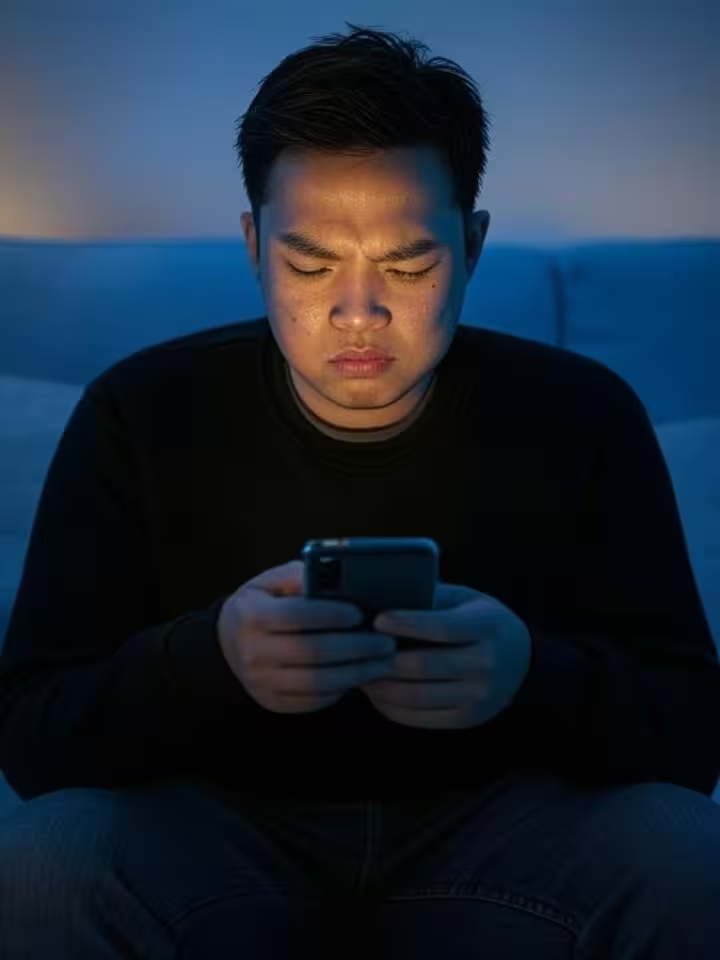
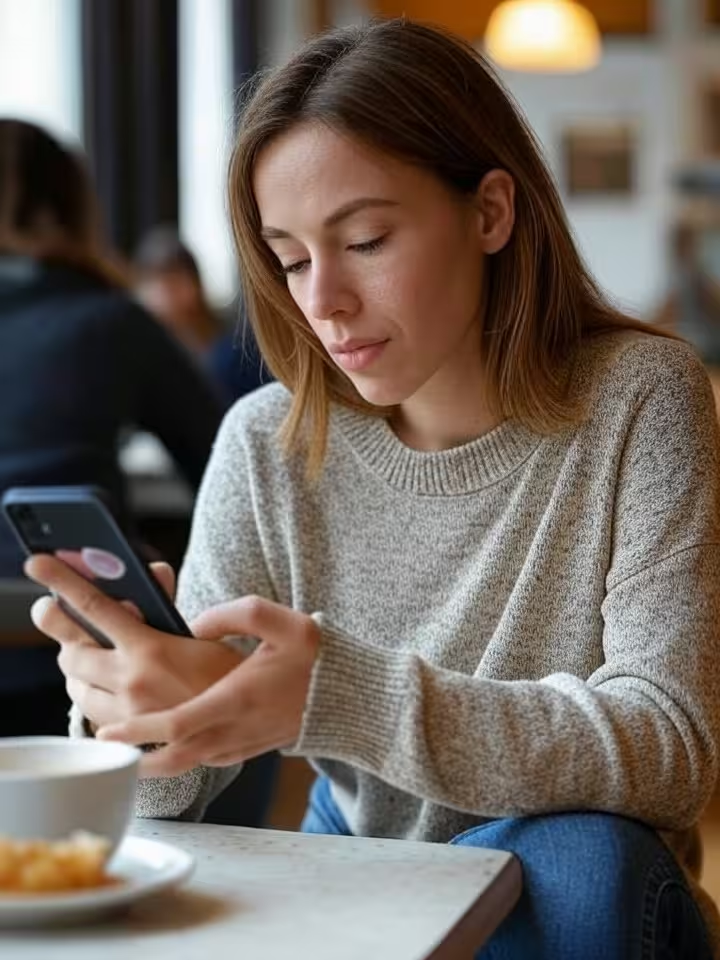
Latte in hand, cell phone screen illuminating my face in a downtown Starbucks. There I was, rereading a message from Sugar Daddy Planet USA that had just changed my weekend plans. I'm not going to lie: sugar dating was never on my radar until a financial rough patch coincided with my fifth year trying to find something real on Tinder. What started as curiosity ended up turning into an experience that taught me more about boundaries, negotiation and self-awareness than any therapy.
I have been navigating the world of online dating for years. I have tried from Bumble for casual encounters to niches like Feeld to explore less conventional dynamics. But sugar dating... that's a universe apart. And believe me, it has a lot more to do with explicit communication, management of expectations and self-esteem than with the Pretty Woman fantasy that Hollywood sells you.
I'm going to tell you real stories - mine and those of people close to me - because if you're considering entering this world, you deserve to know what's really going on behind the verified profiles and promises of first-class travel.
What is sugar dating (beyond the cliché)?
Let's get this straight from the beginning. Sugar dating is a consensual relationship where one person (sugar daddy/mommy) offers financial support, mentoring or experiences in exchange for companionship, time and, depending on the agreement, intimacy. It is not prostitution, although prejudices constantly confuse it. It is a transparent negotiation between adults who know what they want.
The truth is that platforms like Sugar Daddy Planet have democratized this type of relationship. It is no longer something reserved for exclusive circles in New York or Miami. From Mexico to Spain, thousands of people are exploring these dynamics, each with their own rules.
A friend of mine, a 26-year-old freelance designer, started The Inner Circle looking for something serious. After months of conversations that went nowhere, she tried Sugar Daddy Planet USA almost out of spite. Her first hookup was with a 48-year-old entrepreneur. «I wasn't looking for a traditional boyfriend,» she confessed to me. «I was looking for someone who really valued my time, who wouldn't make me waste entire evenings on the ‘let's see when we'll meet up' ghost.» Six months later, he'd helped her pay for a major while they shared dinners, trips, and deep conversations about architecture and business.

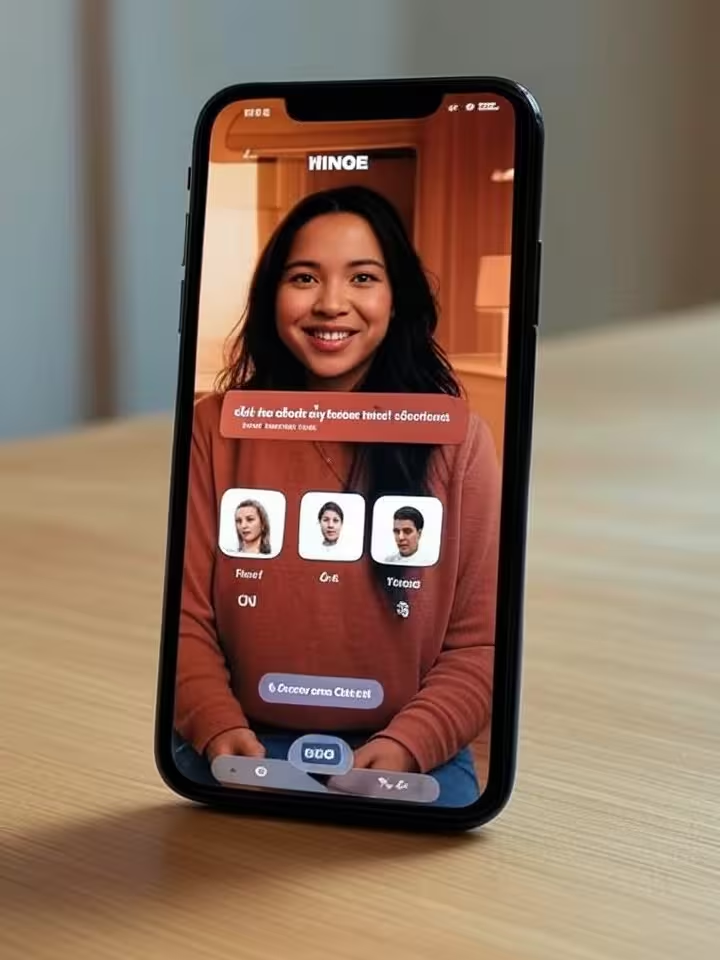
And you know what, it's not all glamour and luxury. I've also seen the dark side: guys at Secret Benefits who promise the moon and offer crumbs. That's why I learned quickly to check all. Reverse image search to detect catfishing, video call before any face-to-face encounter, and never -never- share sensitive financial information in the early stages.
Still, sugar dating can be incredibly empowering when handled with emotional intelligence and clear boundaries. The key is to understand that it's not a conventional relationship, and that means you write the rules.
My first experience: from initial nerves to the trip to Cancun
I'll confess something to you: my first real dive into sugar dating was in 2018, after completely burning out on Tinder and its infinite swipes that led to nothing substantial. I was exhausted from the dating dating sites, Of conversations that died after three messages, of guys who disappeared after agreeing to a date.
I registered in Sugar Daddy Planet with more curiosity than expectations. I created a profile with natural photos -no exaggerated filters or ultra-produced poses- because I sensed that authenticity was going to be my best letter of introduction. In the bio I was direct: I was looking for intellectual connection, interesting experiences and, yes, financial support for a personal project I had in mind.
Soon after, I matched with a businessman in his 50s. His profile was sober: photos at corporate events, one in a vineyard, another reading on a terrace. Nothing ostentatious. His opener was simple but effective: he commented on a book I mentioned in my bio. That got me hooked. Customization always wins as opposed to the generic «hello, how are you».
Conversations flowed for two weeks before the first date. We talked about art, travel, our professional frustrations. What no one tells you is that anxiety prior to the first meeting. Will he be who he says he is? Will there be chemistry in person? Will I feel uncomfortable?
I took every precaution: I shared my real-time location with a friend, we met at a busy downtown restaurant, and I kept my wine glass in sight at all times (basic, but essential). The date was... surprisingly normal. Smooth conversation, genuine laughter, zero pressure. In the end, he proposed a trip to the beach the following month. I accepted, but first we set clear rules: separate rooms unless I decided otherwise, flexible itinerary, and a specific financial agreement for my time.
Cancun was eye-opening. Not only because of the luxuries - the beachfront hotel, the dinners with a view of the Caribbean - but because of the honest conversations about ambitions, fears, and expectations. I realized that I was genuinely enjoying his company. But I also understood something crucial: I was looking for deep emotional connection, not just a transactional arrangement. And he, though charming, couldn't offer that in the format I needed.
Upon returning, the «arrangement» naturally fizzled out. No drama, no hard feelings. It was an experience that taught me more about my own emotional boundaries and relational needs than months of therapy. As you will learn in managing rejection in dating, Sometimes closing a door is the healthiest thing you can do.
When things don't go as expected: red flags and disappointments
Honestly, not all of my forays were so balanced. Another time, with a match on Ashley Madison, things got messy fast. The guy was married-something that didn't bother me in principle, to each his own arrangements-but he started in with love bombing from day one: expensive gifts without ever seeing each other, messages every two hours, grandiose promises about how «special» our connection was.
Giant red flag. Love bombing is an emotional manipulation technique used by people with narcissistic traits to create rapid dependency. I cut him off before it escalated, blocked his number and reported his profile. That experience reinforced something fundamental to me: vulnerability is powerful, but not at the expense of your emotional security..
Then there is the story of a reader who wrote to me months ago. She started at Secret Benefits with a sugar daddy who paid for her college. Everything looked good: fancy dinners, help with academic expenses, he even introduced her to valuable professional contacts. But after six months came the slow fadeHe kept sending spaced-out messages, vague excuses, until he practically disappeared.
She felt used and disposable. I advised her what I always do: define expectations and timelines from the beginning. Does this arrangement have an expiration date? What if one of us wants to end it? How do we manage exclusivity or its absence? Those uncomfortable conversations at the beginning save you a world of pain later.
Honestly, these disappointments teach you resiliency and force you to fine-tune your bullshit detector. I've been through my own version: a match on Sugar Daddy Planet who seemed perfect in chat - funny, cultured, generous - but in person there was zero spark. Chemistry is not negotiated or manufactured. That night I went home questioning whether I was being too picky, whether my standards were unrealistic.
It took me some time to realize that preferring to be alone rather than settling for less than I deserve is not being demanding, it is being discerning.. That clarity helped me to radically improve my profile, focusing on authentic prompts instead of sound bites that could be in any app bio.
The most valuable lessons I learned (that no one tells you)
After years, dozens of conversations and more than a dozen real encounters, these are the lessons I take away from sugar dating:
The initial negotiation defines everything
The most important moment is not the first date, it's the conversation where you set expectations. How much time will you devote? What kind of support do you expect? Is there exclusivity or not? These awkward chats in the beginning save you from devastating misunderstandings later. I learned to have this chat conversation before the first meeting, when we are both calm and can think clearly. It's not romantic, but it's effective.
Your safety is never negotiable
Reverse image search, first date always in a public place, location sharing with someone you trust, mandatory video call beforehand. These measures are not paranoia, they are basic safety protocols. I have known of romance scams that started on Sugar Daddy Planet USA and ended up with thousands of dollars lost. If you have doubts about something, trust your instincts. According to the FBI, romance scams cause millions of dollars in losses every year.
Actively take care of your emotional health
Sugar dating can trigger deep insecurities: do you love me for who I am or for what I offer? Am I enough without the transactional component? If you have an anxious attachment style, as I found I do, set clear boundaries to protect your emotional stability. Take breaks when you feel dating burnout. Talk to friends. And if necessary, consider therapeutic support to process the complex experiences that may arise.
Practical strategies to improve your sugar dating experience
Well, if after all this you are still interested in exploring sugar dating, let me share with you concrete strategies that work:
Your profile is your first negotiation. Don't use generic pictures or vague bios. Be specific about what you're looking for. Instead of «I'm looking for someone generous,» try something like «I'm looking for professional mentoring and support for my creative projects, along with genuine intellectual connection.» Specificity attracts people who really fit what you're offering.
Check this out: the best openers in sugar dating are the ones that show that you read the complete profile. No generic «hello beautiful». Comment on something specific they mentioned, show genuine curiosity. Personalization multiplies your chances of response.
Verify before investing time. Ask for a video call before the first meeting. It is rare for someone legitimate to refuse. If he insists on going directly to the face-to-face appointment without any prior verification, it's a red flag. You can also use reverse lookup tools to verify that the photos are not stolen from the Internet.
And you know what, don't be afraid to ask direct questions via chat: what exactly are you looking for in this arrangement? What is your real availability? Have you had previous experiences with sugar dating? Evasive or too-vague answers are another red flag.
Set your limits from day one. What you are willing to offer and what you are not. How much time you can dedicate. What kind of support you need. And most importantly, when the arrangement ends. Having a review date (e.g., every three months to evaluate whether you both want to continue) eliminates paralyzing uncertainty.
The truth is that many people fail at sugar dating because they go in without a clear strategy. They try to improvise on the fly, and end up in situations they didn't want or accepting less than they deserve.
Cultural differences and contexts that matter
Here's the catch: sugar dating is not the same everywhere. In the United States and Western Europe, it is more normalized and there is more security infrastructure. In Latin America, where I advise readers from Mexico, Argentina and Colombia, there is more social stigma and fewer verification resources.
A reader from Mexico City told me that she started on Tinder with casual intentions, but ended up establishing a sugar arrangement via WhatsApp after weeks of conversation. Discretion was vital for her because of her conservative family environment. She ended up in a relationship that opened unexpected professional doors for her, but with the constant dilemma of a double life.
In Spain, where dating apps have very high usage rates, sugar dating mixes more easily with conventional dating. It's less taboo, which allows for more open conversations from the start. But that also means there are more unserious profiles mixed in with the legitimate ones.
What no one tells you is that the socioeconomic context of your city matters enormously. In large cities with high economic inequality, sugar dating can have more pronounced power dynamics. In college towns, on the other hand, it sometimes works more like mentoring with additional benefits.
Other people's stories: diverse perspectives that broaden the picture
Look, my experience is just one piece of the puzzle. Let me tell you about other paths I've seen:
The case of my friend Daniel: gay, 28, used Grindr primarily for casual encounters. He connected with an older man who initially only sought companionship for social events. Over time, that arrangement evolved into professional mentoring in the tech industry. Today, three years later, Daniel has a better job and a network of contacts that he never would have gotten on his own. His sugar daddy became his best friend and mentor, with no sexual component. This nuance is almost never portrayed in the media.
Sara's experience: 35 years old, divorced, single mother. She entered sugar dating with skepticism after she dating in your 30s was frustrating. Her first arrangement helped her pay for her daughter's daycare during a critical year. «It wasn't the fairy tale I expected,» she confessed to me, «but it gave me the financial breathing room to reorganize my life without the constant stress of making ends meet.» For her, it was a temporary survival tool, not a permanent lifestyle.
Laura's complicated history: 24 years old, graduate student. Her arrangement with a 52-year-old businessman seemed perfect for eight months: trips, gifts, stimulating conversations. But when she started casually dating someone her age, he became possessive even though they had never agreed to exclusivity. It ended in toxic mutual ghosting that left her questioning the whole experience. «I learned that explicit communication isn't enough if the other person doesn't respect agreements,» she told me. A painful but valuable lesson.
These stories illustrate something crucial: there is not only one type of sugar dating experience. It can be empowering, transactional, emotionally complex, liberating or exhausting. Sometimes all at once.
The most common mistakes (and how to avoid them)
After years of observing and living this, I have identified recurring patterns of error:
Mistake 1: Not setting clear boundaries from the beginning. You think you can wing it, but ambiguity breeds resentment. Spend time on the awkward conversation at the beginning. Define everything: frequency of meetings, type of support, expectations of exclusivity, communication protocol, and how to end the arrangement if necessary.
Mistake 2: Ignoring red flags out of financial desperation. When you need money urgently, it's tempting to ignore red flags. But accept this: no arrangement is worth your safety or emotional well-being. If something feels wrong, it probably is. As you'll learn in detect fake profiles, trusting your instinct can save you from dangerous situations.
Mistake 3: Not having an exit plan. What happens when the arrangement ends? Do you have a support network? An alternative financial plan? Sugar dating shouldn't be your only survival strategy. Use it as a supplement while you build other sources of income or stability.
Mistake 4: Confusing the arrangement with a traditional romantic relationship. Genuine feelings may develop, but the foundation is still different. Don't expect it to evolve naturally into something conventional. If you want that, communicate it explicitly and be prepared for the answer to be no.
Mistake 5: Not taking care of your mental health. Sugar dating can trigger deep insecurities about your worth, your attractiveness, your purpose. Don't ignore those emotions. Process them with trusted friends or a therapist. Emotional dissociation as a coping mechanism has long-term consequences.
Is it worth it? My personal reflection after years
So, after all this, is sugar dating worth it? My honest answer: it depends entirely on who you are, what you're looking for and how you handle it.
For me, it was a valuable stage of self-discovery. I learned to negotiate without guilt, to set boundaries without apology, to value my time in a tangible way. I also discovered aspects of my personality that I didn't know: my ability to enjoy temporary connections without the need for permanence, my ability to separate physical intimacy from emotional engagement.
But I also had moments of deep doubt. Nights where I wondered if I was betraying some romantic ideal, if I was «selling out,» if I deserved better. Those doubts are valid and deserve space.
The truth is that sugar dating taught me more about capitalism, power and relationships than years of academic theory. It showed me how almost all relationships have some transactional component, even if we dress it up as romanticism. The difference is that in sugar dating, that transaction is explicit and negotiated.
That said, it's not for everyone. If your self-esteem is already fragile, if you have unresolved issues with money or power, if you tend to be emotionally dependent, sugar dating can amplify those issues rather than solve them.
How to decide if it's for you (honest checklist)
Before you take the plunge, ask yourself these questions with brutal honesty:
Can I separate sex/intimacy from romantic love? Not everyone can, and there's nothing wrong with that. But if you need deep emotional connection to enjoy intimacy, sugar dating will be frustrating.
Do I have a strong support network? Friends who know what you are doing and can support you emotionally. You can't do this in complete isolation.
Am I doing this by choice or out of desperation? If it is out of extreme financial need, be extremely careful. Vulnerability makes you more likely to accept unsafe situations.
Can I handle social judgment if someone finds out? Because it can happen. Are you emotionally prepared for that?
Am I clear about my non-negotiable limits? Things you will never do no matter how much money is on the table. If you're not clear on them, don't start.
Do I understand the legal and security risks? Research the laws in your country. Know the basic safety protocols. This is not optional.
If you answered yes to most of them, you may be in a position to consciously and safely explore this. If you answered no to several, it may not be the right time.
The key is to frame the conversation from your personal needs and objectives, not just monetary. For example, instead of saying «I need X amount per month», you can explain: «I am working on a project that requires X monthly investment» or «My goal is to reduce my workload to focus on my training, which implies X monthly support». This contextualizes the economic aspect within your real ambitions. Also, have this conversation via chat before the first meeting, when you are both calm and can think clearly. Transparency does not detract from the romance if you both understand the nature of the arrangement.
First, recognize that this is completely normal. Regular intimacy and shared experiences can generate genuine attachment. The crucial question is: are those feelings reciprocated? Communicate honestly, but be prepared for any answer. Many sugar daddies/mommies value the arrangement precisely because it has clear emotional boundaries. If the person is not interested in evolving into something more traditional, you will have to decide if you can continue without hurting yourself emotionally. In my experience, staying in an arrangement hoping it will change only prolongs the pain. Sometimes the healthiest thing to do is to end it and look for what you really need in another context.
Use reverse image search with tools such as Google Images or TinEye to verify that the photos are not stolen from the Internet. Search the profile on LinkedIn or professional networks to confirm their work identity (with discretion). Insist on a video call before the first meeting; any legitimate person will agree without a problem. Watch for consistency in their story: details about their work, location and lifestyle should be kept consistent. Beware of those who ask for money before meeting you in person or who use elaborate language that appears to be copied. Scammers tend to promise too much too quickly. Finally, trust your instincts: if something feels strange, it probably is.
Sugar dating itself is not illegal in most countries, including Spain, Mexico and much of Latin America, as long as it is between consenting adults and does not involve direct exchange of money for specific sexual acts (which could be considered prostitution in some jurisdictions). The legal distinction is that the financial support is for time and companionship, not exclusively for sex. That said, research the specific laws in your country. Never sign written contracts detailing sexual exchanges for money, as they could be used against you. Maintain fiscal discretion: if you receive significant amounts, consult with an accountant about income reporting. And above all, protect your identity: use nicknames, do not share official documents until you are absolutely confident, and never allow yourself to be filmed or photographed in compromising situations without your explicit consent.
Reaffirm your boundaries firmly and without apology. You can say something like, «I really appreciate our arrangement, but remember that we agreed to X type of relationship. I don't feel comfortable changing that at this time.» If the person respects your boundaries, the arrangement can continue. If he or she insists, pushes, or uses financial support as a bargaining lever («I pay you so much, you should...»), that's a giant red flag and you should seriously consider ending the arrangement. Your body and your limits are non-negotiable, regardless of the financial component. No one is entitled to more than what you agreed to give. If you feel unsafe to have this conversation in person, do it by text and then cut off contact if necessary.
Conclusion: your path is unique
Look, after sharing all of this, the only thing I can tell you with absolute certainty is that your sugar dating experience will be unique. It won't be exactly like mine, or my friend's, or the stories you read on forums.
You will live it from your own perspective, with your own limits, needs and circumstances. And that's okay. There is no «right» way to do this, only more or less conscious, more or less safe ways.
If you decide to explore this world, do so with your eyes wide open. Set clear boundaries, prioritize your safety, communicate without fear, and never -never- compromise your emotional well-being for money. Sugar dating can be a powerful tool for self-discovery and empowerment, but only if you approach it from a place of strength, not desperation.
And if you decide it's not for you, that's perfectly fine too. There are a thousand ways to navigate the world of modern dating, and none is superior to the others. The important thing is to find what works for you, what makes you feel authentic and respected.
I will continue to explore, learn, and probably make new mistakes along the way. Because in the end, that's what dating is: a constant process of trial, error and growth. Whether it's on Tinder, Sugar Daddy Planet , Bumble or any other platform that comes up tomorrow.
Take good care of yourself. And if you decide to take the plunge, do it wisely.