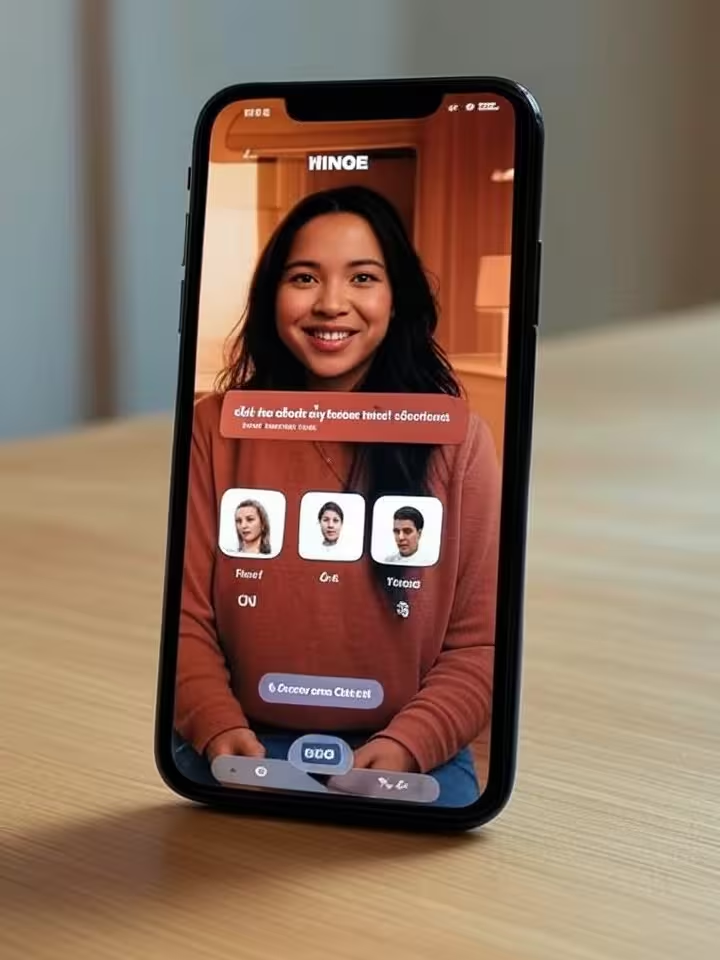
Have you noticed that opening Tinder feels more and more like turning on the console? The swipe, the match that lights up the screen, the boosts, the limited lives... Everything is calculated to hook you exactly like a good video game. And it's no coincidence. Dating apps have been applying dating techniques for years. gamification to keep you sliding, chatting and, hopefully, connecting with someone real.
But here comes the awkward question: does this gamification really help us find a partner or does it just make us addicted to scrolling? After years of testing practically every app on the market (and making quite a few mistakes along the way), I've learned that the answer is not black and white. Gamification can be your best ally or your worst enemy, depending on how you use it.
Let's break this down bluntly, because if you're reading this, you've probably already felt that bittersweet feeling of spending hours on an app without getting any real dates.
What exactly is gamification in dating apps (and why does it work so well)?
Gamification is nothing more than applying game mechanics to non-game contexts. In online dating, this translates into: limited swipes that create urgency, points for completing your profile, power-ups like Tinder's Super Likes, notifications designed to trigger your dopamine, and reward systems that make you feel like you're «progressing.».
Tinder is probably the clearest example. The Super Like works as a power-up that makes you stand out among hundreds of profiles. And you know what? It works. I've seen (and experienced) how a well used Super Like can turn into instant conversation when a normal like would have been lost in the pile. But it doesn't stop there.
Behind all this is the famous ELO score, that invisible ranking system that determines who the app shows you. Basically, it works like matchmaking in an online game: the more you interact and the more successful you are, the better your score, and the more attractive profiles you are shown. The algorithm of dating apps is more complex than it seems, and understanding it can make the difference between getting matches or not.
Badoo takes this to another level with its limited daily «encounters». It's exactly like those mobile game mechanics where you have limited lives that recharge over time. It forces you to come back every day, creating a habit. And here's the psychological trick: artificial scarcity creates a sense of urgency. «If I don't play now, I lose my chances today.».
Bumble uses another interesting approach: the 24-hour timer for women to write first. This time pressure turns each match into a mini-mission with a countdown. The truth is that this mechanic can generate anxiety, but it also eliminates that eternal limbo of matches that never turn into a conversation.
Hinge goes for something different with its prompts and the possibility of commenting on specific photos. Here the gamification is more subtle: it «rewards» you with better results when you complete your entire profile and respond creatively. It's like leveling up your character in an RPG, but instead of strength points, you accumulate genuine interest.
Even niche apps like Feeld gamify exploration with challenges and quests to unlock features. The League, on the other hand, makes you «earn» your way in with an impeccable profile and selection process, such as passing a boss level before accessing the full game.
The truth is that recognizing these elements empowers you. When you know you are being pushed to act in a certain way, you can consciously decide whether to play by their rules or set your own.
The advantages: when gamification really helps you connect
Now, it's not all dark manipulation. Well-designed gamification can genuinely enhance your dating experience. And I say that without irony.
Take Bumble as an example. Its profile verification system rewards you with increased visibility. This drastically reduces the catfishing and fake profiles, creating a more secure environment. When you get that blue check, not only do you feel like you've «unlocked an achievement,» but your matches know you are who you say you are. That little bit of gamification has a real impact on trust.
In Hinge, responding to prompts is basically accumulating social experience points. The more creative and authentic you are, the more deep conversations you generate. I've seen how a good coffee prompt can attract people with similar interests, leading to connections that go beyond the superficial «hi, how are you?».
Coffee Meets Bagel applies scarcity in a smart way: you are given a limited number of bagels (potential matches) each day. This forces you to be selective instead of automatically swiping on everything that moves. And it works. Dating fatigue decreases when you don't have to process hundreds of profiles. Dating burnout is real, and limiting your daily choices can be paradoxically liberating.
The «rewind» button in Tinder is another gamified element that has practical utility. It's like a «continue» in a video game: it gives you second chances when you make a mistake in an accidental swipe. It seems silly, but when you inadvertently reject someone you were interested in, that button is worth gold.
In addition, these mechanics train you in real social skills. You learn to write better openers, to identify red flags early, to present yourself in an attractive way. It's like practicing in a controlled environment before the «real game».
Apps like Inner Circle organize gamified virtual events that create community. I've participated in a few and the experience is totally different from the solitary 2 AM swipe. Suddenly, dating stops being an isolating activity and becomes something more social, more human.
The dangers: when the game plays on you
But here comes the dark side. And believe me, it's very easy to fall into it.
The biggest risk of gamification is that you start accumulating matches as if they were trophies, with no real intention of meeting anyone. This is benching gamified: you keep options open like items in an inventory, without advancing with any of them. I have seen friends (and I include myself at some point) with hundreds of matches without having met anyone in months. The match becomes the goal, not the connection.
The orbiting is another phenomenon amplified by gamification: people who give you likes, interact minimally, but never advance. It's like being in the lobby of a game waiting for the game to start, but it never starts. In Grindr, for example, the speed of chats can turn into an endless runner where you run without getting anywhere.
Then there is the paradox of choice. When you have unlimited access to profiles, your brain goes into «there's always someone better» mode. Apps like Tinder with its infinite swipe system feed this problem. You end up with constant FOMO, unable to commit to any conversation because a «better» match can always come along. It's mentally exhausting.
Algorithms can also work against you. If you are not active, you fall into the pit of low match rate. It's a vicious circle: fewer matches → less motivation → less activity → worse ranking → even fewer matches. And when you reach zero matches for days, your self-esteem suffers. You feel you have «lost the game».
Premium features create another layer of problems. Boosts, Super Likes, seeing who has liked you... Everything costs money. This creates a gap between «free players» and «paid players», where the latter have obvious advantages. If you don't pay, you feel like you are playing with one hand tied behind your back. And when you pay and still don't get results, the frustration multiplies.
The love bombing can also be amplified by boosts. Someone bombards you with intense attention for the first few days (when in «boost» mode) and then disappears. Slow fade becomes the norm: conversations that drag on forever without getting anywhere concrete.
And let's not forget the security risks. Some scammers exploit these mechanics to appear legitimate. That is why it is crucial to know how to detect fake profiles and use tools such as reverse image search before investing emotional time.
ELO score and hidden algorithms
Dating apps use invisible, video game-inspired ranking systems to decide who they show you. Your activity, your successful matches and the time you spend on the app determine your «attractiveness score». The better your ELO score, the more attractive profiles you see. But if you fall in the rankings, you enter a vicious cycle that's hard to break. It's like matchmaking in a competitive game: if you lose a lot, you get matched with low-level players.
The tyranny of limited swipes
Apps like Badoo and Bumble limit your daily swipes to create artificial urgency. This «limited lives» mechanic forces you to come back every day and, if you want more, to pay for premium features. The result is a constant sense of scarcity: «if I don't act now, I miss opportunities.» This time pressure can lead you to impulsive decisions and develop anxiety around dating, turning matchmaking into a race against the clock.
Addiction to match: accumulating without connecting
The biggest danger of gamification is turning matches into trophies that you collect with no real intention of meeting anyone. The notification sound, the screen lighting, the dopamine of the new match... everything is designed to hook you. You end up with hundreds of conversations without making progress with any of them, practicing massive benching. The match becomes the ultimate goal, not the human connection. And when you've gone weeks without meeting anyone real, you realize you've been playing alone.
How to use gamification to your advantage without losing your mind
Okay, so how do you navigate this untapped minefield? Here are concrete strategies I've learned (sometimes the hard way).
Set clear time limits. Use your phone's own timer to limit yourself to 20-30 minutes a day on dating apps. When the alarm goes off, you close the app. No exceptions. This breaks the cycle of «just one more swipe» that can extend for hours. In my case, limiting myself to half an hour forced me to be more selective and focus on quality conversations instead of quantity.
Play with several apps simultaneously, but strategically. Don't use five apps at the same time by swiping massively on all of them. Instead, try two or three with different philosophies: for example, Tinder for volume, Hinge for deeper connections, and Coffee Meets Bagel for curated options. This diversifies your strategy without saturating you.
Treat boosts as what they are: tools, not magic solutions. If you are going to pay for a boost, do it strategically: Sunday night between 8-10 PM when activity is at its peak. And make sure your profile is optimized before. A boost with a mediocre profile is money wasted. The right photos make all the difference.
Ignore vanity metrics. Stop counting matches as if they were points. What matters is: how many interesting conversations do I have? How many real dates have I gotten this month? Those are your real metrics of success. I've met people with 500 matches and zero dates, and people with 20 matches and three meaningful relationships. Guess who's really winning.
Alternate between gamified apps and real events. For every hour you spend on apps, spend equal time on activities where you meet people in person: classes, social events, hobbies. This keeps your social skills sharp and reminds you that dating is not just a screen.
Use pauses strategically. When you feel dating fatigue (and you will), don't hesitate to pause your profile or uninstall the app for a week. You come back with renewed energy and fresh perspective. Some of my best results have come after taking two-week breaks.
Prioritize apps with positive gamification. Her, for example, fosters community with events and forums, not just swipes. Inner Circle organizes real encounters. These platforms use gamification to build connections, not just to keep you hooked to the screen. If you find that an app only makes you feel worse, uninstall it without guilt.
And here is the most important tip: remember that the person on the other side is not an NPC. It's someone real with hopes, fears and their own story. When you start seeing profiles as people instead of collectible cards, everything changes. Conversations flow better, connections are more authentic, and paradoxically, you get better results.
Signs that the game is controlling you
Sometimes you don't realize you've fallen into the trap until it's too late. These are the red flags that indicate that gamification is overpowering you:
You compulsively check the app every five minutes, even in social situations. If you're at a meal with friends and you can't help but open Tinder every time there's a silence, there's a problem.
You feel anxious when you don't have new matches. Your self-esteem goes up and down depending on how many notifications you have. A day without matches makes you feel personally rejected.
You have dozens of open conversations but you don't make progress with any of them. You keep accumulating matches with no real intention of meeting anyone. The match has become the goal, not the means.
You spend significant money on premium features without seeing real results. You've paid for boosts, Super Likes, gold subscriptions, but your real dating stats don't improve.
You feel you «wasted the day» if you didn't use all your available swipes. That artificial urge not to waste your daily «lives» controls your behavior.
You constantly compare your success with others. You're obsessed with knowing how many matches your friends have, or with view your Tinder Insights statistics compulsively.
If you identify three or more of these patterns in yourself, it's time to do a reset. Uninstall the apps for at least two weeks and reevaluate your relationship with online dating. You are not alone if this happens to you; gamification is specifically designed to generate these behaviors.
The future of gamification in dating: where are we going?
The trend is not going to reverse; in fact, it is going to intensify. We are already seeing apps experimenting with augmented reality and AI to create even more gamified experiences. According to technology experts, we will see more video game elements integrated into online dating.
Some apps are already testing customizable avatars, compatibility missions where you complete challenges with your match, and more sophisticated reputation systems. Bumble is experimenting with «game modes» where you can choose different experiences depending on your mood: casual mode, serious mode, friendship mode.
Artificial intelligence will add another layer. Imagine a system that learns your preferences and suggests profiles with chilling accuracy, or AI assistants that help you write optimized messages for each person. It sounds like science fiction, but some platforms are already working on this.
Virtual reality could enable «first dates» in digital environments before meeting in person. This further gamifies the process, but could also reduce the anxiety of those first interactions.
The important thing is to maintain healthy skepticism. Each new gamified feature will come with the promise of «improving your experience,» but the real goal will be to keep you on the platform longer. Being aware of this empowers you to decide what you adopt and what you ignore.
Regardless of where technology evolves, the fundamental principle will not change: apps want your time and your money. Real connections require getting out of the app and meeting people in the physical world. No amount of gamification will change that.
One last thought before your next swipe
Look, I'm not going to pretend that gamification is going away or that we can go back to some pre-digital dating paradise. We're here, in this landscape, and we have to learn to navigate it without losing our way.
Gamification can be your ally if you use it consciously: it helps you to improve your profile, to be more strategic, to stay motivated when rejection hurts. But it becomes your enemy when the game becomes more important than the human connection you're supposedly looking for.
I've gone through all the phases: the initial obsession, the frustration of burnout, the revelation of using these tools strategically. And what I've learned is this: you are in control. The apps design the board, but you decide how you play. You can fall for all their psychological tricks or you can be the smart player who takes advantage of the system without letting it consume you.
Some final tips before you open that app again: give yourself permission to take guilt-free breaks. Celebrate quality conversations, not quantity of matches. Remember that each profile is a real person. Don't spend money on premium features if your basic profile isn't working. And above all, don't let any app determine your value as a person.
Online dating is a tool, not your life. The best love stories I know started with a match, yes, but they were built in coffee shops, walks, deep conversations and shared moments off-screen. The app is just the door; you have to walk through it.
Ready for your next level? This time, play smart.
Super Likes do work, but they are not magic. When you use one, your profile is highlighted for that person with a blue star, which significantly increases the likelihood that they will see and consider you. The problem is that Tinder only gives you one free one a day, pushing you to buy more. My advice: use them strategically on profiles that really interest you and where you think there is real compatibility. Don't waste them on automatic swipes. And most importantly: a Super Like is no substitute for a good profile. If your photos and bio are mediocre, the Super Like will only make more people see a mediocre profile.
The ELO score works like an invisible ranking system. When your account is new, you have a «newbie boost» that shows you very attractive profiles and makes you visible to many people. But after that, your score depends on how many likes you get, how many you give, who you match with, and how active you are. If your score is high, you are shown profiles of other users with high scores. If it goes down, you enter a circle where you see and are seen by less popular profiles. The problem is that it is difficult to raise it once it drops. That's why some users reset their account completely to start again with the initial boost, although Tinder is penalizing this more and more.
It depends on your personality and objectives. Limited swipes force you to be more selective and reduce the mental exhaustion of processing hundreds of profiles. This usually leads to higher quality connections because you really evaluate each profile. The problem is the frustration of «running out of options» in the middle of the day. Unlimited swipes give you freedom and volume, but you easily fall into automatic mode where you swipe without thinking, accumulate empty matches and end up burnt out. My recommendation: if you tend to be addicted or paralyzed by too many options, try apps with limits. If you are naturally picky and frustrated by restrictions, Tinder will work better for you.
Set clear and measurable limits: maximum 20-30 minutes per day on apps, for example. Disable all notifications except for matches (and better yet, disable them all). Change your success metrics: stop counting matches and start counting real dates or meaningful conversations. Take mandatory breaks every two weeks, even if you're doing well. Use your phone's digital wellness features to track how much time you spend on apps and set automatic limits. Most importantly, if you find that you compulsively check the app in social situations, or that your self-esteem depends on notifications, consider taking a month-long break. The apps will be there when you return, but your mental health is more important.