Navigating online dating as a non-binary person: a practical guide from someone who has lived it.
January 15, 2026
I'm not going to sugarcoat it: it can be frustrating. But it's also liberating when you find those real connections that remind you why it's worth trying. Honestly, I've had matches that have made me question my whole approach to dating, and others that have restored my faith that there are people out there who really understand. Let's chat about it like we're over coffee, sharing tricks I've picked up along the way-some by trial and error, others out of sheer necessity.
Apps that actually include (and how to identify them)
Well, let's start with the basics, because choosing the wrong app is like going to a party where no one speaks your language. I've tried pretty much everything in the app store, from mainstream ones like Bumble (which now allows non-binary gender options in its settings) to niche ones like Her, which was originally for queer women but has become more open to the whole community.
Note that Taimi is great for the LGBTQ+ community in general. It has filters that actually respect fluid identities and doesn't force you to fit into rigid «male» or «female» boxes. On the other hand, Grindr has evolved quite a bit in recent years. While it's still mostly for gay men, I've seen non-binary profiles thrive there with a bit of clever presentation.
What no one tells you is that apps like The League or Raya, with their exclusive and select vibe, can be a minefield if you're not in the mood to explain your identity every now and then. Most popular apps are not always the most inclusive, even if they are fashionable.
Now, if you are looking for something more alternative, Feeld is my personal favorite. Yes, I admit, I've had a few interesting adventures there. It allows profiles that explore non-traditional dynamics, like polyamory or kink, without judgment or labeling. Plus, its interface makes it clear from the start what kind of connection you're looking for-something that avoids misunderstandings later on.
Even in places like Spain or Mexico, where queer dating is growing considerably, local apps like Wapa or Amigos con Derechos are joining the mix, adapting to more inclusive customs. The trick is to read reviews from non-binary users before downloading anything. It saves you time, disappointment and that «here again I don't fit in» feeling.
That said, not all apps are perfect. Some still fail miserably on basic things like pronoun checking or sexual orientation options. But hey, we're making progress. And you know what, I once found a match on OkCupid who understood everything without me saying an extra word about my identity. Small victories like that remind you that it's worth it to keep trying.
Apps with non-binary gender options
Not all platforms offer real gender options. Taimi, Feeld, Her and OkCupid are notable for allowing non-binary identities in their settings. Bumble has also improved, but some mainstream apps still force you to choose between binary options. Look for platforms that respect your pronouns from the profile and have inclusive filters to avoid misunderstandings from the start.
Queer communities in niche apps
Niche apps like Feeld, Taimi or Scruff have more conscious communities ready to interact with non-binary people. Grindr, while traditionally focused on gay men, also hosts successful non-binary profiles. These platforms reduce the need for constant explanations because their audience is already familiar with diverse identities, making the process less emotionally draining.
Red flags in mainstream apps
Apps like The League or Raya can be problematic if they don't offer inclusive gender options or if their audience is not educated in diversity. If a platform forces you to identify as male or female without alternatives, it's a sign that it hasn't prioritized inclusion. Also, check to see if they allow custom pronouns in the profile-this indicates real commitment to the non-binary community beyond superficial marketing.
Profile that reflects who you are (without writing an essay)
Creating a profile that screams «it's me» without turning it into a political manifesto is quite an art, and believe me it took me a while to learn it. I have to admit that in the beginning I used to post very long bios explaining my non-binary identity, my use of neutral pronouns, and basically my entire life story. The result? It attracted more invasive questions than genuine connections.
Instead, I now opt for prompts in Hinge that drop subtle hints about who I am. Something like «What I value most is open-mindedness» or «I hate having to...explain the obvious.» I accompany that with photos that capture my fluid style-no forced poses or excessive filters, just real moments that show my current presentation.
Avoid the common mistake of using photos that don't reflect how you look now. That leads to awkward misunderstandings on the first date, and believe me, I've had enough of those. If your hair is pink now but your photos are from when it was black, update them. If your style changed radically in the last few months, your photos should reflect that too.
See, in apps like Happn (which rely on close encounters in real life), a short but impactful bio makes all the difference. Something like «Exploring authentic connections beyond labels» invites deep conversations without overloading. Between us, I've helped non-binary friends to. improve your profile pictures and their match rate increased considerably just by including queer-friendly interests such as drag art, gender podcasts or community events.
The truth is that, psychologically speaking, showing some vulnerability appeals to those seeking the same thing. But no exaggeration-no one wants to read an entire essay on queer theory on a dating app. Also, verify your profile with the blue badge whenever possible. In times of rampant catfishing, that builds trust from the start and sets you apart from fake profiles.
Once, a profile of mine with only five words in the bio («Coffee, dogs, honest conversations») generated more interesting chats than a super detailed one I had used before. Surprising, isn't it? Sometimes less really is more. The people who connected with that minimalist profile were exactly the ones who were looking for authenticity, not explanations.
On the other hand, do not ignore the red flags in other people's profiles. If someone completely ignores your pronouns in the first message after you've made them clear in your bio, swipe left with no regrets. It's empowering to prioritize your comfort and not settle for people who don't make the minimal effort to respect you from the start.
How do you handle the conversation about your identity?
Here's the trick that no one mentions: you don't have to explain your non-binary identity if you don't want to. Seriously. Some people put their pronouns in the bio and let the other person ask if they have questions. Others prefer to broach the subject directly in early conversations to filter out those who aren't ready.
I have tried both approaches. When I put «elle/they» in my profile, some people politely ask me what it means. Others simply respect it without comment. And then there are those who completely ignore that information-those are the ones I quickly dismiss.
Notice that timing matters. On apps like Coffee Meets Bagel or Hinge, where conversations tend to be deeper from the start, mentioning your pronouns or identity in the first few messages feels natural. In contrast, on Tinder or Bumble, where the pace is faster, you can wait for it to come up organically.
What I've learned is that if someone reacts negatively or with «it's too complicated for me,» it's not your job to educate them. There are millions of people on these apps, and not all of them deserve your energy. Rejection in dating apps may hurt more when it involves your identity, but remember: it's their limitation, not yours.
Conversations that flow (without falling into interrogation)
Ah, conversations. That digital limbo where a good opener can lead to an epic date or the eternal silence of ghosting. I confess I've sent literally hundreds of first messages, and the best ones have always been personalized-no more of that generic «hi, how are you» that everyone sends.
On Scruff, for example, where the community is quite diverse, starting with something about a shared interest works wonders. Something like «I saw you like non-binary art, have you tried that festival in Raval?» breaks the ice without assuming anything about the person or forcing the gender issue from minute one.
The situationships are super common in non-binary dating-those ambiguous connections where no one defines exactly what they're doing. Define expectations early to avoid headaches later. A simple question like «what kind of connection are you looking for?» can save you weeks of confusion.
At the same time, it handles the orbiting-those people who see all your Instagram stories but don't respond to your messages-completely ignoring it. It's not personal, it's simply part of the modern dating game. I've experienced that brutal app fatigue, where chatting feels like a full-time job, especially when you have to explain your identity over and over again to different people.
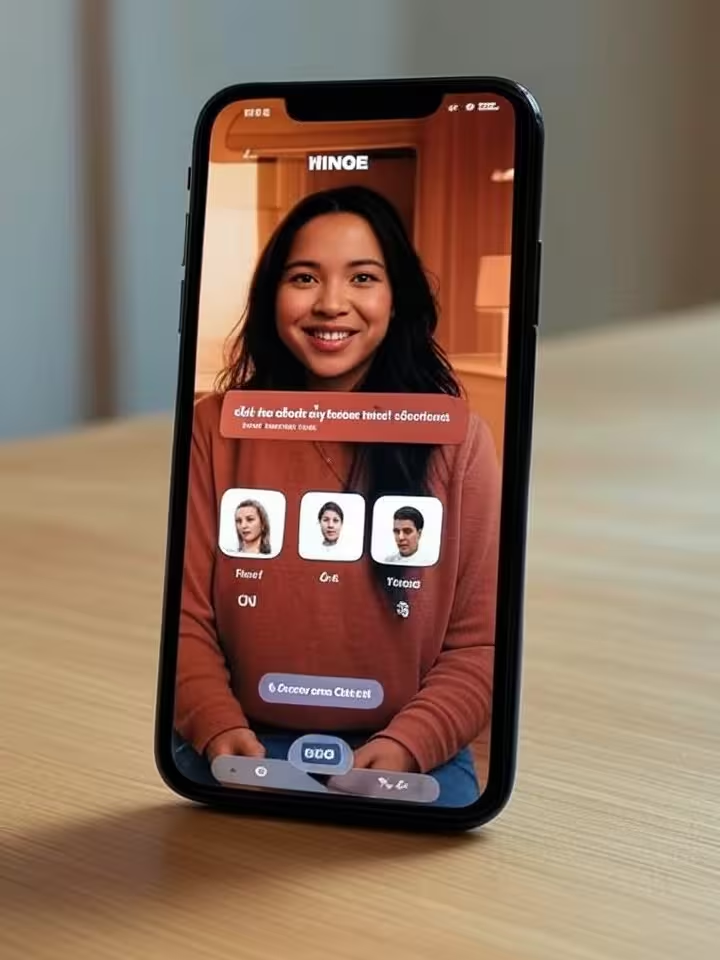
The dilemma of when to propose a video call before the appointment is real. Personally, it helps me filter better-on platforms like Coffee Meets Bagel, which limits daily matches, proposing a video chat after a few days of conversation reduces burnout. You see if there's real chemistry before you invest time getting dressed up and moving around.
Notice that, emotionally speaking, the first effective messages have one thing in common: they are specific and show that you actually read the profile. Build resilience by recognizing green flags, as someone who asks for your pronouns respectfully or who mentions their openness to learning about diverse identities.
Mind you, if you feel the ick in the chat-that gut feeling that something doesn't fit-trust your instincts. Period. You don't need a logical reason to stop responding to someone who makes you uncomfortable, no matter how subtle.
Even in Spanish-speaking contexts, where terms like «elle» or «le» are gradually gaining ground, use them in your profile and conversations to attract natural allies. What I've learned after dozens of matches is that online chemistry doesn't always translate to the real thing. I once had a match on Badoo with amazing sparks over chat, but in person there was absolutely nothing. Frustrating, but part of the process of finding someone compatible.
First date: what to expect and how to prepare
First dates when you're non-binarie have an extra layer of complexity. Beyond the normal nerves of meeting someone new, there's the uncertainty of how they'll perceive you in person versus how they saw you in photos, or whether they'll respect your pronouns face-to-face.
Honestly, I've had it all. Dates where the person used my correct pronouns all night with no apparent effort, and others where I had to constantly correct. Both experiences teach you a lot about real compatibility beyond the initial attraction.
Choose public places always-cafes, parks, art galleries, anywhere with people around. Not just for physical safety, but because public spaces relieve some of the pressure. If the date doesn't go well, it's easier to end it politely over coffee than over a formal two-hour dinner.
The ideal length for a first date is between 1-2 hours. Long enough to know if there is chemistry, but not so long that it becomes awkward if there isn't. And on the topic of who pays, I personally prefer to split the bill or invite I-break with traditional gender dynamics that don't represent me.
Observe the body language and signs of interest. If the person leans toward you, maintains eye contact and asks questions about your life, he or she is probably interested. If she constantly checks her cell phone or seems distracted, well, you know what that means. Move on to a second appointment depends on both people feeling that genuine connection.
After the appointment, the follow-up message matters. Something simple like «I had a good time, I'd like to go again» works just fine. Don't play hard to get by waiting three days-that's old-fashioned and confusing. If you liked the person, say so. If not, it's also okay to be honest instead of disappearing without explanation.
Emotional and physical safety: non-negotiable
Speaking of more serious realities, safety is not optional, especially for us non-binaries, who sometimes face additional prejudices or uncomfortable situations. Always choose public places for first dates, and share your real-time location with a trusted friend.
Apps like Inner Circle have built-in location sharing features, but don't rely on them alone. Use WhatsApp or Find My Friends as well. Make a reverse image search on suspicious photos to avoid scammers or fake profiles. I've dodged a few catfish this way, especially in less regulated apps.
In addition, it recognizes the romance scamsThe following are just a few examples: quick promises of eternal love, people who ask for money after only a few conversations, or profiles that systematically refuse to make video calls. These are huge red flags that you should not ignore.
In the background, it also protects your emotional well-being. If an interaction leaves you feeling anxious, confused or bad about yourself, block and move on. You don't owe anyone explanations on a dating app. I've seen friends fall into repetitive patterns because of FOMO (fear of missing out), but pausing apps when you feel dating fatigue is absolutely key to coming back stronger and with a better mentality.
The detection of fake profiles should be a basic skill. Don't share sensitive personal information (exact address, place of work, daily routines) until you really know the person. And if something feels weird, it probably is-trust that instinct.
Verification and security in profiles
Verify your profile with the official badge when possible and search for the same in matches. Use reverse image search on Google to confirm that photos are authentic. Share your location with friends before dating, always choose public places, and don't share sensitive personal information until you really know the person. Your physical and emotional safety should be top priority.
Handling pronouns in conversations
Define your pronouns clearly in your bio (elle, they, le, or combinations). If someone ignores them in the first few posts, it's a sign of incompatibility. It's not your job to educate every match-filter who doesn't make the minimal effort to respect something so basic. People who are really interested will ask politely if they have questions, and will use your pronouns correctly from the start.
Preventing non-binary dating fatigue
Explaining your identity repeatedly is exhausting. Use your bio efficiently to filter from the start, take breaks from apps when you feel burned out, and don't force yourself to respond to every message. Prioritize matches that show real effort in understanding your identity. Burnout is real in non-binary dating-recognize the signs and take care of your mental health by pausing when you need to.
Lessons from the road: what really works
Here's the interesting part: after literally hundreds of chats, dozens of dates and some memorable ghosts, I can tell you that the dating online is a skill, not pure luck or lottery. For non-binary people, it's fundamentally about finding digital spaces that celebrate fluidity rather than tolerate it.
I've had genuine victories, like a connection in Her that led to a meaningful relationship lasting several months. I've also had failures, like ghostings that hurt twice as much when they involve your identity. But every experience teaches something valuable about what you're looking for and what you definitely don't want to repeat.
Honestly, the balance is in being authentic without exposing yourself too soon. Share your identity at your own pace, with the people who prove worthy of it. And if a specific app doesn't work for you after giving it a real chance, it's not failure-it's just not your platform.
Explore options like Muzz for queer Muslims, WooPlus for diverse bodies, or even regional apps that may have more conscious communities in your area. App algorithms also play an important role-understand how they work to maximize your visibility.
In short-no, wait, I'm not going to use that trite phrase. The important thing is this: you control your narrative in online dating. No one else. Get out there, experiment with different apps and approaches, and if something doesn't fit, there are literally millions of other potential matches waiting. It's been a long and learning-filled journey, but I can honestly tell you that it's worth every swipe when you finally find real connections.
Frequently asked questions about non-binary dating
Should I explain my non-binary identity in every dating app conversation?
You don't have to explain your non-binary identity if you don't want to. You can put your pronouns clearly in your bio (elle, they, le) and let people ask respectfully if they have questions. Many non-binary people prefer to approach the subject only with matches who show genuine interest and respect from the start. If someone ignores your pronouns in the first few messages, it's a sign of incompatibility-it's not your job to educate every match. Reserve your energy for those who make the minimal effort to respect you.
Which dating apps are truly inclusive of non-binary people and not just greenwashing?
Feeld, Taimi, Her and OkCupid are the most genuinely inclusive apps with real non-binary gender options, respectful filters and conscious communities. Taimi stands out for its LGBTQ+ specific filters without forcing you to fit into binary boxes. Feeld allows you to explore fluid identities and non-traditional dynamics without judgment. Bumble has improved by adding non-binary options, although its mainstream user base may be less educated. Avoid apps that only let you choose male/female or have hidden non-binary options-that indicates superficial marketing inclusion, not real engagement.
How to handle dating fatigue when you have to explain your non-binary identity constantly?
Burnout from repeatedly explaining your identity is real and valid. To prevent it, use your bio efficiently by including pronouns and a sentence about fluid identities that filters from the start. Limit your active matches on apps like Coffee Meets Bagel that restrict daily numbers. Take breaks from apps when you feel emotionally drained-pausing for weeks doesn't mean failure, it means taking care of your mental health. Prioritize quality over quantity by focusing on matches that demonstrate real effort in understanding your identity without you having to educate them from scratch. Don't force yourself to respond to every message.
What photos work best in dating profiles for non-binary people without falling into stereotypes?
Photos that reflect your current presentation and fluid style work best-no forced poses or excessive filters. Include a mix: clear close-ups of your face, full-body photos that show your style of dress, and some of you doing activities you enjoy (art, queer events, nature). Avoid very old photos that don't represent how you look now-that causes misunderstandings on first dates. If your presentation has changed recently (new hairstyle, different way of dressing), update the entire profile. Visual authenticity attracts people who really connect with you, not those who expect something different based on outdated photos.
How to respond when someone uses incorrect pronouns on the first face-to-face date?
Correct politely but firmly the first time: «I use elle/they pronouns, by the way.» Watch the reaction-if she apologizes and makes a genuine effort to correct herself, it's a sign of respect. If he ignores the correction, firmly repeat or end the appointment early. You don't have to tolerate basic disrespect for someone else's convenience. If he seems honestly forgetful, give him limited opportunities (2-3 corrections). But if you feel that he or she deliberately ignores your pronouns or minimizes their importance with phrases like «it's too complicated,» that person is not ready to date you respectfully. Always prioritize your emotional comfort over forcing a connection.