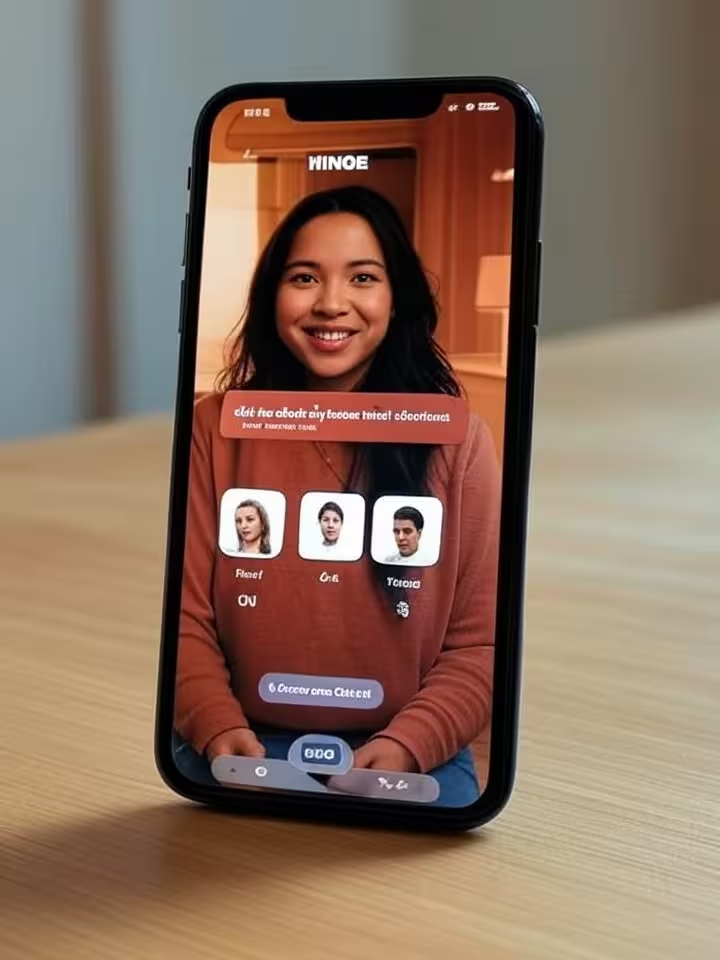
Are you fed up with swipe on Tinder non-stop, right? I was, too. After years of browsing apps where everything seems like a quick discard game-a swipe here, a dead match there-I found Hinge. And something completely changed.
It's not just another dating app with the same superficial dynamic. Hinge was designed from the ground up with a different philosophy: be eliminated. Yes, you read that right. The app wants you to find someone and delete them from your phone. That's only possible when connections go beyond «do you like my photos?» and into real compatibility territory.
If you're looking for something serious-not another mid-week ghosting or another conversation that dies after «haha, yeah»-stay. I'm going to tell you exactly why Hinge works when other apps leave you empty-handed.
Prompts: the difference between a boring bio and a real conversation
Here's the trick that Hinge understands and other apps ignore: photos alone do not tell the whole story. Sure, they matter (a lot), but you know what really generates conversations? Prompts.
Instead of leaving you with an empty bio where you put «I like to travel and pizza,» Hinge forces you to answer specific questions. Things like:
- «What I value most in a partner is...»
- «My greatest irrational fear...»
- «Together we could...»
- «The key to my heart is...»
When I updated my profile with something honest-I said I love to cook but hate washing dishes-I started to get matches that responded to exactly that. It wasn't the typical «hello, how are you?» that you could copy and paste to anyone. It was people commenting «I'll wash if you cook.» or «what's your specialty in the kitchen». Conversations that started off on the right foot.
The truth is that these prompts reveal personality in a way that a list of hobbies never does. I've seen profiles where someone shares their most embarrassing first date anecdote, or the book that changed their life, or that weird hobby they have. And that builds chemistry formerly to send the first message.
Note that Hinge also limits the daily likess (you get between 8 and 10 for free). This is not a frustrating limitation-it's strategic. It forces you to think twice before liking. You reduce the noise, you avoid that automatic mindless swiping you do on Tinder at 2 AM. Instead of 100 superficial matches, you get 5 or 6 that actually have potential.
In comparison, apps such as Bumble let you swipe without limit, and OkCupid lets you write entire essays that no one reads. Hinge finds the middle ground: enough information to connect, without overwhelming.
Prompts that generate real conversations
Responses to specific Hinge questions replace the traditional bio with content that invites comments. Instead of empty likes, you receive messages that respond directly to your prompts, starting conversations with context and substance from the first exchange.
Daily limits that increase quality
The daily likes restriction on Hinge is not a frustrating limitation but a quality strategy. By forcing you to carefully select who you like, you reduce superficial matches and increase the likelihood of compatible connections that can really evolve.
Algorithm based on compatibility, not just appearance
While apps like Badoo prioritize the main photo, Hinge's algorithm analyzes your responses to prompts, your interactions and preferences to suggest compatible profiles. The system learns from your behaviors to show you people with values and interests aligned with yours.
Why don't the conversations in Hinge die after two hours?
I have to admit something: the biggest problem with online dating is not the matches. It's that the conversations die. Ghosting. Slow fade. One word answers. You've lived it a thousand times.
Hinge tackles this problem head-on with something other apps ignore: mutual responsibility.
After a few days of chatting (or not chatting), the app asks you, «Did you go out with [name]?» and «How did it go?». This is the system We Met, and it's not just curiosity-it's strategy. When you respond, the algorithm adjusts your future suggestions. If you say «yes, it was great,» it shows you more similar profiles. If you say «we didn't meet,» it understands that that kind of match didn't work out.
But there is more. This system creates a sense of commitment. You know that eventually the app will ask you if you've met that person. That reduces (not eliminates, let's face it) the temptation to ghost without explanation. Not that it avoids all the drama-dating is still dating-but it minimizes those situations where someone disappears after three days of intense conversation.
The truth is that the structure of Hinge favors conversations with substance from the start. When you like someone, it's not a generic like.comments in one of your prompts or photos. Imagine this: you see the prompt «My hidden talent is...» and the person responds «doing Disney voices while cooking». Your opener is not «hello», it's «What's your favorite voice? I need to know if you do Ursula or stay in Ariel territory».
Boom. Conversation initiated with humor, context and a natural hook.
I've helped friends make this transition. One of them spent months on Tinder with conversations dying after «what do you do for a living?». He tried Hinge, answered prompts honestly (including one about his obsession with true crime documentaries), and within two weeks had a date that turned into exclusivity.The difference? Conversations started with more than just the profile picture.
Still, I'm not going to lie to you: Hinge does not eliminate catfishing or lies in prompts. That's why the app has photo verification-a process where you take real-time selfies that match specific poses. If the profile has the blue check, it is legitimate. This is not foolproof, but it does reduce fake profiles compared to apps without verification.
And you know what else helps. Compared to apps like Happn (which relies on physically crossing paths with someone) or Badoo (where the focus is on quick discovery), Hinge pushes towards DTR earlier. Define The Relationship. That awkward but necessary conversation about what you're looking for.
In my own experiences with Hinge, the conversations flowed naturally into deep topics: what we value in a relationship, future plans, attachment styles, even things like whether or not we want children. It wasn't empty flirting. It was connection with purpose. (I confess that after months on Meetic, where everything was formal but boring to the point of being painful, Hinge was a respite).
Hinge vs. the rest of the market: the battle of the dating apps
Well, let's speak plainly. Why choose Hinge when you have Tinder, Bumble, Bumble, and a dozen others on your phone?
Tinder is the giant, right? Swipe right if you like it, swipe left if not. Fast, addictive, effective for hookups and casual dating. But let's be honest: Tinder's algorithm (the famous ELO score, although now they call it something else) rewards «hot» profiles regardless of depth. If you don't have spectacular photos or don't pay for Tinder Gold/Platinum, your profile disappears in the sea of swipes. It works if you're looking for quick fun. For something serious, it's like fishing with your hands.
Bumble gives the power to women-they write first within 24 hours after the match or the connection expires. Empowering, yes, but in practice many openers end up being «hi» or «how are you?» because the pressure of the clock doesn't inspire creativity. Plus, if you're a man, you passively wait. If you're a woman, you carry the responsibility for the first message every time. Hinge eliminates that unequal dynamic: anyone can start by commenting at a prompt.
OkCupid allows you to write entire essays about yourself and answer hundreds of compatibility questions. The problem: no one reads all that. It's information overload. Hinge gives you enough space to show personality without overwhelming.
Then there are the niche apps. Her for queer women, Grindr for gay/bi men, Feeld for non-monogamous relationships, Christian Mingle for faith-based appointments, The League y Stripe for «elite» connections (read: you need LinkedIn or Instagram verification with a certain number of followers). Those apps are great if you're looking for something super specific, but Hinge covers a broader spectrum without sacrificing depth.
What I love about Hinge is its positioning: «designed to be eliminated». It's not empty marketing-the app literally celebrates when you delete it because you found a match. That appeals to users tired of the paradox of choice, that dating fatigue that burns you out after months of matches that go nowhere.
Note that Hinge also integrates voice and video prompts now. You can record 30-second responses instead of just typing. This shows personality in action: your tone, your laugh, the way you talk. It reduces disappointment when online chemistry doesn't translate in person, a massive problem in apps like POF or Match where it's all text and static photo.
I'll tell you something else: I tried Coffee Meets Bagel, which sends out a limited number of curated matches daily (the «bagels»). It's similar to Hinge in philosophy, but more restrictive. Hinge gives you more control without the feeling of being stuck waiting for the day's suggestions.
That said, I am not unaware that apps like Badoo dominate in certain markets (especially Latin America and Eastern Europe) for their focus on quick discovery with features like Encounters. But for serious relationships in the United States, Spain, and other Western markets, Hinge takes the crown for combining accessibility with serious intent.
And here's what few people mention: Hinge appeals to a specific demographic range-mostly people in their Late 20s and 30s Who are past the «I'm going to swipe 500 people this weekend» phase. People who are actively looking for long-term relationships, not quick validation or a one-night stand with no commitment.
The emotional side: how Hinge takes care of your mental health (or tries to).
Honestly, online dating can destroy you emotionally if you don't take care of yourself. Rejection after rejection, unexplained ghostings, that feeling of not being enough, the constant FOMO thinking there's someone better just a swipe away.
Hinge is not therapy, but its design reduces some of this collateral damage.
First, it promotes real vulnerability. Prompts invite you to share real things about yourself-your fears, your values, your quirks. It's not about looking perfect with photos edited to absurdity. It's about showing genuine bits of who you are. And when someone responds to that vulnerability, you build deeper connection from the start.
This generates natural green flags: consistency in responses, mutual respect, genuine interest in getting to know you beyond the physical. Of course, it also makes it easier to detect red flags. If someone avoids questions about what they are looking for in the app, or pushes for personal data too soon, or their prompts contradict their actions, get out.
In terms of security, Hinge has solid tools compared to less regulated apps. You can easily report and block. Photo verification reduces (not eliminates) catfishing. And always, always: use reverse image search if something seems suspicious, meet in public places for the first date, and tell a friend where you will be.
(I did this religiously after a scare in another app. Don't underestimate basic precautions).
What no one tells you about pursuing serious relationships is that it requires patience. It's not like buying a Boost on Tinder that gives you 10 matches in an hour. It's investing time in profiles that really resonate with you. It's having deep conversations that sometimes lead to nothing, and that's okay. It's learning to handling rejection without destroying your self-esteem.
Hinge facilitates this by focusing on quality over quantity. I've seen friends overcome severe app burnout by changing their strategy: less swipes, more attention to real compatibility. And Hinge is designed for exactly that.
In addition, with its emphasis on commenting specific prompts, you avoid the orbiting (that person who sees your stories but never replies to your messages). Here it's more direct: either there is mutual interest that manifests itself in conversation, or there is nothing. No eternal gray zones.
Deep down, if you're ready for something serious, Hinge pushes you in that direction without false promises. It's not going to magically find your soul mate. But with a solid strategy-respond prompts with honesty, initiate discussions with open-ended questions, be patient-the odds of finding that real connection increase exponentially.
Practical strategies to maximize Hinge
Now, having the right app is just the first step. How do you use it effectively?
1. Choose your prompts strategically
Don't use the first three that appear. Think about what aspect of your personality you want to show. Combine humor with depth. For example:
- A funny one: «My hidden talent is...» (something funny or unexpected).
- A deep one: «What I value most in a partner is...» (show what you are looking for).
- A practical one: «Together we could...» (gives ideas for quotes).
Avoid clichés like «I like to travel» without context. Be specific. Instead of «I love music,» say «I play the guitar poorly but with a lot of enthusiasm.».
2. Your photos matter (a lot)
Yes, Hinge is more than photos, but images are still your first impression. You need:
- A clear photo of your face (smiling, well-lit)
- A full body shot (to show your style)
- Photos doing activities you like (not all selfies)
- Some with friends (but that you are easy to identify)
Avoid: excessive filters, confusing group photos, selfies in the bathroom, photos from 5 years ago. The selection of photos can make or break your profile.
3. Comment, don't just like
When you see a profile you like, resist the temptation to give a generic like. Comment on a specific prompt or photo. Something like:
- «Did you really climb that? I get dizzy on a ladder.»
- «Your opinion about pineapple on pizza is factually correct.»
- «I need to know more about that ‘greatest irrational fear'.»
These custom openers have much higher response rates than a like without comment.
4. Be honest about what you are looking for
Hinge asks you from the beginning if you are looking for a serious relationship, something casual, or you don't know yet. Don't lie. If you are looking for something serious, check it. This filters out people who just want hookups. Early honesty avoids undefined situationships and conversations that go nowhere.
5. Answer «We Met» honestly
When the app asks you if you've dated someone, respond. This improves your future suggestions. If you had a horrible date, flag it-the algorithm will learn not to suggest similar profiles. If it was great, tell it that too.
6. Get to the appointment quickly (but not too quickly).
After 2-3 days of smooth conversation, suggest meeting. You don't need to exchange 500 messages before meeting in person. At the same time, don't propose a date in the first 10 minutes-allow time to establish basic comfort. The middle ground works best.
Mistakes everyone makes at Hinge (and how to avoid them)
Now, the mistakes. I have seen (and made) all of these:
Generic prompts without personality
Answering «travel» to «What makes me happy is...» says nothing. Be specific: «traveling without a plan and getting lost in new cities» tells a story.
Photos where you do not look good
Dark, blurry, or where you are impossible to identify. If your mom has to ask you which one is you in the picture, it's no good.
Give likes without criteria just to «save time».»
Remember that Hinge limits daily likes. If you waste them on profiles that don't really interest you, you run out of options for profiles that are worthwhile.
Do not read prompts before commenting
Commenting on something generic that has nothing to do with what they wrote shows that you weren't paying attention. It's the digital equivalent of calling someone by the wrong name.
Prolonging conversations forever without proposing to meet up
Texting has its limits. If after a week of chatting you haven't talked about seeing each other, one of you will lose interest. Chemistry is confirmed in person, not in messages.
Lying in your prompts or photos
Kittenfishing (lying about details such as height, age, work situation) is always discovered. Better to be honest from the start than to deal with disappointment on the first date.
The «We Met» system that closes the circle
The feature that asks if you actually met your match is not just feedback for the algorithm. It creates implicit accountability that reduces unreasonable ghosting and helps the app learn what kind of profiles work best for you, constantly improving the quality of your future suggestions.
Voice and video prompts for authenticity
Recording 30-second audio or video responses shows your personality in a way that text alone cannot. Your tone, manner of speaking and energy are conveyed directly, reducing the gap between online perception and in-person reality, and filtering out incompatibilities before investing time in dating.
Is Hinge Preferred (the premium version) worth it?
The million dollar question: do you need to pay?
Hinge has a solid free version. You can do everything important: create a full profile, give daily likes, receive matches, chat without limit. But the premium version (Hinge Preferred or HingeX) adds advantages:
- Unlimited Likesyou are not restricted to 8-10 per day
- Advanced filtersHeight, ethnicity, religion, whether they have children, etc.
- See who liked youinstead of waiting for a mutual match
- Send RosesSuper Likes: the equivalent of Super Likes to highlight in the Standouts tray.
Is it worth it? It depends. If you are in a big city with many active users and you are serious about finding a match, advanced filters save time. If you live in a rural area with few users, paying doesn't magically multiply your options.
My recommendation: try the free version first for at least a month. Optimize your profile, understand how the app works, and then decide if the premium features justify the monthly cost (usually around $30-40 USD).
The first date from Hinge: what to expect
Well, you got a match, the conversation flowed, and you agreed to see each other. Now what?
The first appointments from Hinge tend to be different than from Tinder or more casual apps. Why? You already know more about the person thanks to prompts. They already talked about deeper things than «what do you do for a living?»
Choose a relaxed placeCoffee, a walk in a park, an art gallery if they like it. Avoid long formal dinners for the first time-if there's no chemistry, they're stuck for two hours.
Maintain realistic expectationsThe person can be great online and shy in person (or vice versa). Give them a fair chance without judging in the first five minutes.
Observes signs of interestOpen body language, eye contact, questions about you. If they are constantly on the phone or giving one word answers, it's red flag.
Talk about the elephant in the roomIt's okay to mention that they met at Hinge. It's not embarrassing or weird-it's normal in 2024.
After the appointmentSend a message within 24 hours if you are interested. Something simple like «I had a great time, I would love to see you again». If there is no interest on your part, be honest but kind: «I really liked you but I didn't feel that romantic spark». It's better than ghosting.
And remember: not all first dates will lead to second place. That's okay. It's part of the process.
Hinge and mental health: navigating the process without losing your mind
I'm going to be blunt: online dating can fuck up your self-esteem if you're not careful. Seeing profiles of «perfect» people, getting rejections (or worse, being completely ignored), investing emotional energy in conversations that disappear.
Here are some strategies to keep your mental health intact:
Set time limitsDon't check Hinge obsessively every hour. Check a couple of times a day, answer messages, and close the app. Your life is not the app.
Don't take rejection personallyIf someone doesn't respond or there is no match, it doesn't mean you are unattractive or boring. Just that there was no connection with that specific person. Next.
Take breaks when you need themIf you feel dating fatigue-that feeling of emotional exhaustion-pause your profile temporarily. Come back when you have renewed energy.
Celebrate small victoriesAn interesting conversation is already a win, even if it doesn't lead to a date. A pleasant first date counts, even if there is no second one. Not everything has to end in a relationship to be valuable.
Work on yourself in the meantimeUse the time between appointments to develop yourself. Hobbies, friendships, personal growth. When you're good with yourself, you radiate that-and it's attractive.
Seek support if you need itTalk to friends about your experiences. Consider therapy if you notice repetitive harmful patterns in your relationships or if online dating seriously affects your well-being.
True stories: when Hinge works (and when it doesn't)
I confess I've seen it all in my years of surfing this. Friends who found serious matches on Hinge after weeks. Others who tried months without a single decent match. The difference?
Story 1: The one who adjusted his strategy
A friend of mine-let's call him Carlos-spent three months on Hinge without success. His prompts were generic («I like music and sports»), his photos were blurry selfies, and he liked any profile without reading. I helped him redo everything: professional photos, specific prompts with humor, selectivity in likes. In one month he went on five quality dates, and now he's been with someone he met on the app for eight months.
Story 2: The one who knew what she wanted
A colleague-Ana-unloaded Hinge after years on Tinder without finding anything serious. She was brutally honest in her prompts about looking for long-term relationship, not having time for games, and valuing direct communication. That automatically filtered out those looking for casual. Her first Hinge match became her current boyfriend after six weeks.
Story 3: The one who got frustrated and left the app
It's not all success. Another acquaintance-Miguel-tried Hinge for six months without getting a single date. He lived in small town with few active users, his photos were bad, and he didn't invest time in substantive conversations. He eventually quit the app in frustration. The lesson: Hinge works best in medium to large cities, and requires real effort.
The moral: Hinge is not magic. It's a tool. And like any tool, it works when you know how to use it correctly.
Final thoughts: Is Hinge for you?
So, after all this, should you download Hinge?
If you're looking for quick hookups without complications, Tinder or Feeld are probably better options. Hinge is designed for something else.
But if you're tired of superficiality, if you want connections that go beyond «hi there,» if you're ready to invest time in getting to know real people, then yes-Hinge is for you.
It's not going to magically find you a partner. It won't eliminate rejections or bad dates. But it does give you better tools than most apps to filter out incompatibilities early and build genuine connections.
My final tip: download it. Invest time in creating an honest and attractive profile. Be selective with your likes. Start conversations with substance. Be patient. And above all, be authentic.
Because at the end of the day, the best relationships-the ones that really last-are built on honesty, compatibility and mutual respect. And that's exactly what Hinge is designed to facilitate.
Is it worth a try? Absolutely. Does it guarantee results? Nothing does. But if you're looking for something real, your odds with Hinge are significantly better than throwing random swipes hoping something will work.
Try it out. Adjust your profile. Give it time. And who knows-maybe in a few months you'll be writing to tell me you found someone special.
Yes, and the difference is remarkable. Hinge prompts force you to reveal specific aspects of your personality with concrete questions, whereas traditional bios tend to stick to generalities like «I like to travel». Prompts generate natural openers because matches comment directly on your answers, initiating conversations with real context rather than the typical generic «hello». In addition, responding to well-chosen prompts filters compatibility from the start, showing value and a sense of humor before investing time in chatting.
Free Hinge gives you between 8 and 10 likes per day, depending on your activity and location. This limit is intentional to encourage selectivity rather than mindless automatic swiping. To get the most out of them: read each profile completely before liking, prioritize profiles where you really see compatibility in values or interests, and always comment on a specific prompt or photo instead of giving generic likes. This drastically increases your response rate because you show genuine interest. Save your likes for profiles that generate real curiosity, not just physical attraction.
The «We Met» system is an exclusive Hinge feature that asks you after a few days of chatting if you actually met your match and how the experience went. When you answer honestly («yes, it was great», «yes, but no chemistry», «we didn't meet»), the algorithm uses that information to adjust your future suggestions. If you report successful dates with certain types of profiles, it will show you more similar people. If you indicate that a match didn't work out, it learns not to suggest that pattern to you. In addition, this system creates implicit accountability that reduces ghosting, because both users know that eventually the app will ask if the match was made.
The free version of Hinge is solid and perfectly functional for finding serious relationships. You can create a full profile, give 8-10 likes per day, receive matches, and chat without limit. Hinge Preferred (the premium version, around $30-40 USD/month) adds unlimited likes, advanced filters (height, ethnicity, religion, children), see who liked you before the mutual match, and send Roses to highlight in Standouts. It is worth it if you live in a big city with many active users and want to speed up the process by filtering by specific criteria. If you live in an area with fewer users or are just starting out, try the free version first for at least a month. Optimize your profile and learn the dynamics before deciding if the premium justifies the cost.
Hinge conversations have a higher survival rate because they start with real context. When you comment on someone's specific prompt instead of just giving like, the conversation already has a natural starting point, not the void of «hi, how are you?». In addition, the «We Met» system creates implicit accountability that reduces ghosting without explanation. The fact that Hinge limits daily likes also filters out users who are just looking for quick validation or casual hookups, attracting people who actually invest time in getting to know their matches. Finally, the algorithm based on compatibility and not just appearance generates matches that are more likely to genuinely connect, which naturally sustains longer conversations.