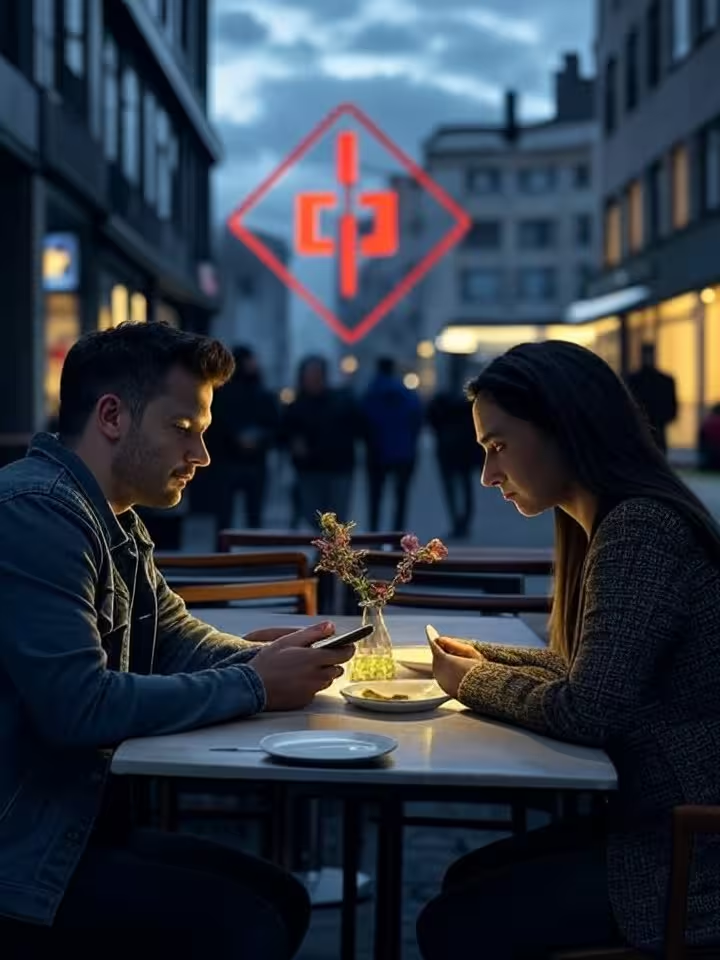
Picture this: you've been chatting on Bumble for days, everything is flowing great, and finally that first date arrives. You sit down at a cafe, order a latte, and suddenly something doesn't add up. It's not that it's a total disaster, but there's one detail that makes you hesitate. The truth is, after hundreds of first dates in my life, I've learned that those subtle signs can save you from months of drama. It's not about being paranoid, it's about listening to your gut and recognizing patterns that, believe me, repeat themselves more than we would like to admit.
Let's chat about those red flags that pop up on first dates, as if we were at a bar sharing stories. Because online dating is an exciting adventure, but no one wants to end up in a nightmare that could have been avoided by paying attention to the right signals from the beginning.
Respect that disappears in seconds
Well, let's start with the basics, which sometimes hurts the most. If on that first date the person is late without warning, or worse, without apology, take a good look. It's not just a matter of punctuality; is an indication of how he values your time and, by extension, you as a person. I remember once at Hinge, I met a guy who showed up 40 minutes late, and his excuse was «crazy traffic» without even a «sorry». In the end, that lack of consideration was repeated in everything: unanswered messages for days, plans cancelled at the last minute, empty promises.
And you know what, it's not just the delay. If he interrupts every other time while you're talking, or checks the phone as if he's in an urgent work meeting, there's a red flag waving loudly there. It's as if he's saying «you're not my priority, not even during these two hours I supposedly set aside to get to know you.».
On the other hand, respect goes beyond nice words in the chat room. OkCupid. Sometimes it manifests itself in how he treats others, especially those in a position of service. Watch how he talks to the waiter at that dinner you hosted. If he's rude, demanding or condescending, imagine how he'll treat you when the novelty wears off and he's not trying to impress you.
The truth is that these things don't change overnight; they are ingrained patterns of behavior. I confess that I ignored this once and ended up in a relationship where customer service drama was constant, where any interaction with a stranger became an unnecessary conflict. What a mistake not to have paid attention to that first sign.
Also, pay attention to how they react when things don't go according to plan. If the restaurant is full and you have to wait, or they get the order wrong, do they lose their composure completely? Flexibility in the face of everyday setbacks says a lot about how they will handle more serious challenges in a relationship. No one is perfect, of course, but there is a difference between momentary frustration and blowing things out of proportion.
Control signs starting soft
Look, control doesn't always come in shouting; it often sneaks in in comments that seem innocent or even «concerned.» For example, if on the first date he's already criticizing your clothes or suggesting you change something about your style, stop for a second. It's not constructive feedback; it's an attempt to mold you to their vision. I've seen this on apps like Happn, where people connect quickly out of proximity, but then in person that possessive side that was hidden behind seemingly charming messages comes out.
Or when they ask too many questions about your exes or your daily routine, not as a healthy curiosity to get to know you better, but as if they were collecting data for a surveillance file. Here's the interesting part: if you feel like you're being interrogated more than conversed with, if every question seems designed to elicit control information rather than genuine connection, that's a clear sign.
Mind you, don't confuse genuine interest with calculated invasion. There is a fine, but perceptible line. Real interest feels warm and reciprocal; invasion feels like a one-way interrogation. But if they insist on knowing where you are all the time, or make jokes about «checking in» on your social life that don't really sound like jokes, run.

In my experience, this escalated in one date that came up from Meetic to invasive questions about my friends of the opposite sex, and it wasn't cute «I like you so much I get nervous» jealousy, it was something darker and more calculated. Notice also how they react if you disagree with them on something, even something minor like what movie to see or where to have dinner. If they get defensive, try to manipulate the conversation to get you to «admit» they were right, or simply can't tolerate a different opinion, there you have valuable information.
Once, a Badoo match casually told me that he «hated it when women went out alone at night, for their safety, of course.» Giant red flag disguised as chivalry. What no one tells you is that these behaviors tend to get exponentially worse over time, so better to catch them early when you can still walk away without complications.
I have to admit that at first I saw it as «intensity» or «passion», I thought it was a sign of how much you cared. But now I know it's control in disguise, and the difference between healthy intensity and toxic control is that the former respects your autonomy while the latter tries to limit it.
Basic respect from minute one
Punctuality, politeness and genuine attention are not optional extras on a first date, they are the bare minimum. If someone can't show you basic consideration when they're trying to impress you, imagine when they're no longer trying. Watch how he treats waiters, how he handles minor mishaps, and whether he actually listens to you when you speak or just waits his turn to talk.
Disguised controlling behaviors
Control rarely comes with a clear label. It starts with «well-meaning» criticisms of your appearance, invasive questions about your past or present, or an inability to tolerate disagreement on minor issues. If on the first date someone is already suggesting changes in your life, overly evaluating your decisions, or showing jealousy of your friendships, it's not romantic intensity: it's a red flag of control.
Lack of reciprocal energy
A first date should feel like a balanced exchange of energy and interest. If the conversation is a monologue on their part or a one-way interrogation, if they avoid eye contact or seem constantly distracted, if they don't ask questions about you or respond with monosyllables, the chemistry just isn't there. And it's okay to acknowledge that early on rather than forcing something that doesn't flow naturally.
Lack of interest: when chemistry is only in the app
Now, let's move on to something that frustrates many: that disconcerting disconnect between chat and reality. You've been sending funny messages on Tinder for days, laughing at memes, sharing stories, feeling like you really connect... and on the face-to-face date, nothing. The awkward silence. The curt responses. The flat energy.
If the person doesn't ask questions about you, or responds with disinterested monosyllables, it's a clear red flag. It's not shyness all the time; sometimes it's disinterest pure and simple, or worse, they're there out of commitment because canceling seemed rude to them. Honestly, I've been on dates where the other person seemed more interested in their plate of pasta than in the conversation, and that hurts, but it's a valuable sign to not invest any more time or emotional energy.
Between us, the app fatigue can work against you. Many people go out on dates when they're already burned out from the process, with no real energy to meet someone new. But if they avoid eye contact, seem constantly distracted, or give the impression that they're thinking about the next swipe even while sitting across from you, don't ignore it. That's valuable information about how present they can be in a relationship with you.
I remember that time I was helping a friend with his Grindr profile, and he told me about a date where the guy came in and only talked about himself for an hour and a half. Total monologue about his work, his accomplishments, his problems, without a single question about my friend. The truth is that a date should be a balanced exchange, not a narcissistic soliloquy where you are simply the audience.
On the other hand, if they cancel at the last minute without a good reason, or reschedule several times with ever more elaborate excuses, it could be benchingThey have you on the sidelines while they explore other options they consider more promising. Still, not everyone is like this, but catching it early saves weeks of false hope and wasted emotional availability.
And the body speaks louder than words. If their body language screams «I'm uncomfortable and want to leave,» such as arms crossed defensively, feet pointing toward the exit, or body constantly turned away from yours, make a mental note. The trick is not to force chemistry when it clearly doesn't exist. If it doesn't flow naturally, better to save both of you time and keep swiping in search of someone you really connect with.
Honesty under the microscope
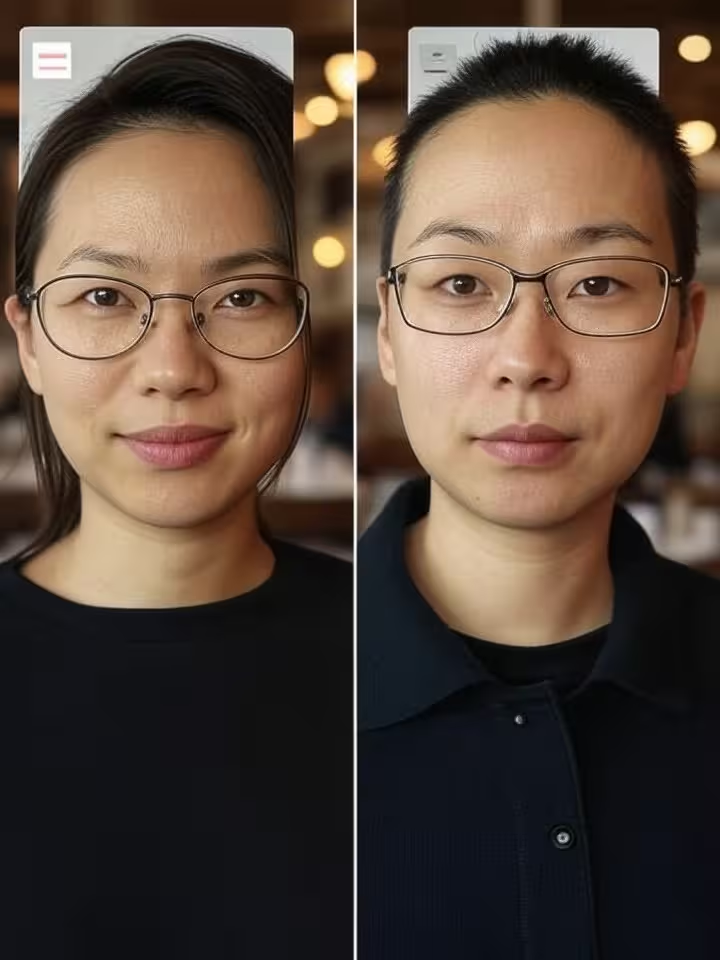
That said, let's talk about lies, which in online dating are unfortunately like bread and butter. If on the first date you discover that they look nothing like their profile pictures - I'm not talking about a flattering angle or a slight filter, but rather a catfish total with photos from a decade ago or directly from someone else - that's a huge red flag waving violently.
I've experienced the unpleasant shock on a date that came out of Plenty of Fish, where the guy was literally 10 years older than his profile said he was, with such a noticeable physical difference that he looked like someone else. It's not superficial vanity; is basic deception about fundamental information, and if they lie about this, what else will they lie about?
Also, if their stories don't add up-such as changing important details about their job, their living situation, or aspects of their life between the chat and the date-seriously ask yourself why they need to lie. Small inconsistencies may seem trivial individually, but added together they paint a disturbing pattern of dishonesty.
Note that the scammers and manipulators are often masters at this, promising the world but systematically avoiding verifiable personal details. On apps like eDarling, which are supposed to be geared toward serious relationships, I've seen profiles that sound absolutely perfect until in person the uncomfortable truth comes out. A friend of mine almost fell into a romance scam because the guy was constantly avoiding video calls with elaborate excuses; thank goodness he made a reverse image search of her photos and discovered that they were stolen from a European model.
Even pay attention if they systematically badmouth all their exes, painting them as absolute villains without ever admitting their own responsibility for the problems. It could be pure projection. No one is always the innocent victim in all their past relationships; if they can't acknowledge any mistakes of their own, they probably won't do it with you when conflicts arise either.
At the end of the day, honesty builds trust, which is the foundation of any functional relationship. Without it, why invest time and emotion in something built on lies that will eventually fall apart? It's better to catch dishonesty early, on that first date, than to discover it months later when you're already emotionally invested.
What to do when you detect a red flag?
Well, so far we've talked about identifying the signs, but what do you do when you see them? First, trust your gut. If something feels strange, even if you can't articulate exactly what, that feeling has value. Your instincts have evolved over millennia to detect threats and unsafe situations, so don't dismiss them as «paranoia» just because the other person seems charming in other ways.
You don't need a full list of evidence to decide that someone is not for you. One or two serious red flags are enough to decide that someone is end the date with elegance and move on. And if you see multiple red flags, definitely don't ignore the pattern in the hopes that «they'll get better with time» or that «they were having a bad day.».
Honestly, I've made the mistake of rationalizing problematic behaviors too many times. «Maybe he's shy and that's why he seems disinterested.» «Maybe he had bad experiences that explain his jealousy.» «He was probably just nervous and that's why he was rude to the waiter.» But the reality is that people show you who they are, especially in those first few encounters when they are trying to make a good impression.
If someone exhibits problematic behaviors when they are actively trying to impress you, imagine what they will be like when they get comfortable and stop trying. Here's the trick that no one mentions: it's not your job to «fix» anyone or give them the benefit of the doubt infinitely. Your job is to protect your emotional well-being and consciously choose who you invest your time in.
Also, communicate your boundaries clearly if you decide to give her a chance despite a minor yellow flag. «It makes me uncomfortable when you constantly check your phone during our conversation.» «I'd rather get to know each other better before sharing such personal details.» Their reaction to those reasonable boundaries will tell you all you need to know. Do they respect them? Do they apologize and adjust their behavior? Or do they get defensive, accuse you of being «too sensitive,» or simply ignore what you said?
Protecting yourself: the practical side of first dates
I confess that, with all this, the most important thing is always your physical and emotional safety. Always choose public places for that first date, preferably places you know and where you feel comfortable. A busy cafe, a park during the day, a popular restaurant. Never, ever go to someone's house or invite them to yours on the first date, no matter how well you have connected on the app.
Share your real-time location with a trusted friend. Many messaging apps like WhatsApp make this easy to do. Tell someone where you will be, with whom, and what time you expect to be back. Set up a scheduled check-in: a message or call at a certain time to confirm that all is well.
And if something feels deeply wrong during the date-your gut screams danger, you see aggressive behavior, you feel threatened in any way-leave immediately. It's not drama or overkill; it's common sense and self-preservation. You have every right to end a date at any time for any reason. You don't owe anyone your time or your company if you don't feel safe or comfortable.
At its core, online dating can be amazing and has successfully connected millions of people, but ignoring red flags leaves you vulnerable to situations that range from simply wasting time to genuinely damaging relationships. I've seen it happen in situations where a Feeld match started pushing for physical intimacy too soon-another clear sign that they don't respect your boundaries or your personal rhythm.
Also keep in mind the signs of false profiles and scams that can manifest themselves even in person. If the story they told you on the app doesn't match what they say on the date, if they avoid answering direct questions about their life, or if they quickly try to move the conversation to financial topics, be on your guard.
The balance between caution and openness
Yes, you have to balance the necessary caution with genuine openness. It's not about going into every date assuming the worst about the other person or obsessively looking for problems where there are none. That would be exhausting and counterproductive, turning dating into a paranoid exercise instead of the potentially exciting experience it can be.
The key is to observe without judging prematurely, to notice patterns without jumping to conclusions based on a single moment. We all have rough days, we all make occasional social mistakes, we can all be nervous on a first date and not present our best self. The difference is in consistent patterns versus isolated moments.
If someone is five minutes late but sincerely apologizes and explains, that's different from being 40 minutes late without warning or apology. If someone casually mentions a different detail about their work than what they said before, it could just be bad memory; but if multiple important aspects of their story constantly change, that's a troubling pattern.
Also, remember that not all red flags carry the same weight. Some are signs of incompatibility rather than character problems. If someone wants to an immediate serious relationship and you want something casual, that is a clear incompatibility but does not mean that either is «wrong». Instead, controlling behaviors, disrespect, or dishonesty are universal red flags that transcend personal preferences.
Green signals that balance the equation
On the other hand, while you're watching for red flags, it's also worth recognizing the green signals that indicate someone might be a good fit. Green flags are just as important as red flags. If someone actively listens, asks genuine questions about you, respects your boundaries when you express them, treats others well, handles setbacks with grace, and shows consistency between what they say and what they do, those are excellent signs.
If they can laugh at themselves, admit when they are wrong, and show appropriate vulnerability without excessive emotional dumping, you are seeing real emotional maturity. If they talk about their exes with respect or at least neutrality, acknowledging their own part in why things didn't work out, that shows valuable self-awareness.
Look for these positive signs with the same attention you pay to the negative ones. Dating should not only be about eliminating the bad, but also about actively recognizing the good when it appears in front of you.
Learning from past red flags
One of the most valuable things you can do is to reflect honestly on your past dating experiences. What red flags did you ignore in past relationships that ended badly? What patterns repeat themselves in the people you choose? Sometimes, we break problematic patterns only when we consciously recognize them.
Keep a mental or actual diary of your appointments. Not obsessively, but noting what worked, what didn't, and especially what early signs predicted later problems. Over time, you will hone your internal radar to detect incompatibilities and red flags earlier and earlier in the process.
And forgive yourself for the times you ignored the signs. We've all done it. Hope, desire for connection, loneliness, natural optimism, all of these can cloud our judgment temporarily. The important thing is to learn and adjust for next time, not eternally punish yourself for past errors in judgment.
Inconsistencies and lies from the outset
Honesty is the foundation of any healthy relationship. If you find that their photos don't reflect reality, that important details of their life change between chatting and dating, or that they consistently evade direct questions with vague answers, you're looking at fundamental dishonesty. Small lies about age, appearance or life situation predict bigger lies in the future.
Trust your gut instinct
Your intuition has evolved over millennia to detect threats and problematic situations. If something feels strange, uncomfortable or just «off» during the date, even if you can't articulate exactly what, that feeling has real value. Don't dismiss it as paranoia or exaggeration. Your gut picks up subtle signals that your conscious mind is still processing, especially in dating situations where emotional and physical safety is at stake.
Conclusion: first dates as a filter, not as a commitment.
To close this long but necessary talk, remember that first appointments are essentially tests, not commitments. These are opportunities to gather information about another person and assess compatibility, not binding contracts that require elaborate justification to terminate. You've invested valuable time in apps like Match, Bumble, Happn or Inner Circle by creating your profile and chatting, so don't waste any more time with someone waving red flags from the start.
Every red flag detected early is time, emotional energy and potential pain saved. You don't need to give «one more chance» to someone who has already shown disrespect, controlling behavior, obvious disinterest or fundamental dishonesty. Those things rarely get better; they usually get worse once the person feels secure in the relationship and stops striving to impress.
Move forward with confidence, adjust your approach based on what you learn from each experience, and you'll find that real, healthy connections appear when you refuse to settle for less than you deserve. In the end, online dating is a skill that develops with practice and self-knowledge, and spotting these early signs is an essential part of mastering it.
Ready for your next date? Go with open eyes, honed instincts, and a willingness to walk away from situations that don't serve you. Your ideal person is out there, but first you have to effectively filter out the ones who are definitely not. And now you have the tools to do it.
You don't need a whole list of red flags to decide that someone is not for you. A single serious red flag related to safety, respect or honesty is enough to politely end the date. If you see aggressive behavior, obvious manipulation, total disrespect, or feel genuinely uncomfortable or threatened, trust your instincts and end the date immediately. You don't owe anyone your time or company if the situation feels wrong. Two or three minor red flags that add up to a pattern are also reason enough not to move forward.
Nervousness manifests as innocent awkwardness, talking too fast, or laughing nervously, but respects your boundaries when you express them. Controlling behavior, even if it masquerades as «concern,» ignores your boundaries, pushes when you say no, or tries to direct your decisions about your appearance, your plans, or your relationships. The key is how they react when you set a clear boundary: someone nervous will respect it and apologize; someone controlling will get defensive, minimize it, or insist that «it's for your own good.» Also, nervousness decreases as the date progresses and you both relax; control tends to intensify.
It depends on the context and the reaction. Arriving 5-10 minutes late with a quick message explaining and a genuine apology upon arrival is not necessarily a red flag, it happens. But being more than 20-30 minutes late without warning, or warning only when they should have already arrived, and especially without a sincere apology, is a sign of disrespect for your time. It shows that they didn't consider you important enough to give you advance notice or plan better. If they also minimize your legitimate annoyance or make elaborate excuses without taking responsibility, it's definitely a red flag about how they will value your time in the future.
A major lie about age, marital status, employment or living situation is a massive red flag that warrants ending the appointment immediately. You can be direct but polite: «I just realized you gave me incorrect information about [topic], and that makes me uncomfortable to continue. I'm going to go, but have a good day.» You don't need lengthy explanations or dramatic confrontation. If you find out they are married or in a relationship when they said they were single, especially end it immediately, as continuing it makes you unknowingly complicit in infidelity. Fundamental dishonesty in basic things only gets worse in deeper relationships, so protect yourself by getting out of the situation quickly.
It's not normal or acceptable to constantly check your phone during a first date, and you should definitely be concerned. A quick glance once or twice is fine, especially if they mention they're waiting for something important, but scrolling through social media, responding to multiple messages, or basically using the phone as if they're alone shows disrespect and fundamental disinterest. Communicate how it makes you feel: if they don't change the behavior or get defensive about their «right» to use the phone, it confirms that they don't value you enough. Someone genuinely interested in getting to know you will be present in the conversation, not dividing their attention between you and their screen. It's a clear red flag that they won't be an attentive partner in a relationship.