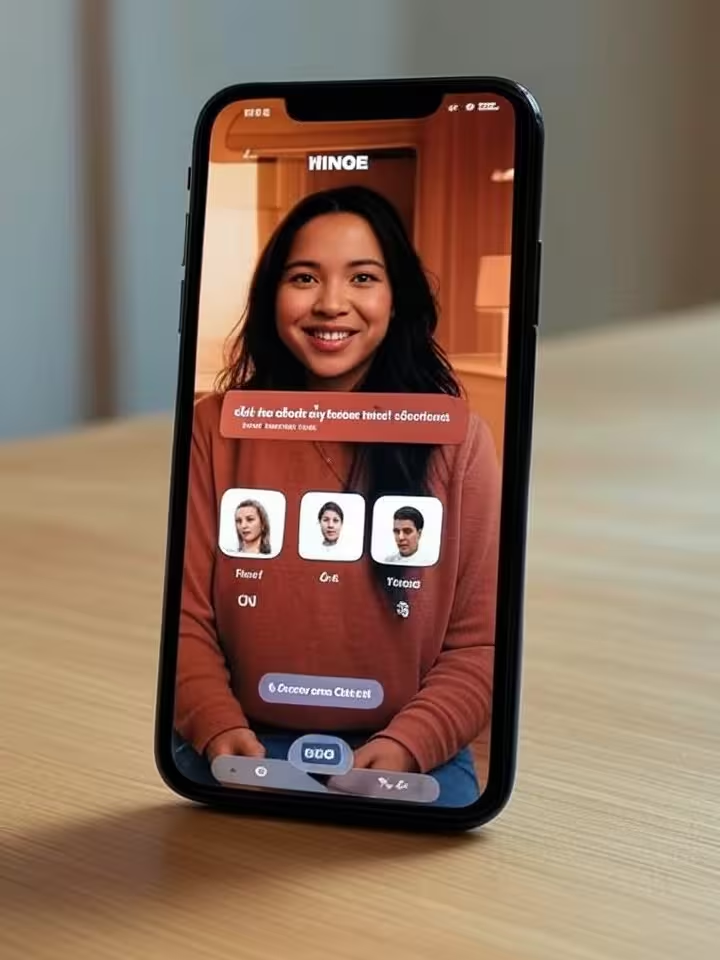
The other night, while checking my Hinge profile for the umpteenth time, I realized something that has saved me more than once in the world of online dating. It's not just uploading pretty pictures or swiping left and right; it's how you respond to those prompts that really makes someone stop and think «this person might be worth it.». I'm telling you this because I've been there, testing since I was a kid. optimize photos in different apps until you understand what makes a profile stand out, and Hinge has always stood out for one specific reason: it forces you to show authentic bits of your personality from the get-go.
The difference with other platforms is substantial. While in more visual apps you can hide behind flawless photos, Hinge puts you in front of the mirror of your words. And that, believe me, can be your biggest advantage or your worst enemy.
Why do Hinge prompts change the rules of the game?
See, on apps like Bumble or OkCupid, you can type a long bio and spout off whatever comes to mind, but Hinge is different. It gives you these pre-designed prompts, like «My biggest fear of missing out is...» or «The way to my heart is...», and you have to answer them creatively. It's like the app is saying, «Hey, don't tell me your whole life, just give me bits and pieces that show who you are.».
The truth is that this format significantly reduces ghosting and dead conversations, because if you respond well, you generate real connection points from the match. I've seen profiles that seem generic and others that make you laugh or think, and guess which ones get more likes. I myself have ignored matches just because their responses were flat as a desert. A well-crafted prompt is the difference between being just another swipe or turning into a memorable conversation.
Here's the catch: Hinge is designed to be deleted, and their prompts are a fundamental part of that philosophy. They don't want you to accumulate infinite matches, but to find worthwhile connections. That's why every prompt should work in your favor as a natural opener.
On the other hand, not all prompts work the same for everyone. Some are light-hearted, ideal for breaking the ice with humor, while others allow you to delve deeper into values or anecdotes that reveal your personality. Here's the interesting part: choose based on what you want to attract. If you're looking for casual, go for playful; if it's deep connection, opt for thought-provoking.
In my years of experience helping people improve their profiles, I have seen radical transformations simply by changing the prompts chosen. Suddenly, boom, more quality matches. It's not magic, it's strategy applied with intention. The key is to understand that each prompt is a window to your world, and you decide which part of that world you want to show first.
The anatomy of a perfect prompt for Hinge
Well, let's start at the beginning: do not copy prompts from the internet without thinking. I remember when a friend of mine, fed up with app fatigue that didn't generate results, asked me for specific advice for Hinge. I told him to look at the prompts available and choose three that would allow him to tell real stories from his life, not aspirational fictions.
For example, instead of a generic one like «My superpower is...», which may sound cliché and repeated in a thousand profiles, go for «A random story about me» if you have funny anecdotes to tell. The truth is that this prevents kittenfishing, that subtle deception where you exaggerate a little to impress. Be honest, because in the end, when the time comes for the first date, everything comes to light anyway.
And you know what, it varies depending on your style and goals. I have to admit that I have tried different combinations and the results change drastically.
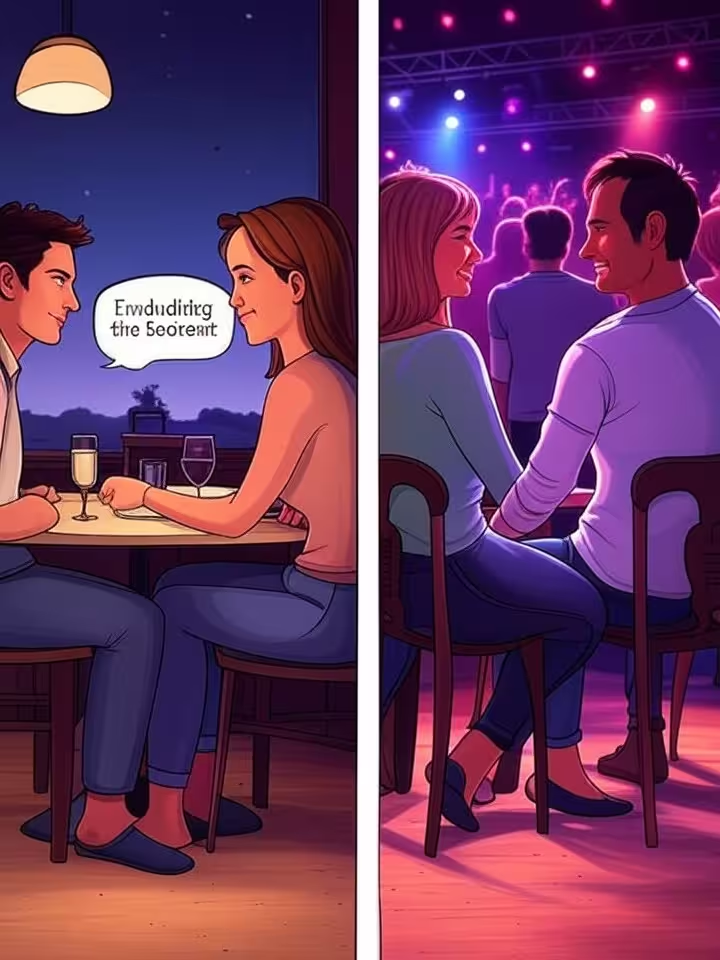
If you prefer something more intellectual or are looking for conversations with substance, prompts like «What I value most in a relationship» can open doors to deep discussions from the very first message. But if you are more playful and your style is lighthearted, «My guilty pleasure» is pure gold for generating laughter and complicity.
I confess I once responded to «Worst roommate I've ever had» with a crazy story from my college involving an ownerless cat and burnt pasta at 3 AM, and that generated more funny openers than any picture of me on the beach with perfect sunset. The trick is to balance: a light one, a personal one and one that shows your vulnerable side without sounding desperate.
This way, you don't fall into the trap of sounding like all the other profiles that repeat the same thing about loving to travel, artisanal coffee and Netflix series. The difference between a forgettable profile and a memorable one is in the specific details that only you can provide.
The ideal length formula
Notice how you respond: keep it concise, between 50 and 150 words per prompt. No one wants to read an essay on a dating app when they're swiping from the subway or waiting for coffee. What no one tells you is that prompts are like conversation hooks; if you respond with something that invites questions or comments, you generate chemistry from the first exchange.
For example, something like «I always wanted to learn to surf, but my biggest failure was falling on the first wave in front of a group of teenagers who were mastering it» naturally invites someone to share their own awkward experience or ask if you tried again. That generates chemistry from the chat, avoiding that dreaded slow fade where conversations simply fade out for no apparent reason.
The most effective Hinge prompts (and how to use them)
Honestly, the most important thing is to inject genuine humor or unfiltered authenticity. Take a common prompt that appears in many profiles: «Together, we could...». Instead of saying something boring like «watch Netflix and order food,» say something like «build the most epic blanket fort and passionately debate why bad movies are actually the best until dawn.».
That shows creativity, a sense of humor and opens the door to shared laughter from the first message. I've tried this on my own profiles and, wow, the difference is huge. Just between us, I once had a match respond to something similar and we ended up on an impromptu indie movie date that would never have happened with a generic «I like to travel».

Think of green flags that you want to communicate without explicitly stating them. The best prompts show, not tell.
Prompt: «My mantra is...»
However, incorporates specific details of your life to avoid sounding generic or like an office motivational poster. If the prompt is «My mantra is...», don't say «live and let live» or «carpe diem»; rather, «As my grandmother says, ‘if you don't risk, you don't win’, and that's why I took the plunge and moved to another city just on a whim two years ago.».
This is not only relatable and specific, but also avoid red flags as to appear superficial or excessively generic. Yet, at the same time, take care of security: don't reveal personal details such as your exact address, place of work or predictable daily routines. Maintain enough mystery to preserve your privacy while sharing your essence.
Prompt: «The most irrational thing I fear».»
On the other hand, play with the language and structure of your answers. Mix short, punchy sentences with others that flow more naturally. For example, in «The most irrational thing I fear»: «Spiders. Not the big ones, but the tiny ones that appear out of nowhere. They completely paralyze me.».
Short and to the point. Or you can stretch a little further, «I secretly fear I won't find someone who understands my obsession with true crime podcasts at 2 AM, because who wants a couple who would rather listen to unsolved mystery stories than a traditional romantic dinner?» Here, you reveal a little of your particular world without overwhelming, You also provide a perfect hook for someone to respond with their own weird obsessions.
I have to admit that responses like this have helped me filter out matches that clearly wouldn't be a good fit for me, significantly reducing the burnout of failed dates and conversations that lead nowhere.

Prompt: «Together, we could...»
This one is perfect for showing off your adventurous side or your shareable interests. Avoid passive responses like «relax» or «have a good time». Instead, be specific: «explore every hidden taqueria in town until we find the perfect taco» or «create an epic playlist for a roadtrip we never planned but ended up taking». This communicates energy, initiative and gives concrete ideas for future dates.
Prompt: «A random story about me».»
The truth is that this is one of the most underutilized but potentially most powerful. Here you can tell something genuinely unique that no other profile will have. Think of embarrassing but funny anecdotes, moments of serendipity or stories that reveal your personality in unexpected ways.
For example: «Once in Japan I ended up in an impromptu karaoke with strangers singing Bohemian Rhapsody in three different languages. It was chaotic, beautiful, and now it's my compatibility test: do you join in the spontaneous karaoke or are you team watching from afar?» This not only entertains, but raises an implicit question about lifestyle and personality.
Deadly mistakes that ruin your Hinge prompts
The truth is that many fall into obvious traps that sabotage their profiles without realizing it. A big one: being negative or complaining in your answers. No prompts like «My least favorite thing about dating is...» answered with bitter complaints about ghosting, breadcrumbing or fake profiles.
That instantly scares people away, even if they have similar experiences. I remember when I edited the profile of a reader who complained about «men who don't respond after the second message,» and we changed it to something empowering about what she's looking for in real connections; her quality matches went through the roof in a matter of days.
Avoid that at all costs. Online dating has enough cynicism; your profile should be an oasis of possibility.
The curriculum syndrome
That said, do not use prompts to list qualities as in a resume. «I'm loyal, fun, adventurous and honest» sounds like a cliché copied from a thousand profiles before yours. Better, show, don't tell. Instead of saying «I'm adventurous,» tell about that time you got lost in a foreign city and it ended up being the best experience of the trip.
Another fatal mistake: ignoring spelling or using emojis excessively. A well-written prompt, without obvious errors, says a lot about your attention to detail and the effort you put into making a good impression. And notice that, deep down, if you answer all your prompts with the same tone and energy, your profile feels flat and monotonous, like those matches that promise a lot but fade away in conversation.
The copy-paste trap
Don't copy and paste answers you saw on other profiles or in «best Hinge prompts» articles. Authenticity is noticeable, and so is falseness. People have pretty finely tuned radars to detect when something sounds rehearsed or stolen. Your goal is not to have the «right» answers, but the right answers for you, the ones that will attract people who are compatible with who you really are.
Even try rotating prompts every month or every other month to refresh your profile. If you feel that your match rate drops or that you're attracting the wrong kind of people, check and adjust. I confess that I do this regularly, and I always find ways to improve, such as adding a touch of authentic vulnerability without overdoing it, avoiding falling into patterns of love bombing that some mistake for passionate sincerity.
Strategic Prompts Revealing Compatibility
Hinge's best prompts not only entertain, they function as natural compatibility filters. By choosing responses that genuinely reflect your values, interests and lifestyle, you attract matches that resonate with who you really are. This dramatically reduces time wasted on conversations that go nowhere and increases the likelihood of meaningful connections from the first message.
Responses that generate natural openers
A well-constructed prompt does the heavy lifting for you, providing obvious hooks for someone to initiate conversation. Instead of leaving your match wondering what to say, your responses should plant seeds of curiosity or points of connection that invite natural questions. This is especially crucial in Hinge, where commenting on specific prompts is the primary way to break the ice, differentiating it from apps based purely on swipes.
Strategic prompts update
Rotating your prompts every 4-6 weeks keeps your profile fresh in the Hinge algorithm and allows you to experiment with different aspects of your personality. What worked three months ago may not resonate now, or perhaps you've developed new interests that deserve to be highlighted. This ongoing optimization strategy is key to maintaining a healthy match rate and avoiding the fatigue of always seeing the same disappointing results.
How to test and optimize your Hinge prompts
Here's the secret that many overlook: your Hinge profile is an ongoing experiment, not a «set and forget» configuration. You need to measure what works and what doesn't, and adjust accordingly. It's not about becoming a dating data scientist, but it is about paying attention to basic patterns.
First, look at which prompts get the most comments or roses. If your prompt about your mantra consistently receives messages while your response to «Together, we could...» is ignored, that tells you something. Hinge's algorithm also favors profiles that generate engagement, so responses that inspire comments not only help you individually with each match, but potentially improve your overall visibility.
Second, test different response styles for the same prompt. For example, if you use «The way to my heart is...», try first with humor («cheese. Lots of cheese. In all its forms»), then with something more emotional («deep midnight conversations about things that matter»). Give each version a few weeks and see which one attracts the most matches of the type you're looking for.
Also, consider asking for honest feedback from close friends, especially those who know online dating well. Sometimes we're too close to our own words to see how they really sound. An objective friend can point out if something sounds pretentious when you were trying to be profound, or if your self-critical mood is crossing the line into low self-esteem.
Hinge Prompts for different dating targets
Not everyone in Hinge is looking for the same thing, and your selection of prompts should reflect your intentions. The beauty of the system is that you can subtly communicate what kind of connection you're looking for without having to explicitly write it out in big letters.
For serious relationships and deep connection
If you are looking for something lasting, focus on prompts that reveal values, vision and emotional depth. Good examples include «What I value most in a relationship,» «My simple life goal is...» or «The best advice I've ever received.» Your answers here should be sincere and show emotional maturity without sounding like you are interviewing for marriage in the first prompt.
For example: «What I value most in a relationship: Honest communication, even when it's uncomfortable. Trust is built in those awkward moments where you decide to be vulnerable instead of shutting down.te. This type of response attracts people who also value emotional depth. without driving away with premature intensity.
For casual hookups with a good vibe
If your target is more casual, opt for playful, spontaneous prompts focused on shared experiences. «Together, we could...», «My guilty pleasure» or «I've been known to...» work well. Keep the tone light, fun and focused on the present rather than the distant future.
Example: «Together, we could: find the best rooftop bar in town to watch the sunset, decide we prefer the one downstairs because it has better music, and end up improvising completely different plans». This communicates spontaneity, flexibility and focus on enjoying the moment without pressure of «where this is going.».
To find compatibility in specific interests
If you have particular hobbies, passions or lifestyles that are important to you, use prompts that unapologetically highlight them. «Total geek with...», «A random fact about me» or «Don't judge me for...» allow you to showcase those quirks that make you unique.
This is especially useful if you have niche interests that could be deal-breakers or deal-makers. For example, if you're vegan and it's important to you, «The way to my heart is: any restaurant that has more than one vegan option other than salad» communicates this humorously but clearly. You'll quickly filter out those who find this problematic and attract those who share or respect it.
The psychology behind Hinge's effective prompts
Understanding why certain prompts work best helps you create more strategic responses. It's not just a matter of being funny or interesting; there's attraction psychology at play.
Prompts that invoke specific emotions (laughter, nostalgia, curiosity, intrigue) generate much more engagement than purely informative ones. A response that makes you laugh is more likely to receive a comment than one that simply lists facts about you.
In addition, specificity generates connection. This is supported by research on relationship psychology and bonding. When you say something specific and particular, you give people multiple anchor points to connect. «I love music» is generic; «I have a different playlist for every mood, including one specifically for rainy Sundays that I can't explain» is memorable and relatable.
Also, showing appropriate vulnerability increases attraction. This does not mean trauma-dumping at a prompt, but being human and imperfect. Admitting silly fears, funny failures or minor insecurities makes you approachable and authentic, which is infinitely more attractive than polished perfection.
Take the next step with your Hinge prompts
At the end of the day, Hinge's perfect prompts do not exist in a vacuum; they are perfect because. authentically reflect who you are and magnetize people who are compatible with you. I've spent years helping people optimize their profiles on all kinds of platforms, and Hinge has consistently seemed to me to best reward genuine effort in showing real personality.
Remember that online dating is fundamentally a skill that you improve with practice and reflection. With well-crafted prompts, you reduce that dreaded paradox of choice, cut through the noise of generic profiles and find matches that are truly worth your time and energy. It's not about manipulating or presenting a false version of yourself, but about learning to effectively communicate your essence in the unique format that Hinge provides.
Test, err, adjust. See what resonates and what falls flat. Ask for feedback. Rotate your prompts when you feel you need a refresh. And above all, keep authenticity at the core of everything you write. The best connections come when someone falls in love with who you really are, not the edited version you thought they wanted to see.
Follow through with these principles, and who knows, maybe your next match is exactly the person you've been looking for., someone who read your prompt about your obsession with tacos or your irrational fear of birds and thought «I need to meet this person». That's what makes Hinge work when you do it right. Now go and create those prompts that truly represent you.
Change one or two prompts at a time, not all at once. This allows you to identify which specific changes improve your match rate and which ones don't work. If you change all three simultaneously and your results improve or worsen, you won't know which prompt was responsible. Give each change at least two weeks to gather enough data before making the next adjustment. This A/B testing strategy helps you optimize your profile based on real results, not assumptions.
Mixing styles definitely works better than using one tone in all three prompts. A profile with variety shows different facets of your personality and attracts a wider range of compatible people. The ideal combination is usually: one with light humor that breaks the ice, one that shows values or depth for serious connections, and one that reveals specific interests or passions. If all three prompts are jokes, you could come across as shallow; if all three are deep, you could come across as intimidating. Balance makes you memorable and approachable at the same time.
First, evaluate whether your responses provide natural «hooks» for comments. If you write something closed-ended like «My superpower is being on time,» there's not much to comment on. Rewrite it with specific details or a touch of humor that invites responses: «My superpower is to always be 10 minutes early, which my friends find disturbing but helpful.» Second, check that your photos are at the same level as your prompts; brilliant prompts with mediocre photos will not generate engagement. Third, consider that the problem could be your dealbreakers or demographic filter settings that are limiting your potential audience too much. Give the changes time before getting discouraged.
Not directly. Each app has its own culture and format that requires adaptation. What works in Bumble's free bio may not translate well to Hinge's structured prompts format. That said, you can recycle successful concepts or anecdotes by adapting them to each app's specific format. For example, if a funny story about your cat works well in your Tinder bio, rephrase it to fit a Hinge prompt like «A random story about me.» Think of it like translating between languages: the core message can be the same, but the presentation must conform to the rules and expectations of each platform to maximize its effectiveness.
If you notice consistent patterns in your matches that don't align with what you're looking for, check what messages you're inadvertently sending. For example, if all your prompts are about parties and nightlife but you want something serious, you'll attract people who are looking for casual fun. If you write about wanting «spontaneous flings» but value stability, there's a disconnect. Analyze what kind of comments you get on your prompts; if they're consistently shallow when you're looking for depth, adjust toward more substantive responses. Also ask yourself if you are being authentic or presenting an exaggerated version of yourself that attracts incompatible people. The key is to ensure that what you communicate genuinely reflects who you are and what you want, not what you think «sells best».