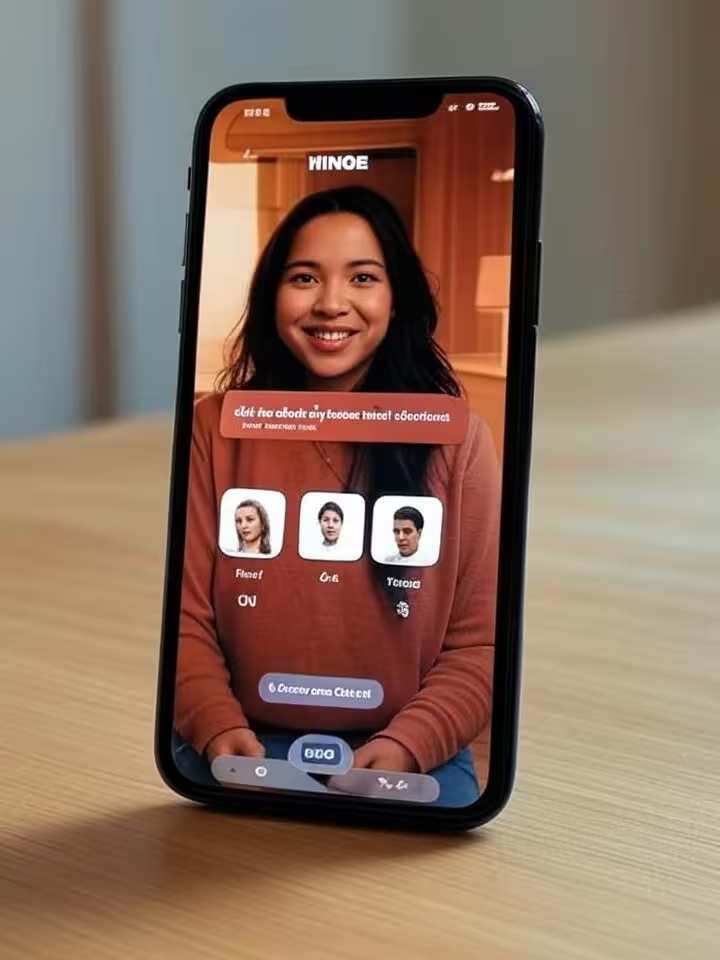
You're scrolling through profiles in your favorite app. Suddenly, your screen shows you not only pretty faces, but compatibilities calculated according to how you communicate, what values you prioritize, even how you handle conflict. Sounds like an episode of Black Mirror, doesn't it? But it's not science fiction. This is already happening right now on several platforms.
After years immersed in this world-testing everything from Tinder to ultra-niche apps like Feeld, analyzing trends, talking to thousands of users-I can tell you one thing with certainty: online dating is living its most transformative moment. And no, I'm not just talking about the fact that there are now more apps. I'm talking about structural changes that will change how we meet people, how we build connection and how we decide who we want to share our life with.
What is to come is not perfect. It will have its controversies, its ethical dilemmas, its frustrating moments. But it also promises to solve real problems we all face: the exhaustion of meaningless swiping, the anxiety of not knowing if someone is who they say they are, that feeling of emptiness after matches that never materialize.

Let's explore this landscape together. Not as futurists peddling smoke and mirrors, but as people who really understand this terrain because they have walked it.
Artificial intelligence will revolutionize matchmaking (and I'm not talking about basic algorithms).
Let's be honest: when we hear «artificial intelligence in dating apps», many of us think of those half-baked algorithms that decide who to show you. The famous ELO score that Tinder popularized, OkCupid's compatibility systems based on your answers to endless questionnaires, or Hinge's suggestions that supposedly learn from your preferences.
But what's coming is another level altogether.
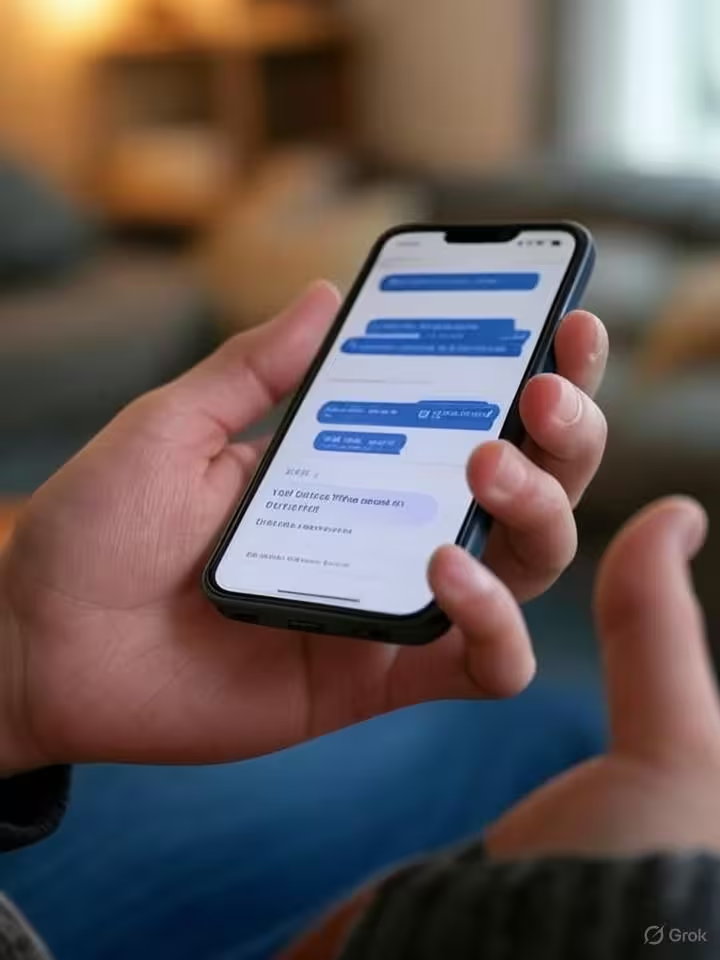
Imagine built-in conversational assistants that analyze your communication patterns. Not to write for you-that would be awful and inauthentic-but to give you useful real-time feedback. «Hey, do you notice that your conversations tend to die when you ask too many questions in a row without sharing about yourself?» Or: «This person seems to really value self-deprecating humor, just like you mentioned in your profile.»
I have beta tested versions of similar features. At first I was repulsed by it, as if I was allowing a machine to intrude on something as intimate as flirting. But then I saw the potential: reducing that dating fatigue We all suffer from weeks or months of conversations that are not moving forward.
The AI of the near future also promises to dramatically improve the detection of fake profiles. I'm not just talking about facial verification-which apps like Bumble already implement-but systems that analyze suspicious behavior patterns: overly generic responses, premature requests to leave the platform, attempts at emotional manipulation. Basically, detecting signs of catfishing before you waste time or money.
But here comes the dilemma that no one wants to mention: to what extent do we want to delegate something as human as romance to algorithms? I've had matches where everything on paper worked-high compatibility according to the app, common interests, similar goals-and on the actual date, zero spark. Nothing. Not even that kind of interesting discomfort that sometimes evolves into attraction.
So what does this mean for the average user? According to experts in psychology of online dating, The key will be to use these tools as a support, not a replacement for instinct. Technology can filter out clearly incompatible options and save valuable time, but the final decision-that «yes, I want to meet this person»-should remain deeply yours.
The problem of the paradox of choice will intensify (or be solved).
Here's the catch: AI could both aggravate and solve one of the biggest problems of modern datingtoo many options.
On the one hand, smarter algorithms could show you infinite «perfect» profiles, feeding that FOMO (fear of missing out) that makes you think «what if there's someone better in the next swipe?» That generates anxiety, indecision, inability to commit to someone because someone more compatible could always appear.
On the other hand, apps of the future could take the opposite path: radical healing. Instead of showing you 50 weekly matches of which none prosper, imagine receiving 3-5 highly personalized connections based on in-depth analyses of personality, values, communication patterns, even your attachment style.
I've experienced something similar with Coffee Meets Bagel, which limits daily matches. I confess that at first I was frustrated-»just this?»-but then I noticed something: paid more attention to each person. I read complete bios, thought of creative openers, invested emotional energy more intelligently.
The future will likely offer both models: «volume» apps for those who enjoy exploring options en masse, and «depth» apps for those who prefer curated connections. The question is: which one works best for you?
Predictive AI
The algorithms will analyze not only what you say you like, but hidden patterns in your behavior: who you really like, how much time you spend reading certain profiles, what kind of conversations you have most of the time. This will allow more accurate predictions about real, not just superficial, compatibility.
Enhanced safety
Real-time scam detection systems, language analysis to identify emotional manipulation, advanced biometric verification and automatic alerts for suspicious behavior. AI will be your digital bodyguard, protecting your emotional and physical safety.
Personalized coaching
Virtual assistants that will help you improve your dating strategy: from optimizing your profile to suggesting better openers based on the personality of your match. They won't write for you, but they will give you the push you need to break out of patterns that don't work.
Virtual reality: when the first date happens in a world that doesn't exist (but feels real)
You know that awful feeling of chatting for weeks with someone, building up huge expectations, and then on the first date finding out that in person it's completely different? Or worse: that there's absolutely no chemistry, and you spend an awkward hour trying to find excuses to leave.
Virtual reality promises to attack exactly that problem.
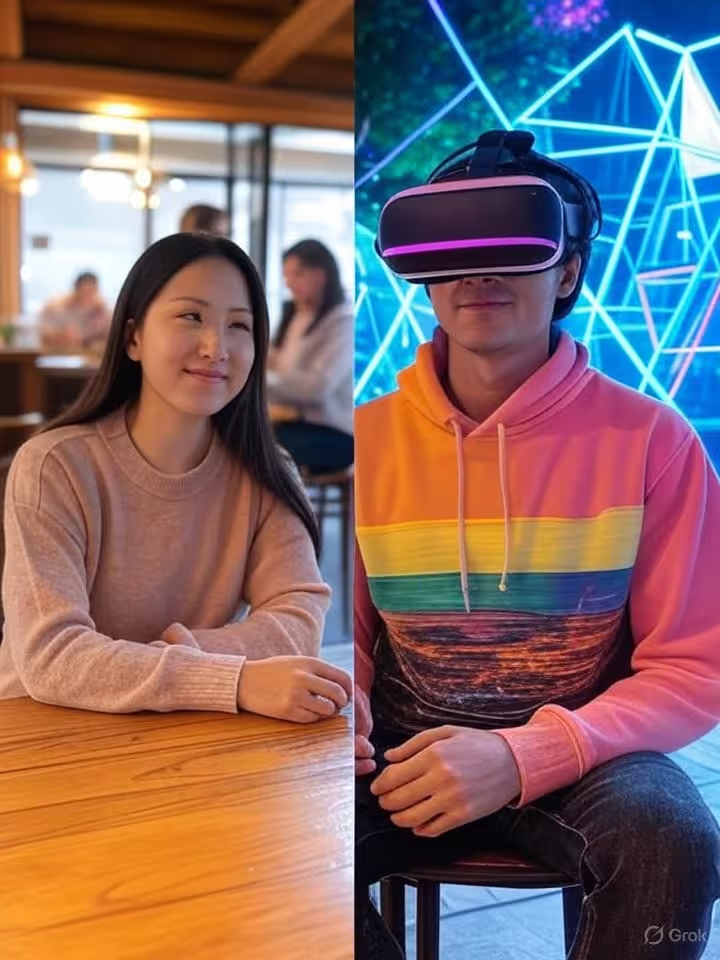
I'm not talking about glorified video calls-those already exist and, let's be honest, are useful but limited. I'm talking about complete immersive experiences where you and your match meet in shared virtual environments: a concert, an art gallery, even a roller coaster. You can interact, react to external stimuli, observe body language (even if it is of avatars).
Platforms like VRChat already experiment with this in a rudimentary way. But imagine dating apps designed specifically for this purpose: optimized environments for intimate conversation, joint activities that reveal compatibility, even the possibility of virtual «touching» (with haptics) to generate simulated physical connection.
I've tested prototypes at technology events. I swear the first time it seemed absurd-»am I really going to wear ridiculous glasses on a date?»-but the experience surprised me. There was something about sharing a virtual space, albeit an artificial one, that generated a different kind of intimacy than a video call.. Perhaps because we were both equally vulnerable in that strange context.
The advantages that no one mentions (and the risks that everyone fears)
For people in rural areas, with limited mobility, or simply in regions where distances make dating difficult-think of many parts of Latin America where going on a date can mean hours of travel-this would change everything. You could have a «real date» with someone 500 kilometers away without leaving your home.
It could also reduce some superficial biases. While avatars would continue to reflect physical appearances, the emphasis would shift toward how you interact, how good a conversation you generate, how you move around in shared spaces. I have seen studies suggesting that VR can reveal aspects of personality that photos would never show.
But here comes the dark side: what happens when the person hides behind an idealized avatar that looks nothing like their real self? We have enough of a problem with kittenfishing (slightly exaggerating your appearance in photos). Imagine that elevated to avatars that can be literally anything.
Moreover, there is a risk that this further fuels avoidance of real intimacy. People becoming addicted to «safe» virtual connections because they don't involve the full vulnerability of physically meeting someone. According to research by psychologists specialized in technology, In this case, the balance will be crucial: use VR as a bridge to real connections, not as a permanent substitute.
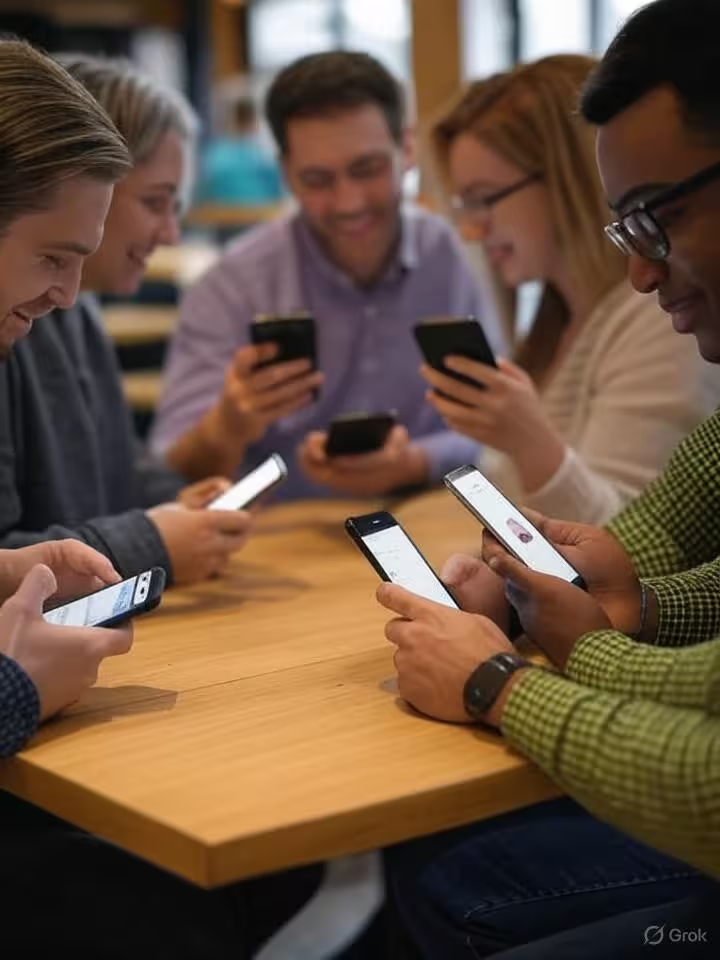
The truth is that this is no longer far-off science fiction. Match Group is exploring metaverse integrations. Niche apps like Flirtual already offer virtual reality dating. And with the advent of more affordable devices-Apple's Vision Pro, Meta Quest enhancements-mass adoption is just a matter of time.
Hyperpersonalization: apps for absolutely every type of person
Look, one of the clearest trends of the future is the extreme market fragmentation. Generalist apps like Tinder or Bumble will no longer suffice. People will demand ultra-specific platforms for their particular needs.
We already see signs of this: Grindr for gay men, Her for LGBTQ+ women, Feeld for polyamorous or unconventional interests, The League for «select» professionals, even apps like Veggly for vegans. But this barely scratches the surface.
Imagine apps for:
- Neurodivergent individuals needing more direct and unambiguous communication
- Fans of specific lifestyles: digital nomads, minimalists, van life enthusiasts, etc.
- Religious or cultural communities with particular values
- People in bereavement or coming out of divorce who need sensitive spaces
- Singles with specific health conditions seeking understanding without judgement
This is not segregation; it is recognize that we all have unique needs and that a one-size-fits-all approach doesn't work. I've talked to users of niche apps and the difference is abysmal: less time wasted filtering out fundamental incompatibilities, more energy devoted to potentially meaningful connections.
The missing cultural regionalization
Here's something I'm passionate about: most apps are designed from an Anglo-Saxon perspective. But dating works completely different according to cultures.
In Spain, for example, dating tends to be more spontaneous and social-dating in groups, meeting in bars. In Mexico, there is a greater emphasis on formal politeness and the process can be slower. In Argentina, deep conversations about politics, philosophy or psychoanalysis are a normal part of the initial flirtation. In Colombia, dance and music are fundamental languages of connection.
The future should bring apps that understand these cultural nuances. Not just translating the interface into Spanish, but designing experiences that respect and facilitate how each culture builds romance. Features such as suggestions for typical dating locations in each region, culturally relevant prompts, even integration with local traditions.
This is just getting started: Badoo has a strong presence in Latin America and Europe with regional adaptations. But there is still a long way to go.
Ultra-specific niches
The future will bring apps for every lifestyle imaginable: from platforms for people with specific diets to communities based on very specific hobbies. This greatly reduces time wasted on fundamental incompatibilities and allows you to focus on meeting people who already share your core values.
Cultural adaptation
Apps will stop being simple translations and start to truly respect the cultural codes of each region. From prompts relevant to Spanish speakers to dating suggestions that make sense in your local context, to understanding that the pace of courtship varies greatly between countries.
Communities, not just matches
Apps will evolve into community spaces where you can participate in events, forums or groups according to your interests. It won't be all about constantly looking for a partner; there will also be options to expand social circles, find friends, or simply belong to a community that understands you.

Security: the issue that will finally be a priority (let's hope)
I'm going to be blunt: dating app safety has historically been a disaster. Catfishing, romance scams, harassment, dating violence... the risks are real and disproportionately affect women and minorities.
The future must-not «should,» but should-prioritize this radically.
We're already seeing steps in the right direction: mandatory photo verification on Bumble and Badoo, location-sharing features on Grindr during dating, integration with emergency services, even the «panic» button that some apps are testing.
But this barely scratches the surface.
Imagine AI systems that detect in real time manipulative language, attempts to cut someone off from the platform too quickly (a common technique of scammers), or behavior patterns typical of predators. Not arbitrary censorship, but intelligent alerts that empower the user with information: «This profile has been reported 5 times for suspicious behavior in the last 3 months.»
We also need integrated education. Discreet pop-ups that teach signs of romance scams, reminders about never sharing financial information, guides on planning safe first dates. This shouldn't be optional; it should be a fundamental part of the experience.
Regulation: it came late but it came
Europe is leading the way with regulations forcing platforms to protect users. GDPR already limits how personal data is handled. Now come specific laws on algorithmic transparency, right to explanation of why you are shown certain profiles, even corporate liability when crimes occur facilitated by platform negligence.
Match Group, which controls Tinder, Hinge, OkCupid and more, already faces mounting pressure. This is a good thing. Companies need to be held accountable.
In Latin America and Spain, the adoption of these regulations will be slower, but inevitable. Users are demanding more protection, and companies that do not adapt will lose market share to more ethical competitors.
The impossible balance: technology versus authenticity
After all this tour of fascinating innovations, we come to the central dilemma that no one solves easily: how do we maintain the humanity of romance in the midst of so much technology?
Because look, you can have the most sophisticated algorithm in the world, hyper-realistic avatars in VR, AI assistants that write perfect openers... but if you lose that real vulnerability that makes the human connection matter, what's the point?
I have seen this in my own experiences. The best matches I had were never the most «perfect» by algorithmic criteria. They were people with whom something inexplicable emerged, a chemistry that no machine could predict. Sometimes it was someone whose bio made me laugh for reasons I didn't even understand. Other times, it was a profile that on paper didn't fit me, but in conversation a shared world opened up.
The future of dating apps will be successful only if it manages to amplify human connection, not replace it. Using technology to eliminate unnecessary friction-verifying that someone is real, filtering out fundamental incompatibilities, facilitating encounters when distance is an obstacle-but without eliminating those moments of uncertainty, vulnerability and risk that make falling in love exciting.
Your role in this future
Here's the part I want you to understand: you have agency on how this develops.
Apps evolve based on how we use them. If we value authenticity, detailed profiles and deep conversations, platforms will reward that. If we stay in the superficiality of infinite swipes based only on physical appearance, that's what they will optimize.
When an app introduces a new feature-say, emotional compatibility analysis using AI-try it critically. Does it really improve your experience or does it just add noise? Give feedback. Companies listen when there's enough of a collective voice.
And crucially: don't let technology disconnect you from your gut. If something feels wrong in a conversation, trust that feeling even if the algorithm says they are 98% compatible. If one virtual date in VR doesn't generate what you expected, don't force a second one just because «in theory it should work.».
The best use of these tools will always be as possibility enhancers, not as directors of your love life.
No, artificial intelligence is designed to enhance the matchmaking process, not replace human connection. The best apps of the future will use AI to eliminate unnecessary friction-such as fake profiles or obvious incompatibilities-but the final decision to connect with someone will remain entirely yours. Technology can suggest more compatible matches or help you improve your conversation strategy, but real chemistry, vulnerability and authenticity can only emerge between people.
They are already starting to appear. Apps like Flirtual offer virtual reality dating right now, and larger platforms like Match Group are exploring integrations with metaverses. With devices like Meta Quest and Apple Vision Pro becoming more accessible, expect mass adoption in the next 2-3 years. However, these experiences will work best as a bridge to real encounters, not as a permanent substitute for physical dating.
The future includes advanced biometric verification, AI systems that detect suspicious behavior patterns in real time, automatic alerts on profiles reported multiple times, integration with emergency services, location-sharing features during appointments, and built-in education on signs of scams and manipulation. There will also be more legal regulations forcing platforms to actively protect their users, similar to what is already happening in Europe.
Yes, the clear trend is towards hyper-personalization. There are already niche apps for LGBTQ+ communities, vegans, professionals, polyamorous people and more. The future will bring ultra-specific platforms for virtually any lifestyle, values or interests: from neurodivergent people to digital nomads to religious or culturally specific communities. This reduces time wasted on fundamental incompatibilities and enables more meaningful connections from the start.
It can improve predictions significantly, but it is not infallible. Advanced algorithms will analyze not only what you say you want, but hidden patterns in your behavior: who you actually like, how much time you spend on certain profiles, what kind of conversations you have most of the time. However, human chemistry has unpredictable elements that no machine can fully capture. AI will be better at filtering out obvious incompatibilities than guaranteeing perfect connections.