Ah, Tinder. That app that literally changed the rules of the game in the modern dating world. Remember when meeting someone meant waiting for fate to intervene at a bar, in class or at some social event? Well, since its launch in 2012, this platform has completely transformed the way we connect with other people. I first downloaded Tinder back in 2015, with a mixture of curiosity and skepticism. I remember thinking: «Is this for real or just a frivolous game of photo sliding?» Almost nine years have passed since then, and currently, Tinder remains the undisputed king of dating apps, but with a lot of updates that have made it more sophisticated, smarter and, honestly, more effective.
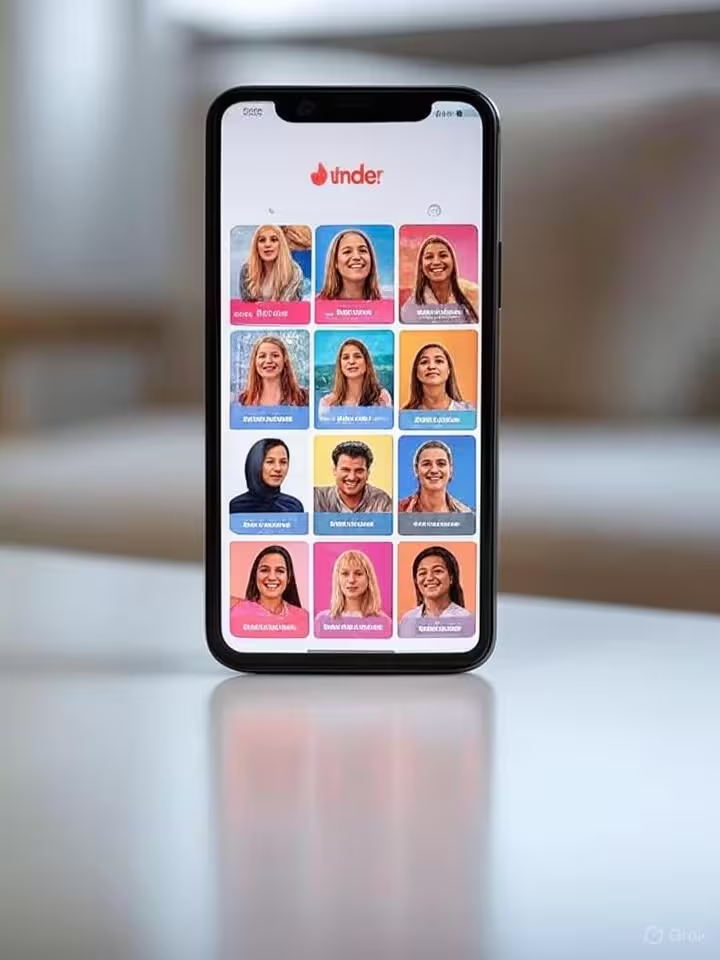
If you have arrived here seeking to understand how Tinder really works -without the urban myths, friends' exaggerations or horror stories-you're in the right place. I'm going to break it all down, step by step, as naturally as we would talk over coffee. I'll include practical tips based on real experiences (mine and those of acquaintances), up-to-date data, and some insights you probably won't find elsewhere. Get ready to dive into the fascinating world of the swipe intelligent.
The basics: What exactly is Tinder and how to take the first steps?
Let's start with the basics, but without underestimating them. Tinder is a geolocalized dating application. which works through a visual selection system: you swipe to the right if you're attracted to someone, to the left if you're not. It seems tremendously simple - and conceptually it is - but behind that simplicity is a whole technological architecture designed to maximize the chances of authentic connection. As Steve Jobs said, «Simplicity is the ultimate sophistication.», and Tinder has demonstrated this masterfully.
To start your adventure on Tinder, the first thing to do is to download the application from your favorite store, Whether it's iOS, Android, or even using the web version (although the latter has fewer active users). The registration process is pretty straightforward: you can link it with your Facebook or Instagram account or simply with your phone number. Personally, I recommend the phone option if you prefer to keep some separation between your social life and your digital romantic adventures.
Once inside, the crucial moment arrives: create your profile. This is where many fail miserably or, on the contrary, where they shine like stars. Your profile is your letter of introduction in a competitive marketplace - and yes, although it sounds crude, it works as a marketplace where your «product» is yourself. You will need to upload between 4 and 9 photographs, write a biography (bio) no longer than 500 characters, and configure some basic parameters such as your preferred age range, maximum distance and sexual orientation.

The art of photos: your first digital impression
Let me be frank: photos are the 90% of your initial success on Tinder. People make split-second judgments, and your first image will determine whether someone stops to look at the rest of your profile or just swipes left without a second thought. I have a friend - let's call him Carlos - who for months couldn't get matches. His photos were dark selfies taken in his room, with a serious expression that was more scary than anything else. I suggested to him to change them completely: we went to a park one sunny afternoon, took natural photos of him smiling, one with his dog, another one doing something he loves (in his case, playing guitar). The result? In two weeks he tripled his matches. It's not magic; it's strategic presentation.
Some specific tips for your Tinder photos:
- First photo: It should be a clear portrait of your face, with good lighting, smiling genuinely. Avoid sunglasses or hats that hide your features.
- Second and third: Show your full body in interesting contexts-doing sports, traveling, at a social event. Variety communicates that you have an active life.
- Fourth and fifth: Include at least one photo with friends (but make sure you are clearly identifiable) and one doing something you are passionate about.
- Avoid: Exaggerated filters, group photos where you can't be distinguished, poor quality images, and above all, photos with ex-partners (even if you've cropped them, it shows).
Remember that according to several studies on dating app behavior, In fact, photos that show authenticity and context generate up to 40% more positive interactions than typical bathroom selfies.
The biography: your chance to stand out with words
If the photos open the door for you, the bio is what makes someone decide to enter. I've seen amazing profiles ruined by an empty or generic «Ask me» or «I don't know what to put here» bio. That communicates laziness or lack of genuine interest. Instead, a well thought out bio can be the differentiator that sets you above the rest.
The key is to be authentic, specific and slightly intriguing. For example, instead of writing «I like to travel» (which is literally what 80% of users say), you could put something like: «I just came back from hiking the Pyrenees solo. Next goal: convince someone that early morning hiking is the best therapy there is». See the difference? The second version opens up natural conversations, shows personality and creates curiosity.
Other elements that work well in Tinder bios:
- A touch of humor (without going too far into the absurd)
- Specific data about your passions or hobbies
- Something that invites interaction: «Open debate: is pineapple pizza a crime or genius?»
- Honesty about what you are looking for: genuine connections, fun, or exploring without pressure.
The science behind Tinder: Deciphering the mysterious algorithm.
Here we enter fascinating territory. Many people use Tinder thinking it's pure chance - like rolling the dice and hoping for the best - but the reality is that there's a sophisticated algorithm constantly working behind the scenes, determining which profiles you see, when you see them and how often you appear on other users' screens.

For years, Tinder's system was based on something called the «Elo Score», a concept borrowed from the world of chess. Basically, it worked by assigning you an «attractiveness» score based on how many likes you received versus how many you gave, and who those likes came from. If you received a lot of «likes» from people with high scores, your own score went up, which made your profile show up to more «desirable» users. It was a rather Darwinian stratification system, which generated no small amount of controversy over its somewhat... well, superficial nature.
However, at present, Tinder has evolved considerably. While the company has never fully disclosed the details of its current algorithm (it is its secret sauce, after all), we do know that it now uses artificial intelligence and machine learning to offer more compatible matches based on multiple factors:
- Recent activity: The more active you are, the more visible you will be. The algorithm rewards those who use the app regularly.
- Behavioral patterns: If you constantly like certain types of profiles, Tinder learns your preferences and shows you more similar options.
- Response time: Users who respond quickly to their matches are considered more «engaged» and receive priority.
- Profile completeness: Profiles with all photos, complete bio and well-defined preferences are favored.
- Reciprocity: If you like someone who previously liked you, the algorithm recognizes that mutual compatibility.
A hypothetical example to illustrate this: imagine you are Ana, a 29-year-old graphic designer in Barcelona. You use Tinder regularly in the evenings, you respond to your matches in less than 2 hours, and you usually like profiles of creative people with elaborate biographies. The algorithm detects these patterns and will start to prioritize showing you profiles of similar people - perhaps photographers, architects, or writers who are also active at night and respond quickly. It's surprisingly smart.
The dangers of «swipe spam» and how to avoid them
A common mistake made by many users - especially men, according to the statistics - is what I call «swipe spam»: compulsively swipe right on all profiles without discriminating, hoping that quantity will compensate for quality. Bad strategy. Tinder's algorithm detects this behavior and penalizes you severely for it.
Why? Because it reduces the experience for other users. If you like absolutely everyone, your matches are meaningless, which leads to dead or non-existent conversations. Tinder prefers selective users who generate real interactions. So, if it detects that you are swiping spam, drastically decreases your visibility, by placing you at the end of the queue in other users' stacks.
The practical recommendation is simple: be selective but not overly restrictive. Like profiles that genuinely interest you, based on a combination of photos, bio and apparent compatibility. Personally, I try to maintain a ratio of about 30-40% likes over the total number of profiles I view. This keeps the algorithm happy while preserving the authenticity of my matches.
Super Likes, Boosts and the premium ecosystem: Are they really worth it?
Here we come to a subject that generates divided opinions: Tinder's paid features. The app currently offers three premium subscription levels: Tinder Plus, Tinder Gold and Tinder Platinum, each with different features and prices that vary according to your age and location (yes, you read that right: they charge more to older users, a practice that has generated criticism but that they continue to implement).
Tinder Plus: The basic premium features
For approximately 10-15 euros per month (depending on your location), you get:
- Unlimited Likes: The free version limits you to about 100 likes every 12 hours.
- 5 Super Likes per day: Instead of only 1 in the free version.
- One Boost per month: Place your profile in front for 30 minutes.
- Passport: Change your location virtually to meet people in other cities or countries before traveling.
- Rewind: Undo your last swipe if you made a mistake.
- Control of who sees you: Limit your visibility only to people you have liked.
Tinder Gold: The intermediate step
For about 20-25 euros per month, you add to all of the above:
- See who liked you: Probably the most valuable feature. It eliminates the guessing game and allows you to be strategic.
- Improved Top Picks: A daily selection of supposedly most compatible profiles.
Tinder Platinum: The complete experience
For approximately 30-40 euros per month, you get all of the above plus:
- Priority in likes: Your profile is displayed before other non-premium profiles.
- Message before the match: You can send a note along with your Super Like.
- View recent likes first: Optimize your chances of mutual match.

Now, the million dollar question: is it worth paying? My honest answer is: depends entirely on your circumstances and objectives. If you live in a big city with many active users and have a decent profile, the free version can work perfectly well. I myself got several interesting matches without spending a euro during my first months.
However, if you are in a smaller area, if you travel frequently, or if you simply want to maximize your possibilities and have the budget, Tinder Gold can be a reasonable investment. The ability to see who liked you saves a lot of time and allows you to focus on people who have already shown interest. In my experience, when I tried Gold for three months, my match rate increased by approximately 60%, mainly because I was able to be more strategic in my decisions.
As Warren Buffett said, «Price is what you pay, value is what you get.». In the context of Tinder, if that €20 a month saves you hours of useless swipes and connects you with genuinely interested people, then the value far outweighs the price.
The Art of Conversation: From Match to First Encounter
Match! That little flash of dopamine when two people choose each other. It's genuinely exciting, especially if it's someone you really liked. But here comes the challenge that holds so many users back: initiate a memorable conversation.
I'll be brutally honest: if your first message is «Hi,» «How are you?» or «Hi beautiful,» you've lost before you've even started. Why? Because that person probably has dozens of matches, and everyone else sent the exact same thing. Your message disappears in a sea of genericity. You need to stand out, but without getting bizarre or overly elaborate.
The formula for the first effective message
After years of observing what works and what doesn't (both in my own experiences and those of friends), I have developed a fairly reliable formula for that initial message:
Personalization + Humor/Curiosity + Open-ended Question = Successful Conversation
Let me illustrate this with concrete examples. Suppose you matched with Maria, whose profile mentions that she loves hiking and has a picture with her golden retriever. Initial message options:
Generic (bad) message:
«Hi Maria, how are you?»
Personalized message (good):
«I saw your picture on the mountain, is it the Caminito del Rey route? I've been wanting to go for months but I need to convince someone that getting up early on Sunday is a good idea 😅»
Personalized message + playful (better):
«Ok, serious question: does your golden retriever take bribes with baubles to give me his approval? Because clearly he's the real judge here. PS: The mountain photo is epic, where did it go?»
Notice the difference? The last message shows that you really looked at their profile, incorporates light humor, and ends with a question that invites an elaborate response. I've used variations of this approach dozens of times, and the response rate is dramatically higher than generic messages.
Keep the conversation flowing without sounding like an interrogation.
Once you have successfully started the conversation, the next challenge is to maintain the natural flow without sounding like a job interview or a police interrogation. I have seen conversations die miserably because one of the two bombards with closed questions or responds with monosyllables.
Some principles that I consistently apply:
- Respond with substance: If you are asked about your job, don't just say «I'm an engineer». Share something interesting: «I'm a software engineer, currently working on an app that helps small farmers optimize their crops. More exciting than it sounds, I promise.».
- Look for commonalities: If you both mention that you like to cook, dig into that. «What was your last culinary experiment? I tried making homemade pasta over the weekend and my kitchen was left as a war zone.».
- Alternates between light and deep: Not everything should be jokes and banalities, but neither should you philosophize from the first message. Find balance.
- Be vulnerable (appropriately): Sharing small imperfections or self-serving anecdotes creates genuine connection.
In my experience, the best Tinder conversations are those where both people contribute equally, share real stories (not just data), and demonstrate genuine curiosity about the other person.
Tinder Safety: Navigating the Risks of the Digital World
Let's face it: meeting strangers on the internet has inherent risks. While Tinder has implemented multiple current security measures, the ultimate responsibility for your well-being rests with you. I've heard enough stories-both positive and troubling-to know that caution never hurts.

Warning signs not to be ignored
Before you meet someone in person, keep your antennae alert for these red flags:
- Profile too perfect: Professional photos only, bio that sounds like marketing copy, no mention of specific personal details. Could be catfishing.
- Excessive haste: He wants your phone number, WhatsApp or social networks immediately, or pushes to meet the next day with hardly any conversation.
- Inconsistencies: Details that don't fit between what your profile says and the conversation, or stories that change.
- Money requests: Obviously, if someone invents an «emergency» and asks for money, it's a scam. Block and report it immediately.
- Resistance to video call: Right now, with all the tools available, flatly refusing a video call before meeting is suspicious.
I have a friend -I'll call her Laura- who almost fell into a complicated situation. She made a match with a charming guy, they talked for a week, and when they finally agreed to meet, he insisted that she come to his apartment directly «because he was cooking something special». Fortunately, Laura had the good sense to decline and propose a public coffee. He was offended and blocked her. Clearly, the intentions were not the best. Always, always, ALWAYS the first encounter should be in a public and crowded place.
Tinder's new verification features
To combat fake profiles and improve security, Tinder introduced several tools that I recommend taking advantage of:
- Photographic verification: A process where you take selfies in real time replicating specific poses. A blue badge appears on your profile confirming that you are who you say you are. Dramatically increases confidence.
- Face to Face: Video calls integrated into the app without the need to share phone numbers. Use them before the first meeting to confirm authenticity.
- Share plans: You can share details of your appointment (time, place, photo of the person) with trusted friends directly from the app.
- Security center: Educational resources and hotlines for reporting inappropriate behavior.
According to data from studies on security in dating applications, In the past, approximately 30% of users have experienced some type of uncomfortable or potentially dangerous situation. Not to scare you, but to help you understand the importance of maintaining basic precautions.
Advanced strategies: Maximizing your success on Tinder
Once you master the basics, you can implement more sophisticated tactics to optimize your experience. These are insights I've gathered from digital dating experts, data analysis, and of course, personal trial and error.
Perfect timing: When to use Tinder
Not all moments are the same on Tinder. The activity peaks typically occur:
- Sunday evenings: Approximately between 20:00 and 23:00. People are at home, relaxed, and planning their week.
- Monday noon: During the lunch break, many users check the app.
- Friday and Saturday nights: Although there is activity, paradoxically it may be less productive because people are physically going out.
If you use a Boost, scheduling it for Sunday between 20:00-21:00 maximizes the impact. I personally tested it on a Sunday last February and got 15 matches in that half hour, compared to 3-4 on a random Thursday morning boost.
The psychology of the Super Like
The Super Likes are controversial. Some see them as desperate, others as genuinely flattering. My perspective after using them strategically: work when used with specific intent.
Don't use your Super Likes on generic profiles or simply because someone is very physically attractive. Reserve them for profiles where you detect real compatibility based on shared interests, similar sense of humor, or just something that genuinely resonates with you. When you Super Like, make sure your profile is optimized, because that person will take a close look at who you are.
Statistically, Super Likes generate approximately 3 times more match probabilities than a regular like, according to internal data shared by Tinder. But the quality of those matches can vary greatly depending on your strategy.
Profile renewal: The «New» effect»
Here is a little known trickWhen you create a new profile or come back after deleting it for a while, Tinder gives you a temporary «boost», showing you to more users during the first 48-72 hours. This is what I call the «new effect».
If you've been on Tinder for months with declining results, consider deleting your account completely (not just pausing it), wait a week, and create a new profile with fresh photos and a revamped bio. I've seen friends resurrect their success on Tinder through this «reset» strategy.
Beyond the match: Transition to the real world
Eventually, if things go well, you will get to the point where you want to meet your match in person. This transition from the digital to the physical world is an art in itself, and where many promising connections fade away.
The general consensus is that after 3-7 days of constant conversation, it is appropriate to suggest a meeting. Before that it may seem rushed; after that, the conversation loses momentum and falls into the dreaded «penpal zone.».
How to propose the first meeting
Be direct but casual. Something like: «Hey, this conversation is great, but I think it would be much better with coffee in between, do you feel like getting together this weekend?» It works perfectly. You don't need to draw up extravagant plans; in fact, it's counterproductive. The first meeting should be:
- Brief: A 30-60 minute coffee. If there is chemistry, they can always extend it. If not, you both have an easy way out.
- Public: I already mentioned it, but I repeat it because it is crucial.
- Alcohol-free (initially): Keep a clear mind to genuinely evaluate the connection.
- In the middle: That no one has to travel disproportionately.
A personal anecdote: my first Tinder date was in a bookstore-café. Perfect because if the conversation stalled, we could always talk about books around it. We ended up spending three hours chatting, and although it eventually didn't work out as a couple, we remained friends. Good ending, considering that many first dates are awkward disasters that both of us would rather forget.
The different «modes» of Tinder: Understanding what each user searches for
A reality that many are unaware of: not everyone on Tinder is looking for the same thing, and that's perfectly fine. The problem arises when there is misalignment of expectations without clear communication. Currently, Tinder has tried to improve this with intent tags, but personal clarity is still your responsibility.
| Type of User | Primary Motivation | Profile Signals |
|------|--------|--------|
| Serious relationship finder | Find long-term partner | Detailed bio, mention values/objectives, varied and contextual photos |
| Casual/Exploratory | No pressure connections, see what comes up | Relaxed bio, mentions «no rush», social photos |
| Networking/Friendships | Expand social circle when moving to new city | Mention «new to [city]», search for local recommendations |
| Validation/Entertainment | Ego Boost, spending time | Less elaborated profile, slow or intermittent responses |
I have met people in each category, and all are valid as long as they are honest. The problem arises when someone in «casual» mode matches someone looking for seriousness without clarifying intentions. That's why, although it may seem awkward, an honest conversation about expectations around the third or fourth exchange is wise.
Tinder and diversity: Inclusivity today
One thing I genuinely appreciate about Tinder's evolution is its growing commitment to inclusiveness. Today, the app offers:
- Expanded sexual orientation options: More than 9 options including heterosexual, homosexual, bisexual, asexual, demisexual, pansexual, queer and more.
- Diverse gender identities: Male, female, transgender male, transgender female, non-binary, and the option to write your own identity.
- Configurable preferences: You can choose to make your profile visible to everyone or only to people within certain criteria.
- Only show me to people I liked« mode: Useful for those who prefer more control over their visibility.
These features not only make Tinder more accessible to the LGBTQ+ community, but also create an environment where every user can express themselves authentically. As Maya Angelou said, «When you know better, you do better.», and Tinder has clearly learned from past criticisms to build a more welcoming platform.
The dark side: Ghosting, breadcrumbing and other modern phenomena
Not everything is rosy in the world of Tinder. There are toxic behaviors that have become dangerously normalized in the digital dating culture, and it's important to recognize them both so you don't fall victim to them and so you don't perpetuate them.
Ghosting: The unexplained disappearance
Ghosting is when someone simply disappears without explanation after conversations or even appointments that seemed promising. One day they are actively responding, the next, dead silence. It's frustrating, confusing and hurts the ego.
I've experienced it and, I admit with shame, I've done it too. Why does it happen? Usually because of emotional cowardice-it's easier to disappear than to have an awkward conversation by saying «I don't feel connected enough.» Nowadays, with the saturation of options that Tinder provides, ghosting has intensified because there is always «someone else» waiting in the stack.
My advice if you get ghosting: don't take it personally. It reflects more on the other person's emotional inability than on your worth. Give yourself 24-48 hours to assimilate, then move on.
Breadcrumbing: Attention crumbs
Breadcrumbing is to keep someone interested with minimal, intermittent attention-an occasional message, a like on a story-with no real intention of deepening the connection. It's like leaving a trail of breadcrumbs so the person doesn't completely walk away, keeping options open.
Detecting it is relatively easy: the person responds from time to time with apparent enthusiasm, but never makes real plans. If you suggest meeting, there are always excuses. After weeks, the relationship has not progressed at all. If you identify this pattern, confront or walk away. Your time is worth more.
Benching and other tactics
Other terms that have emerged include:
- Benching: Keep you as a secondary option while they explore other «better» options.
- Cushioning: Maintain multiple romantic connections simultaneously as a «cushion» in case the main one fails.
- Stashing: Going out with you but never introducing you to friends/family or posting anything together, keeping you «hidden».
Recognizing these behaviors empowers you to set healthy boundaries and not tolerate disrespect.
True stories: When Tinder really works
To balance the perspective, I want to share that Tinder genuinely leads to real and meaningful relationships for millions of people. It's not just a marketing myth; I personally know several couples who met there and are now married or in long-term relationships.
My friend Javier met his now wife on Tinder in 2019. He lived in Madrid, she lived in Barcelona. They used the Passport feature to connect before Javier had a work trip to Barcelona. Their first date was a walk through the Gothic Quarter that lasted 6 hours. Three years later, they moved to Valencia together and got married last year. Is it the norm? Maybe not. Is it possible? Absolutely.
Another story: Marta, an acquaintance from the gym, used Tinder after a difficult divorce. She wasn't looking for anything serious, just to regain confidence. She matched with Carlos, who was in a similar situation. They agreed to be honest about not wanting commitments. Two years later, that «non-relationship» became the healthiest relationship they had ever had. Sometimes, not looking is precisely when you find.
These stories remind me that behind every profile is a real person with hopes, fears and the possibility of genuine connection. Tinder is just the tool; the magic (or lack thereof) comes from the people.
Final thoughts: Is Tinder for you today?
After all this exhaustive analysis, we come to the essential question: should you use Tinder? My nuanced answer is that it depends on what you are looking for and how you use it.
Tinder is excellent if:
- You live in a city with a sufficient population of active users.
- You are willing to invest time in optimizing your profile and having conversations
- You have realistic expectations and emotional resilience to handle rejection.
- You are looking to expand your social circle or explore romantic connections without pressure.
- You can complement it with meeting people offline as well
Tinder is probably not for you if:
- You tend to obsess or develop anxiety with digital interactions.
- You seek external validation as a primary source of self-esteem.
- You are not in an emotionally healthy place to deal with romantic uncertainty.
- You expect immediate results without strategic effort
- You prefer traditional methods of meeting people and are uncomfortable with the digital dynamic.
Personally, I see Tinder as one more tool in the arsenal of modern social life. Not the only one, but not negligible either. I've had positive, neutral and downright terrible experiences on the platform. But I could say the same about meeting people in bars, at events or through friends. The medium does not determine the outcome as much as the intentions and actions of the people involved..
If you decide to use it, do it consciously. Set time limits so as not to fall into infinite scrolling. Prioritize genuine connections over accumulating matches like trophies. Be the person you'd like to meet: honest, respectful, interesting. And above all, remember that your value as a person is not measured by how many likes you get or don't get on an app.
As Brené Brown rightly expressed, «Authenticity is the daily practice of letting go of who we think we should be and embracing who we are.». Apply this to your Tinder experience, and you'll find that even in the shallow world of swiping, deep and authentic connections can emerge.
So, what are you waiting for? If the article has convinced you that it's worth a try (or a retry with a new approach), download Tinder, apply these tips, and give yourself a chance to be surprised. Who knows, maybe your next great love story will be a great one. -Or at least an amusing anecdote to tell - start with a simple slide to the right. In the unpredictable and fascinating ecosystem of modern dating, anything is possible. Best of luck out there!