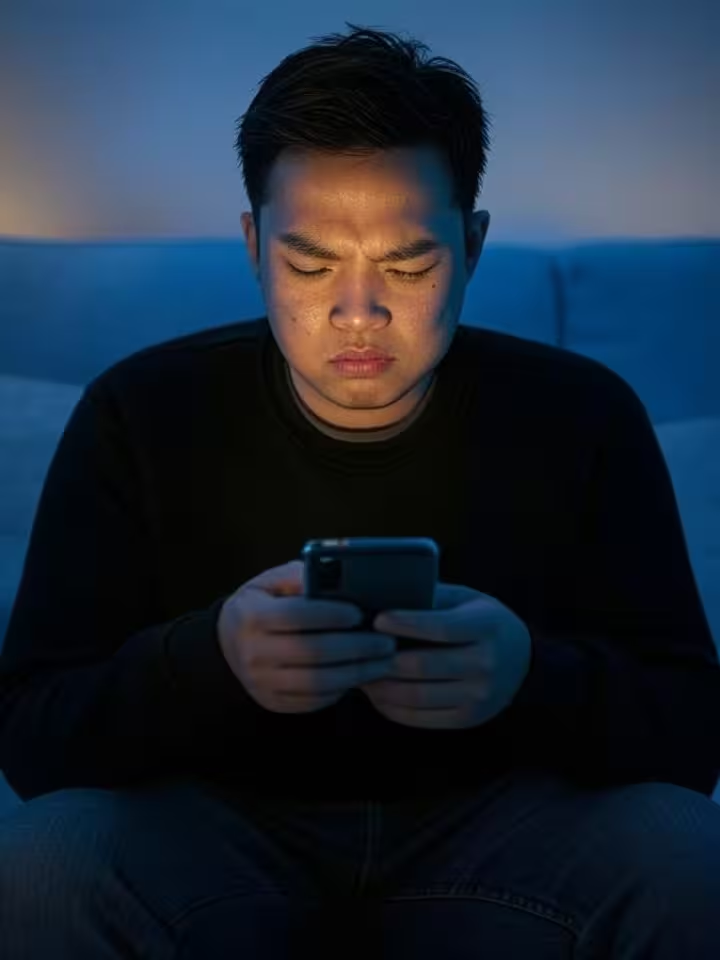
You open Tinder after a tiring day. You have six new matches. You go through them one by one hoping to find that connection that will make you smile. But after two minutes you are already closing the app, frustrated. They all look right on paper, but none of them even make you curious. And the worst thing is that this pattern repeats itself week after week.
The truth is, it's happened to me more times than I like to admit. Over the years I've navigated the entire online dating ecosystem - from the classic Tinder and Bumble to more niche apps like Hinge and Feeld - and I've discovered something fundamental: when you're constantly attracting people you're not interested in, it is almost never a coincidence or bad luck. It's a sign that your profile strategy, your swipe patterns or even your emotional state are sending the wrong signals to the digital dating universe.

After helping dozens of friends optimize their profiles and experiencing this process firsthand, I've come to understand that this problem has specific causes. And the best part: they are all solvable if you are willing to make some honest adjustments.
Why your profile attracts exactly who you're not looking for
Let's start with the basics, because here is the first big culprit. Your dating profile is your digital cover letter, but many times it works like an advertisement promoting a different product than the one you actually offer. And no, I'm not talking about lying -that's obviously terrible- but about unconscious misalignment between what you show and what you really are.
Think of it this way: you have five photos of wild parties, drinks in hand, surrounded by people. Your bio mentions that you're «adventurous» and a «nightlife lover.» But in reality, those photos are from two years ago, when you were going out more. Now you prefer quiet evenings with a series, cooking at home and deep conversations until 3 a.m. The result? You'll attract people who are looking to party and adrenaline, while you crave connection and calm.
I've seen it repeated in profiles of acquaintances who then ask me for help. One friend had all glamorous selfies with flawless makeup and studied poses. It consistently attracted shallow guys obsessed with looks. When she added photos of herself hiking without makeup and reading in a cafe, the type of matches changed radically.
But there's more. On apps like Hinge or OkCupid, where prompts let you drill down beyond a three-line bio, it's tempting to fall back on generic, safe answers. «I love traveling, good wine and spending time with friends.» Honestly, who doesn't? Those phrases say absolutely nothing about you. They don't filter. They don't appeal to anyone specific because they could apply to literally millions of people.
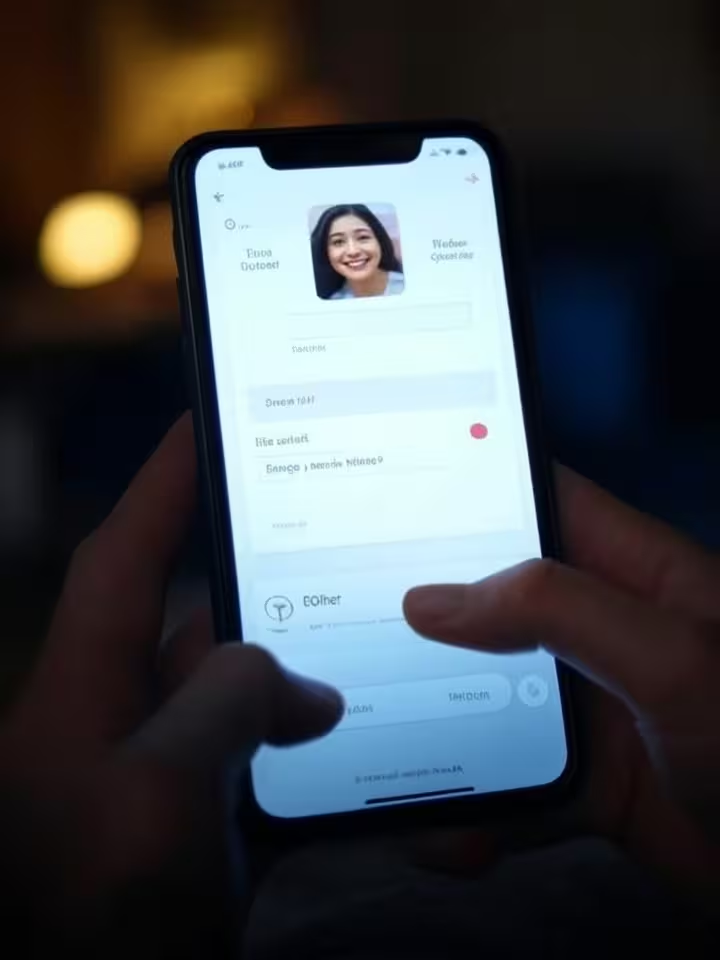
The apps' algorithm also plays its part in this frustrating cycle. Platforms like Badoo, Happn or even Tinder's ELO system analyze your swiping behavior to feed you more of the same. If you've been liking profiles that don't really suit you at all - perhaps out of impatience or not wanting to be «too selective» - the algorithm interprets that as your ideal type and will show you similar variations indefinitely.
I confess something: two years ago I went through a phase where I swiped right almost without thinking, just to see what would happen. The result was predictable: I ended up with hundreds of matches I wasn't interested in and conversations that died in «hi there». I deleted everything, started from scratch by being brutally honest in my profile -including my quirks and specific preferences- and although my match rate initially dropped, the quality of the connections improved exponentially.
Now here's the interesting thing: this digital self-awareness process requires you to be honest with yourself first. Not with the idealized version of you that you would like to project, but with who you really are at this point in your life. That includes what you are looking for: casual, serious, exploring options, deep emotional connection rather than physical. If you're not clear, the algorithm and other users won't be either.
Mixed signals that sabotage your matches
Let's delve into something that few mention but that I have seen destroy infinite possibilities for real connection: contradictory signals in your digital presentation. It's not just about what you say or show, but about the coherence between all the elements of your profile.
Look, in more selective apps like The League, Inner Circle or even Match, the audience has particular expectations. If your profile mixes ultra-casual beach photos with a bio that talks about serious career ambitions, you're confusing your audience. I'm not saying you have to choose between looking relaxed or ambitious-you can be both-but how you present it matters. A photo of you working on your laptop in a cafe communicates ambition more authentically than simply writing «passionate entrepreneur» without visual context.
On the other hand, if you're on apps like Feeld, designed for more open and honest explorations of sexuality and non-traditional relationships, but your bio sounds like something out of a 2000s Match profile looking for «someone special to start a family,» you're going to attract exactly the wrong kind of person. Or worse: you'll scare away those who are looking for the same thing you are out of sheer confusion.
I have helped several friends with this specific issue. One had amazing photos of exotic trips - temples in Thailand, safaris in Tanzania, beaches in Bali - but his real life in Madrid was much more routine: office, gym, beers with friends on Fridays. He constantly attracted people who expected an adventurous digital nomad available for spontaneous getaways. Disappointment was mutual when they got to the first date and discovered the mismatch.
We changed her strategy: she dropped one or two travel photos, but added others of her daily life - her favorite neighborhood cafe, playing sports, cooking at home - and boom, she started connecting with people who valued stability with occasional touches of adventure. Real compatibility, not inflated expectations.
The bio deserves special attention here. Avoid at all costs phrases like «looking for someone fun», «no drama» or «likes to enjoy life». They are so vague that they don't mean anything. Better be specific: «I'm fascinated by debating Almodovar movies until three in the morning» or «Ideal Saturdays include organic market, cooking something new and ending up at a jazz bar.» That filters. And filtering is good, because you don't want to attract everybody, you want to attract your people.
I'll tell you my personal experience: I tried that specific strategy in my Hinge bio and the prompts I chose were deliberately niche. Instead of «I love music» I put «I can talk for hours about why Radiohead is great but overrated». Result: infinitely more interesting conversations with people who shared that passion, rather than the typical boring emoji exchanges.
And another critical thing: pay attention to the red flags on other people's profiles before making a match. If you only respond to superficial messages or profiles that show no real personality, you end up in a cycle of conversations that inevitably die in ghosting or slow fade without satisfactory explanation. The trick is to be selective from the first swipe, not after investing days in conversations that lead nowhere.
The hidden burden of dating emotional fatigue
Now, it's not all the fault of your profile or the algorithm. There's a massive psychological factor that affects what kind of people you attract and, more importantly, which ones you notice: the emotional exhaustion of online dating. And believe me, it's more common than you think.
After months of swiping on multiple apps - POF, Meetic, OkCupid, Badoo - your brain starts to operate on autopilot. You've had so many conversations that start the same («hello,» «how are you,» «what are you doing») that you develop a kind of emotional numbness. You no longer process profiles with real attention. You swipe mechanically. You respond half-heartedly. And in that state of mind, it's almost impossible to recognize a genuine connection even if it's right in front of you.
The truth is that I have felt this firsthand. There was a time when I was in five apps simultaneously, juggling fifteen active conversations. It got to a point where all people seemed the same to me, even the interesting ones. That paradox of choice that the studies about psychology of modern datingso many options that none of them seems special enough.
The result was predictable: I only «noticed» those I wasn't interested in, because my emotional radar was completely disconnected. The first few dates felt like boring job interviews. I would leave each one thinking «okay, but...» and go home to swipe some more, perpetuating the cycle.
There is also a deep psychological component here related to attachment patterns. If you have an anxious attachment style-you need constant validation, you worry excessively about the other's responses-you may be unconsciously attracting people with an avoidant style who reinforce your anxiety. And vice versa. It's an unconscious dance that repeats unhealthy relational dynamics.
A friend with this pattern always ended up with emotionally unavailable guys who ghosted her after two weeks. When she finally worked through her attachment anxiety in therapy, she started noticing-and attracting-more emotionally secure people. The change wasn't in the apps or in her profile, was internal.
That said, my best advice here is counterintuitive: pause the apps when you feel burnout. I took a month off completely from the whole ecosystem - no Tinder, no Bumble, no Grindr, no Her, nothing digital dating-related - and came back with a renewed perspective. When I returned, I had genuine energy for conversation, asking interesting questions and detecting real compatibility. And oddly enough, I attracted better matches because you could tell from my energy and responses that I was present.
Don't underestimate the power of authentic vulnerability in conversations either. If you only make superficial small talk to protect yourself from disappointment, you'll never reach deep connection. Sharing something real-an insecurity, a strange dream, a controversial opinion-can completely change the dynamic. I've seen mediocre conversations turn into amazing dates when someone dared to be vulnerable first.
It's liberating, I promise. But it requires being in the right mental space to take it on.
Practical strategies to attract who you are really interested in
Well, let's cut to the chase with concrete solutions you can implement today to break this frustrating cycle. These are not magic tricks or secret algorithm hacks, but rather strategic adjustments based on years of trial and error.
First: experiment with different apps depending on what you're looking for. It sounds obvious, but most people get stuck on Tinder because it's the most popular. If you only get superficial casual matches there, try eDarling or EliteSingles for something more serious and curated. If the volume of options overwhelms you, Coffee Meets Bagel gives you limited daily matches that prevent burnout. If you're looking for specific niches - LGBTQ+ community, non-monogamous relationships, connections based on particular interests - apps like Taimi, Feeld or even Raya (if you qualify) can connect you with much more aligned people.
In my case, varying platforms opened unexpected doors. When I tried Hinge after months alone on Tinder, the difference was abysmal. Prompts forced you to show real personality, and conversations started with specific comments about answers, not «hello.» The initial connection level was incomparably better.
Second: update your profile regularly, even if you don't change anything fundamental about your life. Change a photo every two weeks, rewrite a prompt about something recent you're excited about, update your Spotify track. This not only refreshes your presence to the algorithm - which tends to prioritize active profiles - but also keeps you authentic. Your profile should reflect who you are TODAY, not six months ago.
Third: be relentlessly selective with your swipes. It sounds harsh, but it's essential. If something in a profile generates doubt in your mind -whether it's the photos, the bio, the responses to prompts- swipe left without remorse. Don't give likes «just in case» or because «well, it's not bad». Every half-hearted match dilutes your energy and confuses the algorithm about what kind of person you're really looking for.
Fourth: optimizes according to how each specific algorithm works. Tinder values regular activity and response rate. Bumble penalizes indiscriminate swipes. Hinge prioritizes completing the entire profile with thoughtful prompts. Knowing these mechanics gives you a real strategic advantage.
Fifth, and this is critical: in conversations, lead with questions that reveal early compatibility. Instead of trading platitudes for days, ask things like «What's your idea of a perfect Sunday?» or «What's something you're passionate about but few people understand?» These questions filter fast and deepen the connection if there is real potential.
I use this strategy religiously after learning it the hard way. On one occasion, a conversation on Happn was going mediocre until I asked about her favorite movie and why. Her answer revealed values completely opposite to mine, saving me from wasting time on a date that was going nowhere. On the other hand, with who is now my partner, that same question triggered a two-hour conversation that ended in a video call that night.
Sixth: define what you are looking for early in the conversation, without unnecessary beating around the bush. You don't need to state intentions in the first message, but by the third or fourth exchange, casually mention whether you are looking for something serious, casual, exploring options or just meeting interesting people. This avoids ambiguous situationships that drain emotional energy for months.
Seventh: don't talk forever before meeting. If there is chemistry in the messages, propose a casual date -coffee, a walk, a specific activity- in the first few days. Prolonging endless chats creates inflated expectations and a greater likelihood of disappointment when you meet in person.
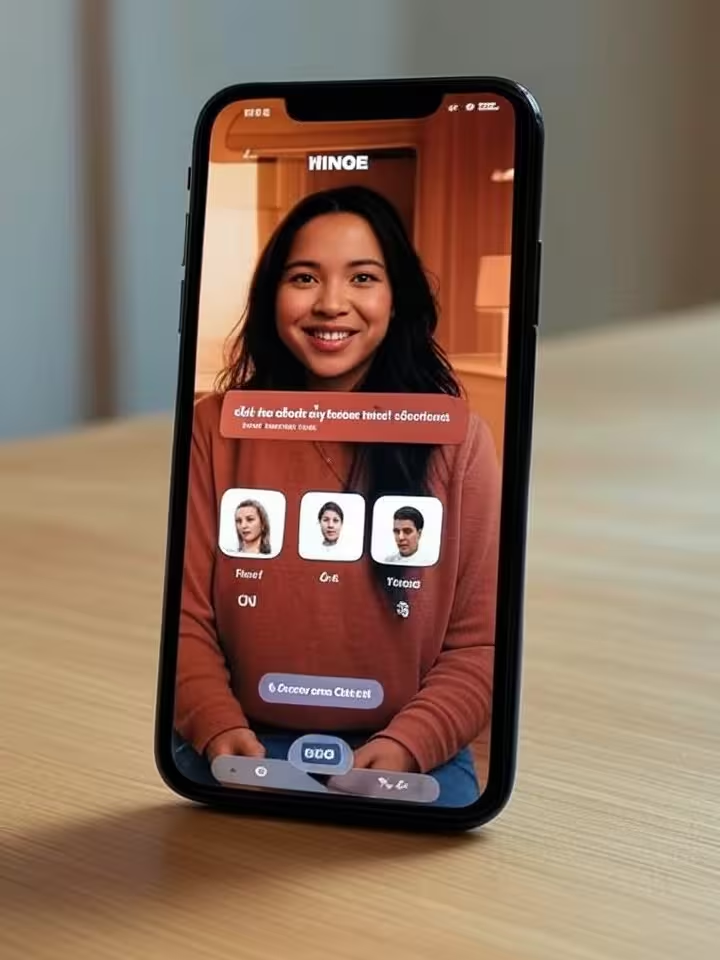
Eighth: use the video call feature before dating if the app offers it (Bumble, Hinge, Badoo have this option). Fifteen minutes of video can reveal more about compatibility than two weeks of messages. And detect red flags that only body language and tone of voice can show.
Finally, celebrate the small victories. A conversation that flows effortlessly. A match that shares your quirky sense of humor. A first date where time flies by without you noticing. These moments matter more than the number of matches or the speed of finding «the right person».
Signs that you are on the right track
How do you know if the changes are working? There are clear indicators that I have learned to recognize after so long navigating this.
First, the quality of your conversations improves significantly. You stop having exchanges that die after «haha yes» and start having chats where you genuinely want to respond, where there is mutual curiosity and questions flow naturally in both directions. If your last five conversations made you smile or think, you're doing well.
Second, you get excited about dating rather than seeing it as an obligation. When you truly attract compatible people, the prospect of meeting them generates positive anticipation, not anxiety or apathy. If you find yourself choosing what to wear carefully because you really want to make a good impression - not out of insecurity but out of enthusiasm - it's a clear sign.
Third, you reduce your time on apps because you no longer need constant validation of matches. When you attract quality, you don't need quantity. You can go days without opening Tinder because you're focused on promising conversations or dates you already have going on.
Fourth, rejection or appointments that don't work out no longer affect you as much. Because you understand that not every connection should work, and that's okay. When someone ghosting or a date has no chemistry, you see it as natural incompatibility, not personal failure.
And finally, you start noticing positive patterns instead of negative ones. You used to think «it's always the same for me, I attract the same wrong guy». Now you think «how interesting, the last three people I've liked share these characteristics that I value».
I have to admit that this last point took me years to understand. I used to focus obsessively on what went wrong, analyzing every ghosting or every mediocre quote ad nauseam. When I shifted the focus to looking at what worked-what kind of openers generated better responses, what photos attracted interesting people, what conversations flowed naturally-everything improved exponentially.
Your profile should reflect who you are today
The misalignment between old photos or generic bios and your actual personality is the number one cause of attracting the wrong matches. If your photos show a lifestyle you no longer lead, or your bio uses vague phrases that could apply to anyone, you're sabotaging your chances from the start. Update regularly with content that genuinely captures your interests, routines and what you're looking for right now.
Emotional fatigue distorts your radar
After months of swiping without satisfactory results, you develop dating burnout that clouds your judgment. In this state, you only notice those who don't interest you because your brain operates on autopilot. Combine this with insecure attachment patterns and you end up repeating toxic dynamics without realizing it. The solution: strategic pauses to reset your emotional energy and focus.
Relentless selectivity from the very first swipe
Giving indiscriminate likes «just in case» confuses the algorithm about your ideal type and dilutes your energy in mediocre matches. Being selective is not superficial, it's strategic: each swipe should respond to something genuine that attracted you to the profile. Combine this with early filter questions in conversations and quick transitions to dates when there is chemistry, avoiding endless message limbo.
When the problem is deeper than it looks
Sometimes, consistently attracting the wrong people is not just a matter of profile or strategy. It's a reflection of deeper-seated psychological patterns that deserve honest attention. And yes, this sounds heavy, but ignoring it only perpetuates the cycle.
If you find that you always end up with the same type of problematic person - emotionally unavailable, narcissistic, unreliable - you may be repeating familiar or past relationship dynamics. Our brains tend to seek out the familiar, even when the familiar is harmful. This is an issue I worked on in therapy for months and it radically changed the way I choose matches.
On the other hand, if your self-esteem is at rock bottom-whether it's from long bouts of rejection on apps, constant comparison to other profiles, or vicious internal criticisms of your appearance-you're going to attract and accept connections that reinforce that low self-esteem. It's a vicious cycle where you accept crumbs of attention because you don't think you deserve more.
There's also the issue of unrealistic expectations fueled by social media and modern dating culture. If you expect every match to be perfect from message one, or for chemistry to explode instantly like in the movies, you're going to constantly rule out potentially compatible people. Real connection takes time and vulnerability to develop.
Honestly, if you identify with any of these deeper patterns, consider working with a relationship therapist. It's not weakness, it's investing in your emotional well-being so you can attract and maintain healthy connections. I did it and it was transformative.
The role of context in your dating experience
Something almost no one mentions: your current life context massively affects who you attract and what kind of connections you can sustain. And I'm not just talking about your geographic location - although small town vs. metropolis living obviously changes the game - but your entire life moment.
If you're in the midst of a job transition, moving, grieving a past relationship, or simply overwhelmed with responsibilities, your energy available for dating is limited. And it shows. You'll attract people in similar situations or, worse, those who are looking for something you can't give right now.
I once tried dating online while changing cities and jobs simultaneously. It was a disaster. My profile attracted people looking for something serious and stable, but I was in survival mode with no emotional capacity for relationship. Result: mutual disappointments and unnecessary guilt.
Also consider your social circle. If all your friends are in serious relationships and you're looking for something casual, or vice versa, that creates invisible pressure that affects your app decisions. You end up swiping according to what you think you «should» want, not what you genuinely desire.
Note that your personality type also matters here. If you're an introvert, managing multiple conversations and dates drains you quickly, leading you to accept the first half-decent thing out of exhaustion. If you're an extrovert, you may be looking for constant connection and settle for superficial attention rather than solitude.
Final thought: this is a process, not a destination.
Look, after everything I've shared, I want to leave you with something fundamental: constantly attracting someone you are not interested in is a sign, not a permanent sentence.. It is your dating system telling you that something needs adjustment, whether it is your profile, your strategy, your emotional state or your self-awareness.
I have lived it in all its versions. I have been in the phase of desperately swiping at everything. In the phase of obsessively rejecting over insignificant details. In the one of settling for crumbs of attention. In the one of pausing completely burned out. And finally finding balance and attracting genuine connections.
Each phase taught something valuable. Online dating is, at its core, a skill that develops with practice, self-reflection and constant adjustment. There is no magic formula because everyone is looking for something different at different times in their lives. But there are universal principles that work: authenticity, selectivity, patience and willingness to learn from each experience.
If you only remember one thing from this article, let it be this: the problem is not you, it is the misalignment between how you present yourself and who you really are or are looking for.. Correct that with brutal honesty, adjust your strategy according to real results, take care of your emotional health, and you will see how the type of people you attract changes radically.
And when someone finally comes along who does interest you and reciprocates, the whole process will have been worth it. Because you'll have gotten there by being genuinely yourself, not an edited version designed to please the masses. That authenticity is the foundation of any worthwhile connection.
Keep testing, tweaking, learning. The next match could be exactly who you need to meet right now.
This usually happens because of misalignment between how you present yourself and who you really are. If your photos show a lifestyle you no longer lead, or your bio uses generic clichés, you will attract matches based on that false image. In addition, the algorithm learns from your previous swipes: if you have liked mediocre profiles out of impatience, it will show you more of the same. The solution is to brutally review your profile by eliminating mixed signals, be specific about your real interests and swipe only when there is genuinely something that attracts you to the profile.
Yes, but only if you choose the right app for what you are looking for. If Tinder gives you only superficial matches, trying Hinge or Bumble can radically change the type of conversations because their design forces you to show more personality from the start. If you're looking for something very specific, niche apps like Feeld for non-monogamous relationships, or Coffee Meets Bagel for daily curation to avoid burnout, can connect you with genuinely aligned people. But switching apps without adjusting your profile and strategy will only move the problem to another platform.
If you consistently attract the same problematic type - emotionally unavailable, avoidant, narcissistic - despite having a well-optimized profile, there are probably deeper psychological patterns at play. Signs include: always ending up with people who ghosted you, feeling extreme anxiety over late responses, seeking constant validation through matches, or chasing those who ignore you while ignoring those who show genuine interest. These patterns often replicate past relationship or family dynamics and deserve therapeutic work to break them.
There is no fixed rule, but at least two full weeks without opening any app, checking matches or thinking about online dating. The goal is to reset your emotional radar that the mechanical swiping has numbed. Signs that you're ready to come back: you're genuinely excited about meeting someone new, you have energy to have interesting conversations, and you can think about your last ghosting without bitterness. Personally, a full month unplugged worked better for me than short breaks, because it allowed for real perspective change rather than just superficial rest.
The best filter questions reveal values and lifestyle without sounding like an interrogation: «What's your idea of the perfect Sunday?» distinguishes between homebody vs. adventurer. «What's something you're passionate about but few people understand?» reveals depth and compatibility of interests. «If you could change one thing about your current routine, what would it be?» shows ambitions and life satisfaction. «How do you handle conflict in relationships?» is direct but crucial to avoid attachment styles that are incompatible. Avoid closed yes/no questions and aim for answers that generate revealing organic conversation.