Getting back into online dating after divorce: how to get started without getting lost along the way
February 12, 2026
Imagine this: you've just closed a big chapter in your life, divorce, and suddenly you realize that the dating world has changed so much that it seems like another planet. I went through that a few years ago, after my own separation, and I confess that at first I felt like a fish out of water on apps like Tinder or Bumble. But well, with time and a few disastrous dates, I learned that it's not about luck, it's about adapting and enjoying the process. If you're in that stage, this article is for you, as if we were chatting in a cafe and I was telling you what worked for me.
The truth is, getting back into dating after a divorce isn't just about downloading an app and starting to swipe. First, you have to look in the mirror and ask yourself if you really want this now. It took me months to feel comfortable; at first, every match reminded me of what I had lost, and that created tremendous anxiety. Honestly, give yourself time. There is no rush. Think about what you're looking for: a casual hookup to distract you, or something more serious? Apps like Hinge with its prompts inviting deep conversation can help you reflect on that as you create your profile.
On the other hand, ignore that voice that says «you're getting too old for this». Nonsense. Online dating has no age limit, period. What no one tells you is that divorce gives you a unique perspective. You've lived through a real commitment, with its ups and downs, so now you value honesty in conversations more. Notice that, in my experience, people in similar situations connect better on platforms like OurTime or SilverSingles, aimed at a more mature audience. There, the chats flow without so much superficiality, and you avoid the burnout of more youthful apps where everything is a quick game of likes.
And you know what, the healing process is not linear. Some days you'll feel ready to meet new people, others you'll want to delete all the apps on your phone. Both states are valid. The trick is to recognize your emotions without judging them, and act when you really feel ready, not because your friends insist or because you think «enough time has passed». The right timing is up to you, no one else.
Building your profile: show your updated version
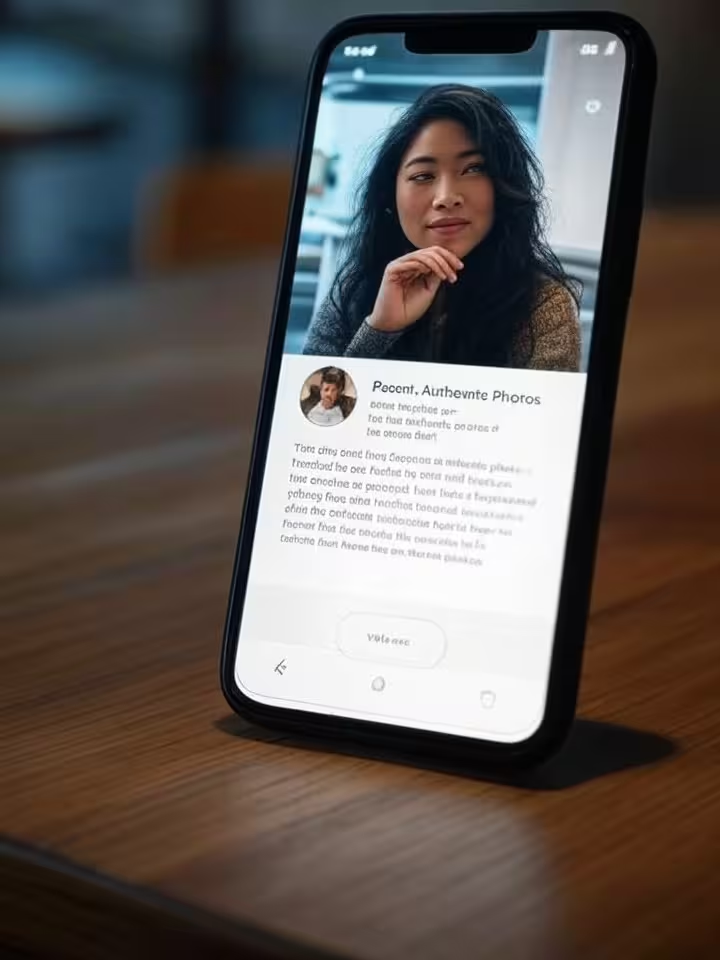
Here comes the interesting part: your profile is like a letter of introduction, but without the filter of past expectations. Forget about photos from your wedding or from times when you were not yourself. Choose recent images that show your life now: maybe one of a trip alone, or practicing that hobby you took up again after divorce. I made the mistake of using old photos at the beginning, and what a disappointment when I got to the appointment and they noticed the difference (I confess that once they told me «you look like the older brother in the photo», how embarrassing).
Just be authentic. In the bio, don't go into divorce details unless you want to; a subtle touch like «newly single and exploring new adventures» will do. Apps like OkCupid allow you to answer questions about values and lifestyles, which is great for filtering matches who understand your background. Also, consider niches like Christian Mingle if faith is important to you, or even Feeld if you're looking for something more alternative. The trick is not to pretend to be who you're not; vulnerability attracts real connections, not empty situationships.
And you know what, avoid the ELO score by obsessing over boosts; focus on quality, not quantity. The truth is, after a divorce, your self-esteem might be bruised, so start with profiles that encourage positive interactions. Try Coffee Meets Bagel, which gives you curated matches daily, reducing the paradox of choice that so overwhelms. Less choice, more intentionality.
Look, there's something important I learned: your profile doesn't have to mention your divorce explicitly to be honest. You can convey emotional maturity in other ways: talking about what you value now, your current hobbies, your vision for the future. If someone asks directly about your marital status in the chat, answer naturally and without drama. «I was married, I'm not anymore, and I'm here looking to meet interesting people» is enough. You don't owe anyone your whole story in the first message.
Emotional healing before the swipe
After a divorce, jumping into dating without processing your emotions is like trying to run a marathon with a broken leg. Give yourself time to heal, work on your attachment style if necessary, and understand what patterns you want to avoid repeating. Online dating works best when you come from a place of fulfillment, not lack. If every match generates extreme anxiety or reminds you of what you've lost, maybe it's not your time yet, and that's okay.
Rebuilding your digital identity
Your profile should reflect who you are now, not who you were during your marriage. Use recent photos that showcase your current life, write an authentic bio without unnecessarily mentioning your divorce, and select apps that align with your new goals. Apps like Coffee Meets Bagel or Hinge foster intentional connections, ideal when you're looking for something genuine after a breakup. Avoid obsessing over metrics like ELO score; focus on presenting yourself honestly.
Protecting your emotional space
After a divorce, you are more vulnerable to toxic patterns like love bombing or breadcrumbing. Learn to spot red flags early: verified profiles, conversations that move forward naturally without pressure, and dates in public places with a safety plan. Don't share sensitive information too early, and trust your intuition if something feels off. Take breaks when you're feeling dating fatigue, because swiping non-stop will only burn you out faster.
Navigating the waters: from chat rooms to actual dating
See, once you have matches, comes the fun but tricky part: the conversations. Don't fall into the slow fade by responding every three days; consistency is key, especially when you've come out of a long relationship and value time. A simple opener like «I saw you like hiking, what's your favorite trail?» can lead to deep chats, away from shallow social media orbiting. Personalize your messages based on something specific to their profile, never use generic copypastes that scream «I'm sending this to 20 people».
Between us, the fear of rejection is real after a divorce. But I tell you, every «no response» is a lesson. I've had hundreds of chats evaporate, like that zombieing where someone reappears months later with a «hey, what's up?». I learned not to take it personally; sometimes it's their own chaos, not yours. When you stop by to ask for the number or make an appointment, If you do, do it naturally, after a good run of messages where you both show genuine interest. And for the first date, choose something casual, like coffee in a public place-safety first, always.
Now, in person, look for green flags: active listening, respect for your story without interrogating you, open body language. If you feel ick over something small, like them talking bad about their ex for the whole date, take note. I had a date on Happn that started great on chat, but live there was no spark; it's normal, don't force it. Chemistry is either felt or not felt, and after a divorce you have a more finely tuned radar to detect when something doesn't add up.
At the same time, do not ignore red flags as love bombing, where you are bombarded with attention to manipulate. After a divorce, you're wiser to spot it. If someone promises you the world on the second date, talks about the future too fast, or makes you feel guilty for setting boundaries, run. Literally. Your previous experience has taught you that healthy relationships are built over time, not instant fireworks.
Taking care of yourself along the way: the emotional side of dating
What nobody tells you is that online dating can be an emotional rollercoaster, even more so post-divorce. Dating fatigue comes quickly if you're on several apps at once; I suffered it with Badoo and Match, swiping non-stop until I burned out. Take breaks, you know? Take time for yourself, to process the attachment style you bring from your marriage -maybe you're anxious and need to work on that so you don't repeat patterns. Understanding your attachment style can completely change your modern dating experience.
I have to admit, the comparison with other profiles generates terrible FOMO. You see someone with perfect photos in exotic locations and you think «I'll never measure up to that». But the reality is that we all edit our best version on apps; no one uploads the photo of the bad day. Focus on your own process, on improving your well-being, and the matches will come naturally. If you need professional help to process the grief of divorce, seek it. There's no shame in that, quite the contrary.
At its core, it's about vulnerability: share a bit of your story when you feel confident, but protect your heart. Apps like The League, with its focus on professionals, can attract people in similar stages, fostering authentic connections. And don't forget safety: use reverse image search to verify photos if something raises doubts, share your location with a friend on a first date, and avoid romance scams that promise the world too soon. Scammers are looking for vulnerable people, and someone recently divorced may be vulnerable.
That said, celebrate the small victories, like a conversation that makes you laugh after months of emotional silence. Or that first coffee where you feel seen as a person, not just «the divorced one.» Each positive experience rebuilds your confidence, one step at a time. You don't need to find your next partner tomorrow; you need to enjoy the process of reconnecting with yourself and others.
What apps work best after a divorce?
Well, it depends on what you're looking for. If you want more serious and deeper connections, platforms like Meetic or Hinge are ideal. Hinge with its prompts forces you to show personality beyond the photos, which attracts people looking for substance. In my experience, after divorce you appreciate that depth; you don't have the patience for eternal small talk.
On the other hand, if you're over 40 or 50, OurTime or SilverSingles are designed for your demographic. People there generally come from similar backgrounds, so conversations flow without as much explanation. There are even specific niches: if faith is important, Christian Mingle; if you're looking for something alternative or non-monogamous, Feeld. The truth is, you don't have to limit yourself to Tinder or Bumble just because they're popular; explore until you find your niche.
And you know what, don't discount lesser known apps. Coffee Meets Bagel gives you curated matches reducing the paradox of choice, which after a divorce can be a relief. Less swipes, more intentionality. Also, some apps allow you to specify that you have kids, which automatically filters out those who aren't open to it, saving you time and disappointment.
Sugar dating: an option that few mention but many explore
Look, there's one topic that almost no one talks about openly when it comes to getting back into dating after a divorce: sugar dating. And the truth is, for many divorcees-especially men who have rebuilt their financial stability-sugar dating can offer something that traditional apps don't always provide: clarity of expectations from the start. No games, no ambiguity, no wasting weeks on conversations that go nowhere.
After a divorce, you value your time more than ever. Sugar dating works precisely because both parties know what they are looking for and what they are offering. It's not just about money; it's about genuine companionship, shared experiences and connections where emotional maturity is a plus, not an obstacle. If you come from a long marriage, you probably have professional stability and know what you want, two qualities that are highly valued in this type of relationship.
Of course, as with any form of dating, safety and honesty are paramount. Research the platforms, verify profiles and establish clear limits from the beginning. Don't jump in without being well informed. If you are interested in exploring this alternative with a realistic and practical perspective, this guide on dating for divorced men offers specific tips that can help you navigate this world with confidence.
In the end, the important thing is that you choose the dating modality that aligns with your current needs, without letting yourself be limited by what people will say. Your post-divorce life, your rules.
Managing expectations: realism vs. optimism
Look, after a divorce, expectations are a minefield. On the one hand, you don't want to be so cynical that you sabotage every possibility; on the other, you don't want to get your hopes up too quickly and suffer another disappointment. The balance is in maintaining realistic expectations without losing your openness. Not every match will be your next partner, and that's okay.. Some will be practice, others friendships, and maybe one or two will become something special.
I have to admit, I started out with sky-high expectations, looking to replicate what I thought I had in my marriage. Fatal mistake. Every date felt like a failed audition, and that frustrated me. When I let go of that pressure and began to see dating as a way to meet interesting people with no hidden agenda, everything changed. The conversations got better, the dates became more relaxed, and paradoxically, the real connections appeared.
On the other hand, don't normalize bad behavior. If someone makes you breadcrumbing giving you crumbs of attention, block it out and move on. After a divorce, you know your worth, so don't accept less than you deserve. Ghosting hurts, yes, but remember that it reflects more on the other person than it does on you. Don't internalize every rejection as confirmation that «you're not ready» or «you're not worth it»; sometimes there's just no connection, and that's part of the game.
Still, stay optimistic. Online dating has connected millions of people, including many post-divorce. Your story isn't over; you're just writing a new chapter. And who knows, maybe your next match will surprise you in ways you never imagined.
Difficult conversations: when and how to bring up your divorce
Here's a question that plagued me in the beginning: when do you bring up the topic of divorce? In the profile? In the first message? Do you wait until the third date? The truth is, there's no single answer, but I'll share with you what I learned. Don't put it in your bio unless it is absolutely relevant. for what you are looking for or an integral part of your current identity. Phrases like «divorced with two children» are informative but may limit your matches before someone gets to know you.
Instead, let it come up naturally in conversation. If someone asks about your past or why you're on apps, answer honestly but without drama. «I was married for a few years, it didn't work out, and now I'm exploring new connections» is enough to get you started. If there's real interest, you'll dig deeper later. What I avoided was dumping my trauma on strangers; I saved the emotional details for when there was real trust, not at the first coffee.
Note that some people value total transparency from the start, others prefer to get to know you first without labels. Calibrate according to the conversation. If you feel like someone is judging you for your divorce before they met you, they probably weren't your match anyway. Emotionally mature people understand that divorces happen, and they won't define you by it. And if you have children, yes, mention it relatively early - it's important information that may be dealbreaker for some, and better to know early.
Moving forward with confidence: lessons from someone who lived through it
Still, remember that dating is a skill, and you will get better with practice. I started out clumsy, with mistakes like benching someone for fear of commitment, but now I see every experience as a step forward. I encourage you to try, to laugh at the fails - because you will have them, we all do - and to know that there is someone out there who will value your post-divorce resilience. Your story, with all its scars, is what makes you interesting and authentic.
The truth is that dating after divorce is not just about finding a partner; it is about rediscovering yourself. You learn what you like, what you tolerate and what is non-negotiable. Every conversation, every date, is information about yourself as much as about the other person. And that self-awareness is invaluable. You may find that you prefer the spontaneity of Tinder, or the structure of Hinge, or the specific niche of a specialized app. Anything goes as long as it's authentic to you.
Even give yourself permission to make mistakes. If you send a cringe message, if you choose photos that don't flatter you, if a first date is a total disaster-that's all part of the process. I've been on dates where I didn't even know how to end the conversation, then learning how to do it with elegance. Every failure teaches you something, so don't beat yourself up. Laugh, learn, adjust, and move on.
In summary - wait, no, I'm not going to summarize; I'll just say that if I could navigate this and find genuine connections, so can you. Keep swiping with intention, protect your heart but keep it open, and who knows, maybe your next great story will start with a simple match. Dating after divorce is not the end of your love life; it's a new beginning, and you deserve to enjoy it.
How long should I wait after divorce before starting dating apps?
There is no fixed rule. Some people feel ready after a few months, others need years. The important thing to ask yourself is whether each match generates extreme anxiety, whether you compare everyone to your ex, or whether you are looking to fill an emotional void. If you answer yes to these questions, you probably need more healing time. Start when you can see dating as a way to meet interesting people, not as an urge to not be alone. Consider working with a therapist to process the grief of divorce before you dive in; this will improve your experience dramatically.
Should I mention my divorce in my dating profile?
It's not necessary unless you feel it's an integral part of who you are now. Phrases like «divorced exploring new connections» can work, but avoid dramatic details in the bio. It's better to let the topic come up naturally in conversations, where you can give context without being defined by a label. If you have children from the marriage, do mention them relatively early on, as this is relevant information for potential matches. The key is to convey emotional maturity through your profile - current hobbies, genuine interests - without the need to explain your past before someone gets to know you.
Which apps are best for finding something serious after a divorce?
Hinge and Meetic are excellent options for deep connections. Hinge with its prompts forces you to show personality beyond photos, attracting people looking for substance, ideal when you no longer have the patience for eternal small talk. Meetic attracts a more mature audience looking for long term relationships. If you're over 40, OurTime or SilverSingles are designed for your demographic, with users generally sharing similar backgrounds. Coffee Meets Bagel reduces the paradox of choice with daily curated matches, encouraging intentionality. Avoid very casual apps like Tinder at first, unless you're exploring without serious expectations; the quick swipe can be overwhelming post-divorce.
How do I avoid repeating the same toxic patterns from my marriage in online dating?
Work on your self-awareness before taking the plunge. Identify your attachment style-whether you are anxious, avoidant or secure-and how it influenced your marriage. Consider therapy to process specific patterns you want to change. In dating, pay attention to early red flags: if you are attracted to someone who repeats dynamics of your ex, such as lack of communication or over-control, stop and reflect. Look for opposite green flags: open communication, respect for your boundaries, consistency between words and actions. Apps like OkCupid with values questions help you filter compatibility before investing emotionally. And give yourself time; the rush to replace what's lost often leads to bad decisions.
Is it normal to feel guilt when you start dating other people after divorce?
Totally normal, especially if the divorce was recent or if the marriage lasted many years. Guilt can come from residual loyalty to your ex, fear of judgment from others, or feeling like you «should» be sad instead of meeting people. Give yourself permission to feel those emotions without judgment. Remember that your marriage ended, and you have the right to pursue happiness again. Guilt lessens with time and exposure-every date you enjoy reminds you that you deserve this new stage. If the guilt is paralyzing, talk to a therapist; it may indicate unprocessed grief. In the meantime, go slowly, with no pressure to find something serious right away; explore at your own pace.